
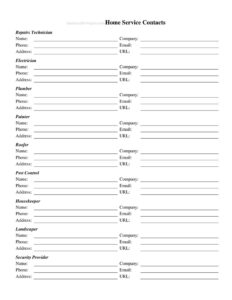
Home Service Contact Sheet
Organize every plumber, electrician, and contractor in one place with this free Home Service Contact Sheet template — free PDF and DOCX download.
PDF
DOCX
4 downloads
0
likes
Download Files
- DOCX
A Home Service Contact Sheet is a simple, organized document that lists the phone numbers, names, and account details of every service provider connected to your home — from the plumber to the lawn care crew. Most people use it so anyone in the household can find the right number quickly during an emergency or routine repair, without digging through old receipts. It’s free to download in both PDF and DOCX formats, with no signup required.
What Is a Home Service Contact Sheet?
A Home Service Contact Sheet is a one-page reference that consolidates contact information for the companies and individuals who maintain, repair, or service your home. It’s typically created and kept by a homeowner, renter, or property manager and may be posted on the refrigerator, stored in a household binder, or shared digitally with family members and house sitters. The sheet documents who to call for plumbing, electrical, HVAC, pest control, landscaping, and similar needs — along with account numbers, service schedules, and after-hours lines. Rather than serving any legal purpose, its job is purely practical: to put critical contacts in one predictable, easy-to-find location so problems get handled fast.
When Do You Need a Home Service Contact Sheet?
This sheet earns its keep in everyday moments and genuine emergencies alike. Common situations include:
- A burst pipe or no-heat emergency when you need a plumber or HVAC technician immediately and can’t remember which company you used last.
- Leaving for vacation and handing a house sitter or neighbor a single page with every number they might need.
- Moving into a new home and building a fresh list of trusted local providers from scratch.
- Managing a rental property where tenants or a property manager must know exactly who to call for repairs.
- Coordinating care for an aging relative so multiple family members can reach the same handyman, electrician, or cleaning service.
- Routine seasonal maintenance such as gutter cleaning, furnace tune-ups, or sprinkler winterization that you schedule with the same vendors year after year.
What a Home Service Contact Sheet Should Have
A useful contact sheet groups providers by the type of service they perform and captures enough detail to reach them and identify your account. At minimum, each entry should include the service category, the company or contractor name, a primary phone number, and an emergency or after-hours line if one exists. Strong sheets also note an account or customer number, the service address the provider covers, the date of the last service, and any recurring schedule. A header identifying the household or property and the date the sheet was last updated keeps the information trustworthy. Leaving blank rows lets you add new vendors over time without redesigning the page.
How to Fill Out a Home Service Contact Sheet
Because this is a flexible reference form, fill it in row by row with the providers you actually use:
- Label the sheet. At the top, write the household name or property address and today’s date so everyone knows it’s current.
- List the service type. For each row, enter a category such as Plumbing, Electrical, HVAC, Pest Control, Landscaping, or Appliance Repair.
- Add the provider name. Record the company name and, if relevant, your preferred technician.
- Enter the primary phone number. Include the main line you’d call during business hours.
- Note the emergency number. Add any 24-hour or after-hours line separately so it’s instantly visible.
- Record account details. Write your customer or account number to speed up calls and billing questions.
- Capture service notes. Jot the last service date, the next scheduled visit, or special instructions like gate codes.
- Review and post. Double-check the numbers, then print and post the sheet or save it where the household can find it.
Organizing Providers by Category
Grouping entries by service type makes the sheet far faster to scan in a stressful moment. Consider clustering related trades — for example, keep plumbing, HVAC, and electrical together under “Home Systems,” and group landscaping, pest control, and pool service under “Outdoor.” Place the most urgent contacts, such as a 24-hour plumber or your utility company, near the top. If you maintain more than one property, create a separate sheet per address rather than mixing them, since account numbers and service schedules differ. A consistent layout means a babysitter, relative, or new roommate can locate the right number in seconds.
Keeping the Sheet Current
A contact sheet is only as good as its most recent update. Set a reminder to review it twice a year — many households pair this with daylight-saving clock changes — and replace any vendor you’ve stopped using. When you hire a new provider, add them immediately while the details are fresh. If you share the sheet digitally, store it somewhere the whole household can access, and reprint the posted copy whenever numbers change. Recording the “last updated” date at the top makes it obvious when a refresh is overdue.
Common Mistakes to Avoid
- Listing only the main number and forgetting the after-hours line you’ll actually need during a midnight emergency.
- Letting it go stale by never updating numbers after a company changes ownership or you switch vendors.
- Omitting account numbers, which slows down every service call and billing inquiry.
- Mixing multiple properties on one sheet so it’s unclear which provider covers which address.
- Hiding the sheet in a drawer no one checks instead of posting it somewhere visible.
- Forgetting utilities and the landlord, which are among the most important contacts in a true emergency.
Frequently Asked Questions
What is a Home Service Contact Sheet used for? It’s used to keep all of your home’s service provider contacts — plumbers, electricians, HVAC techs, landscapers, and more — in one organized place. The goal is so anyone in the household can quickly reach the right company during a repair or emergency. It saves time and reduces stress when something goes wrong.
How do I fill out the contact sheet? Start by labeling it with your household or property and the date, then add one row per provider with the service type, company name, phone number, emergency line, and account number. Include notes like the last service date or gate codes where helpful. Leave blank rows so you can add vendors later.
Is this form legally binding? No, a Home Service Contact Sheet is purely an organizational reference and carries no legal weight. It does not create a contract or obligate any provider to do anything. Its only purpose is to help you find and contact the right people quickly.
Where should I keep the sheet? Post a printed copy somewhere visible, such as the refrigerator, inside a kitchen cabinet, or in a household binder. Many people also save a digital copy that family members or a property manager can open from their phones. Keeping it where everyone expects to find it is what makes it useful.
How often should I update it? Review the sheet at least twice a year, and update it immediately whenever you hire a new provider or a company changes its phone number. Recording a “last updated” date at the top helps you spot when a refresh is overdue. An out-of-date sheet can be worse than none at all during an emergency.
How much does this template cost? It is completely free to download from Business Forms Pro in both PDF and DOCX formats, with no signup required. You can print it as-is or open the DOCX to customize the categories for your home. Use it for as many properties as you need.
This template is provided as a general example for informational and organizational purposes only and does not constitute legal, financial, or professional advice. Service provider arrangements and requirements vary by location and contract — review your own agreements and consult a qualified professional where appropriate.
Related Forms
- Petsitter Information
- Address Book with Tabs
- Class Reunion Student Update Form
- Team Roster
- Incoming Calls
- Memo Template
Browse more in Contact.