
Mortgage Assumption Letter
Download a free Mortgage Assumption Letter template to request an assumption packet from your lender, with field-by-field guidance and a free PDF/DOCX download.
DOCX
2 downloads
0
likes
Download Files
- DOCX
A Mortgage Assumption Letter is a written request sent to a mortgage lender or servicer asking to take over (assume) an existing home loan from the current borrower. Most people use it as the first formal step toward transferring an assumable mortgage — for example after a divorce, inheritance, or family transfer — and it’s free to download here in both PDF and DOCX formats with no signup required.
What Is a Mortgage Assumption Letter?
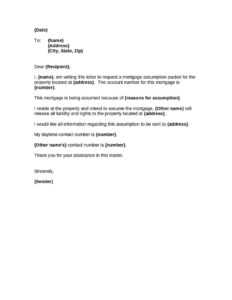
A Mortgage Assumption Letter is a customer letter addressed to a lender or loan servicer that formally requests the documents and procedures needed to assume an existing mortgage. The person who wants to take over the loan (the assuming party) writes it, identifying the property, the loan account number, and the reason for the assumption. The letter notes that the original borrower intends to release their liability and rights to the property. It does not transfer the loan by itself — rather, it opens the conversation and triggers the lender to send an assumption packet outlining requirements, qualification criteria, and paperwork. Think of it as the introduction that gets the assumption process started in writing.
When Do You Need a Mortgage Assumption Letter?
This letter is useful any time someone wants to step into an existing home loan rather than refinance with a brand-new one. Common scenarios include:
- Divorce or separation — one spouse keeps the home and assumes the mortgage so the other can be released from liability.
- Inheritance or death of a borrower — an heir who now resides in the property wants to take over the payments and the loan.
- Family transfers — a parent transfers a home to an adult child, or relatives reorganize ownership of a shared property.
- Buying a home with an assumable loan — a buyer wants to assume a seller’s favorable, low-interest mortgage instead of getting a new one.
- Removing a co-borrower — two people on the loan want one to remain solely responsible and the other released.
- Avoiding higher rates — assuming an older mortgage with a lower rate can be cheaper than refinancing at current rates.
What a Mortgage Assumption Letter Should Have
To be useful to the lender, the letter needs enough identifying detail to locate the account and understand what you’re asking for. A complete letter includes the lender’s name and mailing address, a clear salutation, the full name of the person requesting the assumption, the property address, and the mortgage account number. It should state the reason for the assumption, confirm that the assuming party resides at (or intends to occupy) the property, and note that the original borrower will release their liability and rights. Finally, it must give a mailing address for the assumption packet and daytime contact numbers for both parties, closing with a polite thank-you and the sender’s signature.
How to Fill Out a Mortgage Assumption Letter
- Address the lender. At the top, enter the lender or servicer’s Name, Address, and City, State, Zip exactly as shown on your statement.
- Add the salutation. In the Dear {Recipient} line, use a specific contact or a department such as “Loss Mitigation” or “Loan Servicing” if you have one.
- Identify yourself. Enter your full legal name as the person requesting the assumption packet.
- Name the property. Fill in the full address of the property tied to the mortgage.
- List the account number. Copy the mortgage account number precisely from your statement so the lender can locate the loan.
- State the reason. In reasons for assumption, briefly explain why (divorce, inheritance, transfer, etc.).
- Confirm residency and release. The template states you reside at the property and that {Other name} will release all liability and rights to the property address.
- Direct the packet. Provide the mailing address where you want assumption information sent.
- Add contacts. Enter your daytime number and the other name’s number.
- Sign off. Close with “Sincerely,” and the Sender name.
What Happens After You Send the Letter
Once the lender receives your request, they will typically confirm whether the loan is assumable and mail back an assumption packet. Not every mortgage can be assumed — many conventional loans contain a “due-on-sale” clause, while certain government-backed loans (such as FHA, VA, and USDA) are more commonly assumable, subject to lender approval. Expect the lender to require the assuming party to qualify financially, much like a new borrower: they may review income, credit, and debt-to-income ratios. There may also be an assumption fee and processing paperwork. The original borrower is usually only released from liability once the lender formally approves a “novation” or release. Keep a copy of your letter and any tracking information, and follow up by phone if you don’t hear back within a couple of weeks.
Mortgage Assumption vs. Refinancing
It helps to understand how an assumption differs from a refinance. In an assumption, the existing loan stays in place with its current interest rate, balance, and remaining term — only the responsible borrower changes. In a refinance, a completely new loan replaces the old one, often with a new rate and closing costs. Assumptions can be attractive when the original loan carries a lower interest rate than what’s available today, and they sometimes involve lower fees. However, the assuming party still must qualify, and not all loans permit assumption. This letter is the appropriate starting point only when you intend to keep the existing loan rather than replace it.
Common Mistakes to Avoid
- Wrong account number. A single transposed digit can delay the lender’s ability to find your loan — copy it carefully from a statement.
- Assuming the loan is automatically assumable. Always ask the lender first; many loans have due-on-sale clauses.
- Forgetting contact details. Omitting a daytime number or the other party’s number slows communication.
- Leaving out the reason. A vague request gives the servicer less context to route your case correctly.
- Assuming the letter releases liability by itself. Release of the original borrower requires formal lender approval, not just a sentence in a letter.
- Not keeping a copy. Always retain a signed copy and proof of mailing for your records.
Frequently Asked Questions
What is a Mortgage Assumption Letter? It is a written request to your mortgage lender or servicer asking for an assumption packet so you can take over an existing home loan from the current borrower. The letter identifies the property, the loan account number, and the reason for the assumption. It begins the process but does not complete the transfer on its own.
How do I fill out a Mortgage Assumption Letter? Enter the lender’s name and address, your full name, the property address, and the exact mortgage account number. Explain the reason for the assumption, note that the original borrower will release liability, and provide a mailing address and daytime phone numbers for both parties before signing as the sender.
Does a Mortgage Assumption Letter need to be notarized? The letter itself is generally a simple written request and usually does not need notarization. However, the lender’s formal assumption and release documents that follow may require notarized signatures. Always follow the specific instructions in the assumption packet your lender provides.
Is the mortgage assumption legally binding once I send this letter? No. Sending the letter only requests information and starts the conversation. The assumption becomes binding only after the lender approves the assuming party and both sides sign the lender’s official assumption agreement, which may include a formal release of the original borrower.
Are all mortgages assumable? Not necessarily. Many conventional loans include a due-on-sale clause that limits assumption, while government-backed loans such as FHA, VA, and USDA are more often assumable with lender approval. Contact your servicer to confirm whether your specific loan qualifies before proceeding.
How much does this template cost? The Mortgage Assumption Letter template is completely free to download here in PDF and DOCX formats, with no signup required. Note that your lender may charge a separate assumption or processing fee, which varies by loan and institution.
This Mortgage Assumption Letter template is a general example provided for informational purposes only and is not legal, financial, or tax advice. Mortgage assumption rules, eligibility, and release requirements vary by loan type, lender, and jurisdiction. Consult your lender and a qualified professional before relying on this document.
Related Forms
- Letter Demanding Action
- Credit Freeze Security Letter
- Bank Fee Waiver Letter
- Letter Reporting Business To Regulatory Agency
- Price Adjustment Request Letter
- Demand of Delivery
Browse more in Customer Letters.