
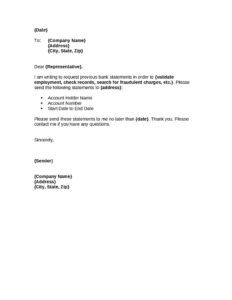
Bank Statement Request
Use our free Bank Statement Request letter template to formally ask your bank for account statements — easy PDF and DOCX free download, no signup.
DOCX
2 downloads
0
likes
Download Files
- DOCX
A Bank Statement Request is a written letter you send to your bank or credit union asking it to issue copies of your account statements for a specified period. People most commonly use it to obtain official records for loan applications, tax filing, audits, or visa paperwork — and you can download it here free in PDF and DOCX formats with no signup required.
What Is a Bank Statement Request?
A Bank Statement Request is a formal customer letter addressed to a bank that asks for printed or electronic copies of account statements. It is typically written by an account holder, an authorized signatory, or a company finance officer, and it documents exactly which account, which date range, and which delivery method the customer needs. Banks rely on the letter to verify the request is legitimate, to confirm the requester has authority over the account, and to keep a paper trail for their records. Because statements often contain sensitive financial information, the letter usually identifies the account holder, the account number, and a clear authorization to release the documents.
When Do You Need a Bank Statement Request?
A short, professional letter is the cleanest way to ask for records the bank may not provide automatically. Common situations include:
- Loan or mortgage applications — lenders frequently require three to twelve months of statements to verify income and balances.
- Tax preparation or an audit — your accountant or a tax authority may request older statements that are no longer accessible online.
- Visa, immigration, or travel applications — embassies often ask for stamped bank statements proving sufficient funds.
- Replacing lost or missing statements — you may need copies from a period that has dropped off your online portal.
- Business bookkeeping and reconciliation — companies request statements to close out a quarter or prepare financial reports.
- Legal or dispute matters — divorce, probate, or a financial dispute may require certified historical records.
What a Bank Statement Request Should Have
To process your request quickly, the letter should clearly identify you and the account, leave no ambiguity about the dates, and tell the bank how to deliver the documents. A complete request generally includes the date of the letter, the bank’s name and branch address, your full name and contact details, the account number (or last few digits), the exact statement period you need, your preferred format and delivery method, the reason for the request if relevant, and your signature. If you are requesting certified or stamped statements — common for visa or legal use — say so explicitly so the branch knows to apply an official seal.
How to Fill Out a Bank Statement Request
- Add the date at the top so the bank can track its response time.
- Address the bank by name, including the specific branch and its mailing address where your account is held.
- State your details — your full legal name, mailing address, phone number, and email so the bank can confirm your identity and reach you.
- Identify the account by type (checking, savings, business) and account number; some letters use only the last four digits for security.
- Specify the statement period with clear start and end dates, for example “January 1 to June 30, 2024.”
- Choose a format and delivery method — printed copies by mail, electronic PDF by email, or pickup at the branch.
- Explain the purpose briefly if it helps, and note if you need certified or stamped copies.
- Sign and print your name; if you are not the primary holder, include proof of your authority to access the account.
How to Submit Your Request
You can usually deliver the letter in several ways: hand it to a teller at your branch, mail it to the address on your statement, or attach a scanned, signed copy to a secure message through online banking. Bring or attach a valid photo ID, since banks verify identity before releasing financial records. If the request is for a business account, the bank may require it on company letterhead and signed by an authorized signatory listed on the account. Keep a dated copy of the letter for your files, and ask how long processing will take — older or archived statements can take several business days and may carry a small retrieval fee.
Fees and Turnaround
Many banks provide recent statements free of charge, especially if you bank online, but copies of older or archived records often carry a per-statement or per-page fee. Certified or stamped statements may cost more because a branch officer must process them manually. Turnaround varies: current statements can sometimes be printed on the spot, while archived documents may take a week or longer to retrieve. Ask the bank to confirm any charges before they proceed so there are no surprises, and note in your letter if there is a deadline you are working toward, such as a loan closing date.
Common Mistakes to Avoid
- Vague date ranges — “the last few months” forces the bank to guess; give exact start and end dates.
- Wrong or incomplete account number that prevents the bank from locating your records.
- Forgetting to sign the letter, which many banks treat as an unauthorized request.
- Not mentioning you need certified copies when a visa office or court requires an official stamp.
- Omitting your contact details, so the bank cannot reach you with questions or fees.
- Requesting at the last minute without allowing time for archived statements to be retrieved.
Frequently Asked Questions
What is a Bank Statement Request letter? It is a formal written request asking your bank to issue copies of your account statements for a defined period. People use it for loans, taxes, visa applications, and record-keeping. The letter identifies the account holder, the account, and the statements needed so the bank can process the request and verify your identity.
How do I fill out a Bank Statement Request? Add the date, address the bank and branch, state your full name and contact details, identify the account number and account type, and specify the exact statement period and delivery format. Sign the letter and include identification. If you need certified or stamped statements, say so clearly in the request.
Does a Bank Statement Request need to be notarized? No, a notary is generally not required. The bank verifies your identity using your signature and a photo ID rather than a notarized document. However, if you are requesting on behalf of someone else, you may need a power of attorney or other proof of authority.
Is there a fee to get my bank statements? Recent statements are often provided free, while copies of older or archived records may carry a retrieval or per-page fee. Certified or stamped statements can cost more because they are processed manually. Ask your bank to confirm any charges before they proceed.
How long does it take to receive the statements? Current statements can sometimes be printed immediately at a branch, while archived statements may take several business days or more to retrieve. If you have a deadline, mention it in your letter and ask the bank about its turnaround time.
Is this template free to download? Yes. You can download the Bank Statement Request template free in both PDF and DOCX formats with no signup required. Edit it to match your bank, account, and the statement period you need before printing or sending.
This template is a general example provided for informational purposes only and is not legal, financial, or tax advice. Bank policies and document requirements vary by institution and jurisdiction — confirm your bank’s specific process and consult a qualified professional if you have questions about your situation.
Related Forms
- Letter Firing a Lawyer
- Credit Card Dispute Letter
- Delivery Demand
- BBB Complaint Letter
- Mortgage Assumption Letter
- License Verification
Browse more in Customer Letters.