
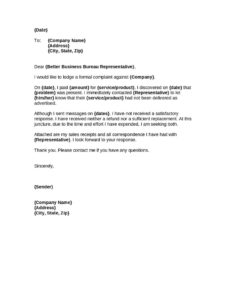
BBB Complaint Letter
Use our free BBB complaint letter template to file a clear, effective complaint against a business and request a resolution — free download in PDF and DOCX.
DOCX
5 downloads
0
likes
Download Files
- DOCX
A BBB complaint letter is a written request submitted to the Better Business Bureau describing a problem you’ve had with a company and the resolution you’re seeking. People most often use it when direct attempts to resolve an issue with a business have failed and they want a neutral third party to help mediate. You can download this BBB complaint letter template free in PDF and DOCX, with no signup required.
What Is a BBB Complaint Letter?
A BBB complaint letter is a formal document a consumer prepares to accompany or support a complaint filed with the Better Business Bureau. It identifies the business involved, summarizes what went wrong, references any prior contact, and states the specific outcome the consumer wants. The Better Business Bureau is a nonprofit organization that facilitates communication between consumers and businesses, so the letter is meant to be factual and professional rather than emotional. While the BBB does not have legal enforcement power, a well-documented complaint letter often prompts a company to respond and resolve the matter to protect its reputation and BBB rating.
When Do You Need a BBB Complaint Letter?
A BBB complaint letter is useful any time normal customer service channels have not produced a fair result. Common situations include:
- Defective or undelivered products — you paid for goods that never arrived, arrived damaged, or did not match the description.
- Poor or incomplete service — a contractor, repair shop, or service provider failed to complete the work you paid for.
- Billing disputes — you were overcharged, charged for items you didn’t order, or billed after canceling.
- Refund refusals — a company won’t honor its stated return, refund, or warranty policy.
- Unresponsive businesses — repeated calls and emails have gone unanswered and you need a documented record.
- Misleading advertising — the product or service was materially different from what was promised in marketing.
What a BBB Complaint Letter Should Have
An effective BBB complaint letter is concise, factual, and organized. To be complete and persuasive, it should include your full contact information, the business’s name and address, the date and details of the transaction, a clear chronological account of the problem, copies or references to supporting documents (receipts, contracts, emails), and a specific statement of the resolution you want. Sticking to verifiable facts and avoiding insults keeps the complaint credible and easier for the BBB and the business to act on.
How to Fill Out a BBB Complaint Letter
Follow these steps to complete the template accurately:
- Add the date at the top so there is a clear record of when you submitted the complaint.
- Enter your contact details — full name, mailing address, phone number, and email so both the BBB and the business can reach you.
- Identify the business by its legal or trade name, address, and any account, order, or invoice number associated with your transaction.
- State the transaction details, including the purchase date, the amount paid, and the product or service involved.
- Describe the problem in a clear, chronological paragraph: what you expected, what actually happened, and how it has affected you.
- Summarize prior contact — note when you contacted the business, who you spoke with, and what response (if any) you received.
- State your desired resolution, such as a refund, replacement, repair, or corrected bill, and any deadline you propose.
- List your attachments, then sign and print your name to confirm the complaint is accurate.
Tips for Writing an Effective Complaint
The tone of your letter matters as much as the facts. Keep the language calm and businesslike; an angry letter is easy to dismiss, while a measured one is harder to ignore. Be specific with dates, dollar amounts, model numbers, and names so the company can quickly verify your account. State exactly what you want — vague requests like “make this right” leave room for the business to do nothing, whereas “a full refund of $149.99 within 14 days” is concrete and actionable. Finally, keep the letter to one page where possible and attach supporting documents rather than describing them at length.
How the BBB Complaint Process Works
After you submit your complaint, the BBB typically reviews it to confirm it falls within the types of disputes it handles, then forwards it to the business and asks for a response. The company usually has a set window to reply, and the BBB relays its answer back to you. You may have the chance to accept the resolution, reject it, or continue the back-and-forth. The process is informal mediation, not a lawsuit, so cooperation is voluntary — but many businesses participate to maintain a positive rating. Keep copies of every document you send and receive in case you later need to pursue other options.
BBB Complaint Letter vs. a Demand Letter
A BBB complaint letter and a legal demand letter serve different purposes. The BBB letter is part of a voluntary, reputation-based mediation process and does not threaten litigation. A demand letter, by contrast, is a formal notice that you may pursue legal action if the matter isn’t resolved, and it is often drafted by or with an attorney. Many consumers start with a BBB complaint because it is free and low-pressure, then escalate to a demand letter or small claims court only if the BBB process doesn’t resolve the issue.
Common Mistakes to Avoid
- Being vague about the resolution — failing to say exactly what outcome you want makes it easy for the business to stall.
- Using emotional or abusive language — insults undermine your credibility and can get the complaint dismissed.
- Leaving out key facts — missing dates, amounts, or order numbers make it harder for the business to identify your case.
- Forgetting supporting documents — receipts, contracts, and email screenshots strengthen your position.
- Skipping direct contact first — the BBB expects you to have attempted to resolve the issue with the business.
- Not keeping copies — always retain a copy of your letter and any attachments for your records.
Frequently Asked Questions
What is a BBB complaint letter? It is a written statement submitted to the Better Business Bureau that describes a dispute with a business and requests a specific resolution. It documents what went wrong, references your prior attempts to fix it, and asks the BBB to help mediate between you and the company.
How do I fill out a BBB complaint letter? Add the date and your contact information, identify the business and transaction, describe the problem in clear chronological order, summarize any prior contact, and state the resolution you want. Attach copies of supporting documents and sign the letter before submitting it.
Is a BBB complaint letter legally binding? No. The BBB process is voluntary mediation, and the bureau cannot force a business to act or impose penalties. However, many companies respond and resolve complaints to protect their public rating and reputation.
Does the BBB charge a fee to file a complaint? No. Filing a complaint with the Better Business Bureau is free for consumers, and this complaint letter template is also free to download here in PDF and DOCX with no signup.
Should I contact the business before filing with the BBB? Yes. It’s best to attempt a direct resolution with the company first, and the BBB generally expects you to have done so. Documenting that prior contact in your letter strengthens your complaint.
What should I do if the BBB complaint doesn’t resolve my issue? If mediation fails, you may consider other options such as a dispute with your credit card company, a complaint to a state consumer protection agency, a formal demand letter, or small claims court. Keep all your documentation in case you escalate.
This BBB complaint letter template is a general example provided for informational purposes only and is not legal, financial, or consumer-protection advice. Complaint procedures and consumer rights vary by jurisdiction and by Better Business Bureau region, so consult a qualified professional or your local consumer protection office for guidance specific to your situation.
Related Forms
- Credit Freeze Security Letter
- Service Pause Request Letter
- Bank Statement Request
- Delivery Demand
- Mortgage Assumption Letter
- Challenge Missed Appointment Letter
Browse more in Customer Letters.