
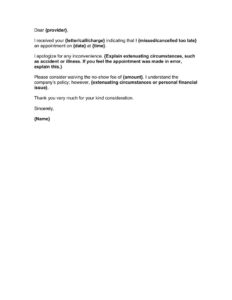
Challenge Missed Appointment Letter
Dispute an unfair missed appointment charge with our Challenge Missed Appointment Letter template, available as a free download in PDF and DOCX.
PDF
4 downloads
0
likes
Download Files
A Challenge Missed Appointment Letter is a formal written response used to dispute a no-show fee, missed appointment penalty, or cancellation charge that you believe was applied incorrectly or unfairly. The most common reason people use it is to contest a charge after a clinic, salon, contractor, or service provider billed them for an appointment they say was missed. This template is free to download in PDF and DOCX, with no signup required.
What Is a Challenge Missed Appointment Letter?
A Challenge Missed Appointment Letter is a customer-written document sent to a business or service provider to formally dispute a missed appointment charge. It is typically used by patients, clients, and customers who received a no-show fee but believe the charge is invalid — perhaps because they cancelled in time, were never properly notified, or attended at the scheduled time. The letter lays out the customer’s account of events, references any supporting evidence, and requests that the charge be removed or the account corrected. It creates a paper trail and gives the provider a clear, professional opportunity to review and resolve the issue.
When Do You Need a Challenge Missed Appointment Letter?
This letter is useful any time you are charged for an appointment you do not believe you missed or were not fairly given the chance to cancel. Common situations include:
- You cancelled within the required notice window but were still billed a no-show fee.
- You arrived on time but the provider’s records incorrectly logged you as absent.
- The appointment was rescheduled or cancelled by the provider, yet you received a charge.
- You never received a confirmation or reminder, and the appointment time was unclear or disputed.
- A medical emergency, family crisis, or other unavoidable circumstance prevented you from attending.
- The cancellation policy was never disclosed to you, or the fee exceeds what was originally agreed.
In each of these cases, a clear written challenge is far more effective than a phone call alone, because it documents your position and the date you raised the dispute.
What a Challenge Missed Appointment Letter Should Have
To be persuasive and complete, your letter should clearly identify the parties and the disputed charge, then make a factual, respectful case for reversing it. A strong letter includes your full contact and account details, the date and time of the appointment in question, the amount of the fee, a concise explanation of why the charge is incorrect, references to any evidence (emails, texts, confirmation numbers, or call logs), and a specific request — usually that the charge be removed or refunded. Keeping the tone calm and professional makes it easier for the recipient to act on your behalf rather than become defensive.
How to Fill Out a Challenge Missed Appointment Letter
Because this is a free-form business letter, follow these steps to adapt the template to your situation:
- Add the current date at the top, followed by the provider’s name, business name, and mailing address.
- Open with a clear subject line, such as “Re: Disputed Missed Appointment Charge — [Date].”
- State your full name, account or patient number, and contact information so the provider can locate your file.
- Identify the specific appointment by date, time, and the service or department it was booked with.
- Reference the exact charge you are disputing, including the amount and any invoice or statement number.
- Explain factually why the charge is incorrect — for example, that you cancelled on a certain date and time, or were never notified.
- Cite supporting evidence, naming the emails, texts, confirmation numbers, or call records you can provide.
- State your requested outcome clearly: removal of the fee, a refund, or correction of your account.
- Close politely, sign your name, and keep a dated copy for your records.
How to Strengthen Your Case
The most convincing missed appointment challenges rely on documentation rather than recollection. Before you send the letter, gather any confirmation emails, appointment reminder texts, phone records showing a cancellation call, or screenshots of an online booking portal. If you cancelled by phone, note the date, time, and name of the person you spoke with. If the provider’s stated cancellation policy gives a specific notice window — such as 24 or 48 hours — quote it and show how you complied. Attaching copies (never originals) of this evidence to your letter makes it easy for the recipient to verify your account quickly and approve the reversal without further back-and-forth.
How to Send It and Follow Up
Send your letter using a method that creates proof of delivery whenever a meaningful amount of money is involved. Email gives you a timestamp, while certified mail provides a signed delivery receipt. Some providers also accept disputes through a patient or customer portal — if so, paste the same content into the portal message and keep a screenshot. After sending, allow a reasonable response window of one to two weeks before following up. If the provider declines and you still believe the charge is wrong, your documented letter becomes valuable evidence should you escalate to a manager, your insurer, a payment dispute with your card issuer, or a consumer protection agency.
Common Mistakes to Avoid
- Writing emotionally or accusingly — an angry tone makes staff less willing to help.
- Leaving out the appointment date, time, or charge amount, which forces the provider to hunt for your record.
- Failing to mention or attach the evidence that proves your version of events.
- Sending originals of documents instead of copies you can replace.
- Not keeping a dated copy of the letter and any attachments for your own files.
- Missing the provider’s dispute deadline, as some businesses limit how long you have to contest a charge.
Frequently Asked Questions
What is a Challenge Missed Appointment Letter? It is a formal letter a customer or patient sends to dispute a no-show fee or missed appointment charge they believe is unfair or incorrect. It documents your account of what happened, references supporting evidence, and requests that the charge be removed or refunded.
How do I write a missed appointment dispute letter? Start with the date and the provider’s details, state your name and account number, identify the disputed appointment and charge, and explain factually why it is wrong. End with a clear request and keep the tone professional throughout. Using our free template gives you a ready-made structure to fill in.
Can I really get a missed appointment fee waived? Many providers will waive or reduce a no-show fee when a customer presents a reasonable explanation and supporting evidence, especially for a first occurrence or a genuine emergency. There is no guarantee, but a clear, polite, well-documented letter significantly improves your chances.
Do I need to include evidence with the letter? Evidence is not strictly required, but it makes your challenge far more persuasive. Confirmation emails, reminder texts, call logs, or a screenshot of a cancellation are the strongest forms of proof, so include copies whenever you have them.
Is this letter legally binding? No, the letter itself is a request rather than a binding document — it does not force the provider to cancel the charge. However, it creates a dated record of your dispute that can support a later escalation, payment chargeback, or complaint if the matter is not resolved.
Is this template really free? Yes. You can download the Challenge Missed Appointment Letter as a free PDF or DOCX file with no signup required, then customize the wording to match your specific situation.
This template is provided as a general example for informational purposes only and does not constitute legal, financial, or professional advice. Cancellation policies, consumer protections, and dispute requirements vary by jurisdiction and by provider — consult a qualified professional or your local consumer protection resources if you need guidance on your specific situation.
Related Forms
- Delivery Demand
- Membership Cancellation Letter
- Close Unauthorized Account Letter
- Credit Card Dispute Letter
- Letter Reporting Business To Regulatory Agency
- BBB Complaint Letter
Browse more in Customer Letters.