
Request to Correct Credit Report
Dispute inaccurate credit report items with a free Request to Correct Credit Report letter template — easy PDF and DOCX free download, no signup.
DOCX
2 downloads
0
likes
Download Files
- DOCX
A Request to Correct Credit Report is a written letter you send to a credit bureau or furnisher asking them to investigate and remove inaccurate information from your credit file. People most often use it after spotting errors — like accounts that aren’t theirs or balances that are wrong — when reviewing their credit report. You can download this template free in PDF and DOCX, with no signup required.
What Is a Request to Correct Credit Report?
A Request to Correct Credit Report is a formal dispute letter addressed to a credit reporting bureau (such as Equifax, Experian, or TransUnion) or a creditor that supplied the data. It documents the specific items you believe are inaccurate and asks the recipient to investigate and delete them so your file reflects your true credit history. Under the Fair Credit Reporting Act (FCRA), the bureau generally has 30 days from receipt to investigate. The letter creates a dated paper trail, identifies the disputed account, and requests written confirmation once corrections are made — making it a key first step in cleaning up reporting errors.
When Do You Need a Request to Correct Credit Report?
This letter is useful any time you find information on your report that doesn’t match reality. Common situations include:
- You spot an account on your report that you never opened, possibly due to identity theft or a mixed file.
- A balance, credit limit, or payment status is reported incorrectly — for example, a paid-off loan still showing a balance.
- An account is listed as late or in collections when you paid on time or already settled it.
- The same debt appears more than once, inflating your reported obligations.
- Outdated negative items remain on your report beyond the time they should have aged off.
- Personal details such as your name, address, or account ownership are wrong and tied to someone else’s history.
What a Request to Correct Credit Report Should Have
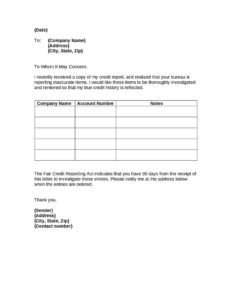
To be effective, your dispute letter should clearly identify you, the bureau or company you’re writing to, and exactly what you want corrected. A complete letter includes the current date, the recipient’s full name and mailing address, a clear statement that you reviewed your report and found errors, the specific account number(s) in dispute, and a description of why each item is inaccurate. It should reference the FCRA’s 30-day investigation window, request written notification once the items are deleted, and close with your full name, mailing address, and a contact number. Including copies (never originals) of any supporting documents — like a paid statement or police report — strengthens your case.
How to Fill Out a Request to Correct Credit Report
- Enter the Date you are sending the letter. This matters because the 30-day investigation clock starts from when the bureau receives it.
- Address the letter to the Company Name and fill in the recipient’s full mailing Address, including City, State, Zip. Use the dispute address listed on your credit report or the bureau’s website.
- Keep the salutation as “To Whom It May Concern” or replace it with a specific department if one is provided.
- In the body, confirm the Company Name field again as needed, then enter the Account Number for the item you’re disputing.
- Use the Notes field to describe precisely what is wrong — for example, “This account was paid in full on [date]” or “This account does not belong to me.”
- Sign off with your name in the Sender field.
- Add your full Address, City, State, Zip, and Contact number so the bureau can mail you the results.
How to Send the Letter and What Happens Next
Mail your completed letter using certified mail with a return receipt requested. This gives you proof of the delivery date, which is important because the FCRA generally requires the bureau to complete its investigation within 30 days of receiving your dispute. Keep a copy of the signed letter and all attachments for your records. After the bureau investigates, it must send you the results in writing and provide a free copy of your report if a change is made. If the disputed item is corrected or deleted, the bureau cannot put it back without certifying that it is accurate and notifying you. If your dispute is rejected, you have the right to add a brief statement of dispute to your file and may consider escalating the matter.
Disputing With the Bureau vs. the Creditor
You can send this letter to the credit bureau reporting the error, to the company that furnished the information (the original creditor or collector), or to both. Disputing with the bureau triggers its duty to investigate and contact the furnisher. Disputing directly with the furnisher can be effective when you have documentation proving the account details are wrong. Many people send their request to both for the strongest result. Adjust the Company Name and Address fields to match whichever recipient you are contacting, and tailor the Notes to the specific record each party controls.
Common Mistakes to Avoid
- Being vague — failing to identify the exact account number or explain why the item is wrong makes it harder to investigate.
- Disputing every item at once without specifics, which can lead the bureau to treat the request as frivolous.
- Sending originals of supporting documents instead of copies.
- Mailing the letter without certified tracking, leaving you no proof of when the 30-day window began.
- Forgetting to include your full return address and contact number, so the bureau can’t notify you of results.
- Not keeping a dated copy of the letter and any attachments for your own records.
Frequently Asked Questions
What is a Request to Correct Credit Report? It is a dispute letter you send to a credit bureau or creditor asking them to investigate and remove inaccurate items from your credit file. It identifies the specific account in question and requests written confirmation once the error is corrected. The letter relies on your rights under the Fair Credit Reporting Act.
How do I fill out the letter? Add the date, the recipient company name and address, the disputed account number, and a clear note explaining what is inaccurate. Then sign it and include your full mailing address and contact number so the bureau can respond. Attach copies of any documents that support your claim.
How long does the bureau have to respond? The Fair Credit Reporting Act generally gives the bureau 30 days from receipt of your letter to complete its investigation. Sending the letter by certified mail establishes the receipt date that starts this clock. The bureau must then notify you of the results in writing.
Does this letter need to be notarized or witnessed? No. A credit dispute letter does not require notarization or witnesses to be valid. Your signature, accurate details, and supporting documentation are what make the request effective.
Will sending this letter guarantee the item is removed? Not automatically. The bureau must investigate, and items are typically deleted only if they cannot be verified as accurate. Providing clear documentation and a specific explanation greatly improves your chances of a correction.
How much does this template cost? It is completely free to download here in both PDF and DOCX formats, with no signup required. You can customize it on your computer or print and complete it by hand.
This template is a general example provided for informational purposes only and is not legal, financial, or credit-repair advice. Consumer protection rules and credit reporting requirements vary by jurisdiction and over time — consult a qualified professional or your local consumer protection agency for guidance on your specific situation.
Related Forms
- Letter Demanding Action
- Membership Cancellation Letter
- Membership Cancellation Letter Refund
- Mortgage Assumption Letter
- Payment on Specific Accounts
- Request to Inspect Corporate Records
Browse more in Customer Letters.