
Request to Inspect Corporate Records
Use this free Request to Inspect Corporate Records template to formally demand access to company books as a shareholder — free PDF and DOCX download.
DOCX
5 downloads
0
likes
Download Files
- DOCX
A Request to Inspect Corporate Records is a formal written demand from a shareholder asking a corporation for access to specific company books and records. Most people use it to exercise their statutory right to review documents like shareholder lists, financial statements, or board minutes when they have a legitimate, ownership-related concern. You can download this template free in PDF and DOCX formats — no signup required.
What Is a Request to Inspect Corporate Records?
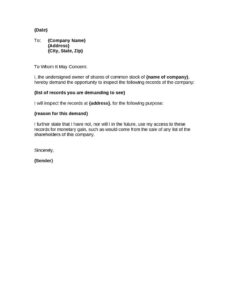
A Request to Inspect Corporate Records is a letter sent by a shareholder to the company in which they hold stock, formally invoking their right to inspect certain corporate documents. In most jurisdictions, shareholders of a corporation have a legal right to examine records such as accounting books, meeting minutes, bylaws, and lists of other shareholders, provided the request is made in good faith and for a proper purpose. The letter documents who is making the demand, which records are being requested, where the inspection will take place, and why. It also reassures the company that the requesting shareholder will not misuse sensitive information, such as a shareholder list, for personal financial gain.
When Do You Need a Request to Inspect Corporate Records?
Shareholders typically send this letter when they need verifiable information about how a company they own a stake in is being run. Common scenarios include:
- You suspect mismanagement or financial irregularities and want to review the company’s accounting books and financial statements.
- You are preparing for a proxy contest or shareholder vote and need a current list of shareholders to communicate with them.
- You believe the board of directors has acted improperly and want to read board or committee meeting minutes.
- You are evaluating the value of your shares before selling or transferring them and need underlying financial records.
- You are investigating a potential conflict of interest, related-party transaction, or excessive executive compensation.
- You have been denied informal access to information and need to create a formal, documented record of your demand.
What a Request to Inspect Corporate Records Should Have
To be effective and to satisfy most legal inspection requirements, the letter should clearly establish your standing as a shareholder and the specifics of your demand. A complete request includes the company’s name and address, a statement that you are an owner of shares (ideally noting the type, such as common stock), a precise list of the records you wish to inspect, the location where you intend to review them, and the proper purpose behind your request. Many statutes require the purpose to be reasonably related to your interest as a shareholder. This template also includes an assurance that you will not use the information — particularly any shareholder list — for personal monetary gain, which is a common condition attached to inspection rights.
How to Fill Out a Request to Inspect Corporate Records
- In the To block, enter the Company Name, followed by the Address and City, State, Zip. Address it to the registered office or the corporate secretary where possible.
- After “To Whom It May Concern,” the letter identifies you as the undersigned owner of shares of common stock. Insert the name of company exactly as it appears in corporate documents.
- In the list of records you are demanding to see field, be specific. List each document type — for example, “the list of current shareholders,” “the annual financial statements for the last two fiscal years,” or “minutes of board meetings held in the prior year.”
- In the address field, state where you intend to conduct the inspection. This is often the company’s principal office during regular business hours.
- Under reason for this demand, write a clear, proper purpose connected to your role as a shareholder — vague reasons may be rejected.
- The letter includes a built-in statement that you will not use the records for monetary gain, such as selling a shareholder list. Review it and keep it intact.
- Sign as the Sender, print your name, and add the date and your contact details.
Why the “Proper Purpose” Statement Matters
The single most important element of this letter is the stated purpose. Inspection rights are not unlimited — companies can lawfully refuse a demand that is made for an improper reason, such as harassment, advancing a personal agenda unrelated to the business, or harvesting shareholder data to sell. Phrasing your purpose clearly and tying it to your economic interest as an owner strengthens your position. Examples of generally accepted purposes include valuing your shares, investigating suspected wrongdoing, communicating with fellow shareholders about company matters, and determining whether your investment is being managed properly. The no-monetary-gain assurance in this template directly addresses one of the most common objections companies raise when shareholder lists are requested.
What Happens After You Send the Letter
Once the company receives your demand, it generally has a limited window — set by state corporation law — to respond and either grant access or explain its refusal. Send your letter using a method that creates proof of delivery, such as certified mail with a return receipt, and keep a dated copy for your records. If the company grants access, you may inspect and copy the listed records at the agreed location. If it refuses or ignores a valid demand, the documented request becomes important evidence should you need to pursue the matter further, including through legal channels in your jurisdiction.
Common Mistakes to Avoid
- Listing records too vaguely — “all company documents” is far weaker than a specific, itemized list.
- Stating an improper or purely personal purpose that is not tied to your shareholder interest.
- Failing to confirm your shareholder standing or omitting the type and basis of your ownership.
- Sending the letter to the wrong address instead of the registered office or corporate secretary.
- Not keeping proof of delivery, which weakens your position if the demand is contested.
- Removing the no-monetary-gain assurance, which can give the company grounds to deny a shareholder-list request.
Frequently Asked Questions
What is a Request to Inspect Corporate Records? It is a formal letter a shareholder sends to a corporation demanding access to specific company books and records, such as financial statements, meeting minutes, or shareholder lists. It documents your ownership, the records you want, where you will inspect them, and your purpose. It is commonly used when informal requests for information have been ignored or denied.
Who can use this form? Generally, a person or entity who owns shares in a corporation may use it to exercise their inspection rights. Some jurisdictions impose minimum holding requirements or a minimum length of ownership before inspection rights apply. Check the rules in your state and the company’s bylaws to confirm your eligibility.
Do I have to give a reason for my request? Yes, in most cases. Corporate inspection statutes typically require a “proper purpose” reasonably related to your interest as a shareholder. Stating a clear, legitimate purpose — and keeping it on record — significantly improves your chances of having the demand honored.
Does this letter need to be notarized? Notarization is usually not required for a basic inspection demand, but some states or company bylaws may require the demand to be made under oath or verified. Sending it by certified mail with a return receipt is widely recommended to prove delivery and timing.
Is this letter legally binding? The letter itself is a demand, not a contract, but it can trigger the company’s legal obligation to respond within the timeframe set by your jurisdiction’s corporation law. If the company wrongfully refuses a valid demand, the documented request supports any further action you may take.
How much does this template cost? Nothing — this Request to Inspect Corporate Records template is completely free to download in PDF and DOCX formats, with no signup required. You can edit it to match your situation and the records you need to review.
This template is a general example provided for informational purposes only and is not legal advice. Shareholder inspection rights, proper-purpose standards, and procedural requirements vary by jurisdiction and by a company’s governing documents. Consult a qualified attorney before sending a demand or relying on this form.
Related Forms
- Bank Statement Request
- Close Unauthorized Account Letter
- Delivery Demand
- Installment Payment Request Letter
- License Verification
- Loan Comparison Chart
Browse more in Customer Letters.