
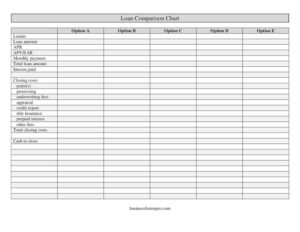
Loan Comparison Chart
Use this free Loan Comparison Chart template to weigh interest rates, fees, and terms side by side before borrowing — free download in PDF and DOCX.
PDF
DOC
4 downloads
0
likes
Download Files
- DOC
A Loan Comparison Chart is a simple side-by-side worksheet that lets you line up two or more loan offers so you can see which one truly costs the least. People most often use it when shopping for a mortgage, auto loan, personal loan, or business financing and want to compare interest rates, fees, and monthly payments without getting lost in the fine print. You can download this template free in PDF and DOCX, with no signup required.
What Is a Loan Comparison Chart?
A Loan Comparison Chart is a structured table used by borrowers, financial coaches, and small-business owners to evaluate competing loan offers in one place. Instead of flipping between separate quotes, you record each lender’s key terms in matching rows and columns so differences jump out instantly. The chart documents details such as the loan amount, interest rate, annual percentage rate (APR), term length, monthly payment, fees, and total cost over the life of the loan. Its purpose is decision support: it turns scattered marketing language and disclosure forms into an apples-to-apples comparison. While it has no legal force on its own, it is an invaluable planning tool that helps you ask sharper questions and avoid choosing a loan on monthly payment alone.
When Do You Need a Loan Comparison Chart?
This worksheet earns its keep any time more than one financing path is on the table. Common situations include:
- Shopping for a mortgage and comparing fixed-rate versus adjustable-rate offers from several banks or brokers.
- Financing a car through a dealership, credit union, and online lender to find the lowest true cost.
- Consolidating debt and deciding whether a personal loan, balance-transfer card, or home equity line saves the most.
- Seeking a small-business loan and weighing a term loan, SBA loan, and line of credit with different fees and repayment schedules.
- Refinancing existing debt to confirm a new rate actually beats your current loan after closing costs.
- Coaching a client or family member through a borrowing decision and needing a clear visual to explain trade-offs.
What a Loan Comparison Chart Should Have
A useful chart captures every figure that affects the real cost of borrowing — not just the headline rate. At minimum, it should include columns for each loan option and rows for the lender or product name, loan amount (principal), interest rate, APR, term length, payment frequency, monthly payment amount, origination and other fees, prepayment penalties, and total repayment over the full term. Many borrowers also add a row for special conditions such as collateral requirements, variable-rate adjustment caps, or introductory periods. The single most important element is the total cost line, because two loans with similar monthly payments can differ by thousands once fees and term length are factored in.
How to Fill Out a Loan Comparison Chart
- Label each column with the lender or product name (for example, “Bank A 30-Year Fixed” or “Credit Union Auto Loan”) so each offer has its own dedicated space.
- Enter the loan amount you are requesting in each column; keep this consistent across options so the comparison stays fair.
- Record the interest rate and the APR separately. The APR reflects fees and gives a truer cost picture than the nominal rate.
- Fill in the term length in months or years and the payment frequency (monthly, biweekly, etc.).
- Write the monthly payment quoted or calculated for each offer.
- List all fees — origination, application, closing, or processing charges — and note any prepayment penalties.
- Calculate the total cost by multiplying the payment by the number of payments and adding upfront fees.
- Add notes for conditions like rate locks, collateral, or promotional periods, then review the completed chart to identify the best overall value.
Reading the Numbers: Rate vs. APR vs. Total Cost
One of the biggest benefits of a Loan Comparison Chart is that it forces you to look past a single attractive number. A lender may advertise a low interest rate while charging high origination fees, which pushes the APR — the more honest yardstick — much higher. Conversely, a slightly higher rate with no fees can be the cheaper deal. Term length matters too: stretching a loan over more years lowers the monthly payment but usually raises the total interest paid. By recording rate, APR, monthly payment, and total cost in the same view, your chart reveals these trade-offs at a glance and helps you match the loan to your real priority, whether that is the lowest payment now or the least money paid overall.
Tips for Getting the Most From Your Comparison
Gather written quotes or official loan estimates before you fill anything in, since verbal numbers change. Compare offers as of the same week, because rates move daily. If one lender quotes a different loan amount or term, adjust it to match the others or note the difference clearly so you are not comparing unequal options. Finally, keep your completed chart on hand when you call lenders back — being able to cite a competitor’s exact terms is one of the most effective ways to negotiate a better rate or waived fee.
Common Mistakes to Avoid
- Comparing monthly payments only and ignoring how a longer term inflates total interest.
- Confusing the interest rate with the APR, which hides the impact of fees.
- Leaving out fees and prepayment penalties that quietly raise the real cost.
- Using quotes from different dates when rates have shifted between them.
- Entering different loan amounts or terms across columns, which makes the comparison meaningless.
- Forgetting to calculate the total repayment, the figure that ultimately tells you the cheapest loan.
Frequently Asked Questions
What is a Loan Comparison Chart used for? It is used to evaluate two or more loan offers side by side so you can identify the one with the lowest true cost. Borrowers rely on it to compare interest rates, APR, fees, monthly payments, and total repayment in a single view. This makes complex offers far easier to understand before you commit.
How do I fill out a Loan Comparison Chart? Give each loan offer its own column, then fill in matching rows for loan amount, interest rate, APR, term, monthly payment, fees, and total cost. Keep the loan amount and term consistent across offers so the comparison is fair. Once complete, compare the total-cost row to spot the best value.
Is a Loan Comparison Chart legally binding? No. It is a personal planning and decision-making tool, not a contract or agreement. The binding terms come from the loan documents you sign with a lender, so always confirm the final figures against the official loan agreement.
Should I use the interest rate or the APR to compare loans? APR is generally the better comparison figure because it includes most fees, giving a more complete picture of cost. The plain interest rate alone can make a fee-heavy loan look cheaper than it really is. Recording both in your chart lets you see the difference clearly.
Can I use this chart for any type of loan? Yes. The template works for mortgages, auto loans, personal loans, student loans, debt consolidation, and small-business financing. You can add or rename rows to capture details specific to a particular loan type, such as collateral or rate-adjustment caps.
How much does this Loan Comparison Chart template cost? It is completely free to download here in both PDF and DOCX formats, with no signup or account required. The DOCX version is fully editable so you can customize columns and rows to match the offers you are comparing.
This Loan Comparison Chart template is a general example provided for informational purposes only and is not financial, legal, or tax advice. Loan terms, fees, and regulations vary by lender and jurisdiction. Consult a qualified financial professional before making any borrowing decision.
Related Forms
- Mail Theft Letter
- Letter Reporting Business To Regulatory Agency
- Membership Cancellation Letter Refund
- Installment Payment Request Letter
- Letter Demanding Action
- Payment on Specific Accounts
Browse more in Customer Letters.