
License Verification
Download a free License Verification letter template to authorize release of your license status to an employer or board, with simple fill-in fields and free download.
DOCX
3 downloads
0
likes
Download Files
- DOCX
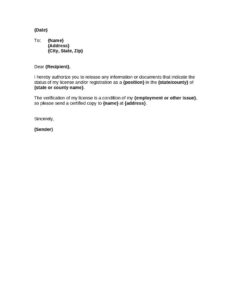
A License Verification letter is a short written authorization that lets a licensing board, agency, or institution release the current status of your professional license or registration to a third party — most often a prospective employer. People use it to satisfy a hiring requirement quickly, and you can download this template free in PDF and DOCX with no signup required.
What Is a License Verification Letter?
A License Verification letter is a signed request, issued by the license holder, that grants permission for an agency or board to disclose details about that person’s license or registration. It typically confirms whether a license is active, expired, or in good standing, along with the issuing jurisdiction and the position or profession involved. The letter is addressed to whichever office maintains the license record, and it instructs that office to send a certified copy of the verification to a named recipient at a specific address. Because licensing records are often controlled by privacy and disclosure rules, this written authorization gives the agency the clear consent it needs before releasing any information about your status.
When Do You Need a License Verification Letter?
This letter comes up whenever someone needs official proof that your license or registration is valid. Common situations include:
- Starting a new job where a valid professional license is a condition of employment, such as nursing, real estate, contracting, or insurance.
- Applying for licensure in another state and needing your current state to verify your existing credential (often called license endorsement or reciprocity).
- Renewing a contract or vendor agreement that requires up-to-date proof of registration.
- Onboarding with a staffing agency or hospital system that must document every clinician’s license status.
- Responding to an audit or compliance review where a regulator or client requests certified verification.
- Joining a professional network or panel, such as an insurance carrier credentialing a provider before listing them.
What a License Verification Letter Should Have
To be useful, the letter must clearly identify everyone involved and exactly what is being authorized. A complete version includes the name and address of the agency or board receiving the request, a salutation to the correct office or recipient, and an explicit statement authorizing the release of your license and registration status. It should specify your position or profession, the state or county that issued the credential, and the reason verification is needed. Critically, it must name the third party who should receive the response and provide their mailing address, plus a request for a certified copy. Finally, it needs your signature as the license holder, since the authorization carries weight only when it comes from you.
How to Fill Out a License Verification Letter
Work through the fields in order so nothing essential is missing:
- To / Name: Enter the name of the licensing board, agency, or office that holds your record.
- Address and City, State, Zip: Add the full mailing address of that agency so the request reaches the right department.
- Dear {Recipient}: Address the specific contact or office, such as “Licensing Verification Department,” if you don’t have a name.
- Position: State your profession or title — for example, “registered nurse” or “licensed real estate agent” — as it appears on the license.
- State/County and {state or county name}: Indicate the jurisdiction that issued your license and name it precisely.
- Employment or other issue: Explain why verification is required, such as a condition of employment or a license reciprocity application.
- Name and Address (recipient of the certified copy): Provide the person or company that should receive the verification and their full mailing address.
- Sender: Sign and print your name as the license holder to authorize the release.
Tips for a Smooth Verification
Before you mail or submit the letter, confirm the exact name of the office that maintains your record — many states route license verification through a board’s verification or credentialing unit rather than its general mailbox. Include your license number if you have it, since that single detail can speed up the lookup considerably. Many agencies now offer online verification portals, so check whether your board accepts an electronic request or requires this signed letter on paper. If the recipient needs a certified copy, expect a processing fee and a turnaround time of several days to a few weeks; build that into your hiring or application deadline. Keep a copy of the signed letter for your own records in case you need to follow up.
How This Differs From a License Itself
It is easy to confuse a verification letter with a copy of your actual license. Your license is the credential the board issued to you; a verification letter is a request asking the board to confirm that credential’s current standing to someone else. Employers and regulators often prefer verification straight from the source because it confirms the license is genuine and still active — something a photocopy of your wall certificate cannot prove. This letter is the bridge that authorizes that source-to-recipient confirmation.
Common Mistakes to Avoid
- Leaving the recipient address blank, which leaves the agency unsure where to send the certified copy.
- Naming the wrong jurisdiction, such as listing a county when the license is issued at the state level.
- Forgetting to sign the letter, which means the agency cannot act on an unauthorized request.
- Omitting your license number or identifying details, slowing down the search for your record.
- Being vague about the position, so the board cannot match the request to the correct credential type.
- Sending it too late to meet an employer’s deadline, since certified copies can take time to process.
Frequently Asked Questions
What is a License Verification letter used for? It is used to authorize a licensing board or agency to release the status of your professional license or registration to a third party. Most people send it to satisfy an employment condition or to support a license application in another jurisdiction.
How do I fill out the License Verification letter? Enter the agency’s name and address at the top, address the correct department, then state your position, issuing jurisdiction, and the reason verification is needed. Finish by naming who should receive the certified copy, including their address, and signing as the sender.
Does this letter need to be notarized or witnessed? Most license verification requests only require your own signature as the license holder, not a notary or witness. However, some boards have their own forms or notarization rules, so confirm the specific requirements with the issuing agency before sending.
Is a License Verification letter legally binding? The letter functions as your authorization for the agency to release information, so it does carry legal weight as consent. It does not change your license status itself — it simply permits disclosure of that status to the named recipient.
How much does this template cost? The template on this page is completely free to download in both PDF and DOCX formats, with no signup required. Note that the issuing agency may charge its own fee to produce a certified verification.
Can I email this letter instead of mailing it? Some agencies accept emailed or online requests, while others require a signed paper letter or their own portal. Check the board’s preferred method before sending, especially if a certified copy must be mailed to your recipient.
This License Verification letter template is provided as a general example for informational purposes only and is not legal advice. Licensing rules and verification procedures vary by state, county, and profession — consult the issuing agency or a qualified professional to confirm the requirements that apply to your situation.
Related Forms
- Mail Theft Letter
- Request to Correct Credit Report
- Credit Freeze Security Letter
- Cell Phone Service Issue Letter
- Delivery Demand
- Bank Statement Request
Browse more in Customer Letters.