
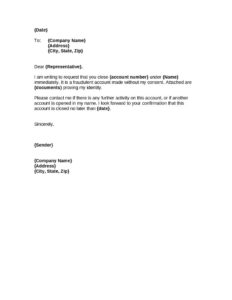
Close Unauthorized Account Letter
Use a free Close Unauthorized Account Letter template to formally dispute and request closure of an account opened without your consent — free download.
DOCX
0
likes
Download Files
- DOCX
A Close Unauthorized Account Letter is a formal written request asking a bank, lender, or service provider to close an account that was opened in your name without your permission. People most often use it after discovering a fraudulent or mistakenly created account on a credit report or statement. You can download this template for free in PDF and DOCX formats — no signup required.
What Is a Close Unauthorized Account Letter?
A Close Unauthorized Account Letter is a document you send to a financial institution or company to notify them that an account associated with your name or identity was created without your authorization, and to demand that it be closed and any related activity reversed. It is typically issued by the consumer or victim of identity theft, though a parent or legal guardian may send one on behalf of a dependent. The letter documents your dispute in writing, creates a paper trail, and formally puts the company on notice. It serves both as a closure request and as supporting evidence if you later escalate the matter to credit bureaus, regulators, or law enforcement.
When Do You Need a Close Unauthorized Account Letter?
This letter is useful in any situation where an account exists that you never agreed to. Common scenarios include:
- You spot a credit card, loan, or bank account on your credit report that you never opened.
- You receive a welcome packet, debit card, or statement for an account you did not request.
- A subscription or utility service was set up in your name by someone else.
- An employee, ex-partner, or family member opened an account using your information.
- A company auto-enrolled you in a product or membership without clear consent.
- You were a victim of a data breach and a new account appeared under your identity.
What a Close Unauthorized Account Letter Should Have
To be effective, the letter should clearly identify you, identify the disputed account, and state exactly what you want done. Key elements include your full name and contact details, the date, the recipient company’s name and address, any account or reference number, a plain statement that you did not authorize the account, a demand to close it immediately, a request for written confirmation, and a list of any documents you are enclosing. A firm but professional tone and a clear deadline for response strengthen the request and signal that you intend to follow up.
How to Fill Out a Close Unauthorized Account Letter
Because this is a letter template, you complete it by replacing the bracketed placeholders with your own information. Follow these steps:
- Add your details: Enter your full legal name, mailing address, phone number, and email at the top so the company can verify and contact you.
- Insert the date: Write the date you are sending the letter; this establishes your timeline of notification.
- Address the recipient: Add the company or bank name, the relevant department (such as Fraud or Customer Service), and its mailing address.
- Reference the account: Include the account number, application reference, or any identifying number tied to the unauthorized account.
- State the dispute: Clearly explain that the account was opened without your authorization and that you are reporting it as fraudulent or unauthorized.
- Make your demand: Request that the account be closed immediately, that any charges or balances be voided, and that the company confirm closure in writing.
- List enclosures: Note any attachments, such as a police report, identity theft affidavit, or copy of your ID.
- Sign and keep a copy: Sign the letter and retain a copy for your records.
How to Send the Letter and Follow Up
Send the letter by certified mail with a return receipt so you have proof the company received it and a record of the delivery date. Keep the receipt, a copy of the signed letter, and copies of every enclosure together in one file. Many companies must respond within a set window once notified of fraud, so note any deadline you stated and mark a follow-up date on your calendar. If you do not receive written confirmation that the account was closed, send a second copy, escalate to a supervisor, and consider filing complaints with the relevant consumer protection agency or financial regulator.
Related Steps to Protect Your Identity
Closing one unauthorized account is often only part of resolving identity theft. Alongside this letter, you may want to place a fraud alert or security freeze with the major credit bureaus, dispute the account directly with each bureau, and file an identity theft report. Reviewing your full credit report can reveal whether other unauthorized accounts exist. Keeping a timeline of every call, letter, and confirmation you receive makes it far easier to demonstrate that you acted promptly and in good faith.
Common Mistakes to Avoid
- Sending the letter to a general address instead of the fraud or dispute department, which can delay processing.
- Leaving out the account number or reference, making it hard for the company to locate the record.
- Failing to keep a signed copy and proof of mailing.
- Using vague language instead of clearly stating the account is unauthorized and demanding closure.
- Forgetting to request written confirmation that the account was closed.
- Admitting partial responsibility or paying any disputed balance before the matter is resolved.
Frequently Asked Questions
What is a Close Unauthorized Account Letter? It is a formal written notice asking a bank, lender, or service provider to close an account that was opened in your name without your consent. The letter documents your dispute, demands closure, and requests written confirmation. It also creates a record you can use if you need to escalate the issue later.
How do I fill out the letter? Replace the bracketed placeholders with your name and contact information, the date, the recipient’s details, and the disputed account number. Then clearly state that the account is unauthorized, demand that it be closed, and list any documents you are enclosing. Sign the letter and keep a copy for your records.
Does this letter need to be notarized? Notarization is generally not required to send a closure or dispute letter. However, some companies may ask you to provide a notarized identity theft affidavit or a copy of a police report as supporting evidence. Check the company’s fraud procedures and follow their specific documentation requirements.
Is the letter legally binding? The letter itself is a request and notice rather than a contract, so it does not by itself force a company to act. It does, however, formally put the company on notice and can trigger legal obligations they have regarding fraud and disputes. Sending it by certified mail strengthens its value as evidence.
How should I send the letter? Send it by certified mail with a return receipt so you have proof of delivery and the date. Keep copies of the signed letter and all enclosures. If you do not get written confirmation of closure, follow up in writing and consider escalating to a regulator.
How much does this template cost? This Close Unauthorized Account Letter template is completely free to download from Business Forms Pro in both PDF and DOCX formats. There is no signup, subscription, or payment required. You can edit it as many times as you need for your situation.
This template is provided as a general example for informational purposes only and is not legal, financial, or tax advice. Rules governing unauthorized accounts, fraud disputes, and identity theft vary by jurisdiction and by company policy. Consult a qualified attorney or relevant consumer protection authority for guidance on your specific situation.
Related Forms
- Information on Refused Credit
- Letter Reporting Business To Regulatory Agency
- Membership Cancellation Letter
- BBB Complaint Letter
- Mortgage Assumption Letter
- License Verification
Browse more in Customer Letters.