
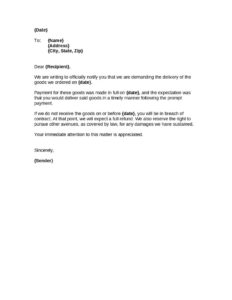
Delivery Demand
Demand overdue goods you've paid for with a clear, professional Delivery Demand letter template — free download in PDF and DOCX, no signup required.
DOCX
1 downloads
0
likes
Download Files
- DOCX
A Delivery Demand letter is a formal notice sent to a seller or supplier requesting that they deliver goods you have ordered and already paid for. People most often use it when a vendor has accepted full payment but failed to ship or hand over the products by the expected date. You can download this Delivery Demand template free in PDF and DOCX, with no signup required.
What Is a Delivery Demand?
A Delivery Demand is a written customer letter that puts a seller on formal notice that goods are overdue and must be delivered by a stated deadline. It is typically issued by a buyer — an individual, business, or purchasing department — who has paid in full and is still waiting on an order. The letter documents the original order date, confirms that payment was made, and sets a firm cutoff for delivery. It also signals that failure to deliver will be treated as a breach of contract, after which the buyer may demand a full refund and pursue legal remedies. In short, it creates a clear, dated paper trail before any dispute escalates.
When Do You Need a Delivery Demand?
This letter is appropriate any time a paid-for order has stalled and informal follow-ups have not produced results. Common situations include:
- You paid in full for merchandise weeks ago, and the supplier keeps pushing back the ship date without a firm commitment.
- A wholesaler accepted your purchase order and deposit but has gone quiet, and inventory you depend on has not arrived.
- You prepaid a manufacturer for custom or made-to-order goods and the agreed completion date has passed.
- A contractor or vendor was paid for materials that were supposed to be delivered to your job site but never showed up.
- You bought equipment online, your card was charged, and the seller has not shipped despite multiple emails and calls.
- You want a documented final warning on record before requesting a chargeback, refund, or legal action.
What a Delivery Demand Should Have
To be effective and credible, the letter should clearly identify both parties and reference the underlying transaction. A complete Delivery Demand includes the recipient’s full name and mailing address, a reference to the order and the date it was placed, confirmation that payment was made in full and when, a specific deadline for delivery, and a plain statement of consequences if that deadline is missed. It should remain professional and factual rather than emotional. Including a clear delivery cutoff date is essential — a vague request to deliver “soon” carries far less weight than a firm date that establishes when a breach occurs.
How to Fill Out a Delivery Demand
- In the To block, enter the recipient’s Name — the seller, company, or responsible contact you are addressing.
- Add the recipient’s Address and City, State, Zip so the letter reaches the correct party and a mailing record exists.
- In the salutation, fill in the Recipient name after “Dear” — use the individual’s name or the company contact where possible.
- Enter the order date in the first blank to identify exactly which order you placed and when.
- Enter the payment date to confirm that you paid in full and on what day — this anchors your right to delivery.
- Set the delivery deadline date — the firm “on or before” date by which the goods must arrive to avoid breach.
- Sign off with your name in the Sender field, and add any company name or contact details so the recipient can respond.
Sending the Letter Effectively
How you deliver the demand matters as much as its content. Send it using a method that creates proof of delivery — such as certified mail with return receipt, a courier with tracking, or email with a read receipt — so you can show the seller actually received it. Keep a dated copy for your records along with the original order confirmation, invoice, and proof of payment. If you communicated by phone or email earlier, attach or summarize those exchanges to demonstrate that this is a formal escalation rather than a first contact. A calm, businesslike tone is more persuasive than threats, while still making the deadline and consequences unmistakable.
What Happens After the Deadline
If the seller delivers the goods by the stated date, the matter is typically resolved and no further action is needed. If the deadline passes without delivery, the letter has established a documented breach of contract. At that point your options may include requesting a full refund, initiating a payment dispute or chargeback through your card issuer, filing a complaint with a consumer protection agency, or pursuing recovery through small claims or civil court. Because the letter put the seller on notice with a firm date, it strengthens your position in any of these next steps. Specific remedies and time limits vary by jurisdiction and by the terms of your purchase agreement.
Common Mistakes to Avoid
- Leaving the delivery deadline blank or vague — without a firm date, there is no clear point at which a breach occurs.
- Failing to reference the original order date and payment date, which weakens your proof that goods are owed.
- Sending the letter to a generic address with no name, so it never reaches a decision-maker.
- Using an angry or threatening tone instead of a factual, professional one that holds up under scrutiny.
- Not keeping copies or proof of delivery, leaving you with no record if the dispute escalates.
- Discarding the underlying invoice, receipt, and prior correspondence that support your demand.
Frequently Asked Questions
What is a Delivery Demand letter used for? It is used to formally notify a seller that goods you ordered and paid for have not been delivered and must be by a specific deadline. It documents the transaction, sets a firm cutoff, and warns that missing it will be treated as a breach of contract. This creates a written record before you take further action.
How do I fill out a Delivery Demand? Enter the recipient’s name and address, the order date, the date you paid in full, and the firm deadline for delivery, then sign as the sender. Each field anchors a specific fact — who you are addressing, what they owe, and by when. Keeping these details accurate makes the letter far more effective.
Is a Delivery Demand legally binding? The letter itself is a notice rather than a contract, but it relies on the binding agreement you already have — your order and payment. It does not create new obligations; it asserts existing ones and sets a deadline. Its main legal value is establishing a documented breach if the seller fails to deliver.
Does a Delivery Demand need to be notarized or witnessed? No, this type of customer letter generally does not require notarization or witnesses to be valid. What matters most is that the recipient actually receives it, so sending it by a trackable method like certified mail is recommended. Keep your proof of delivery with your copy of the letter.
What happens if the seller ignores my demand? If the deadline passes without delivery, you can typically request a full refund, dispute the charge with your payment provider, or pursue other remedies allowed by law. The letter helps show you gave clear, dated notice. Available options and timelines depend on your purchase terms and local rules.
How much does this template cost? Nothing — you can download this Delivery Demand template completely free in both PDF and DOCX formats, with no signup or account required. The editable DOCX version lets you adjust the wording, dates, and contact details for your situation. Print it or send it digitally once it is complete.
This Delivery Demand template is provided as a general example for informational purposes only and is not legal, financial, or tax advice. Contract and consumer-protection requirements vary by jurisdiction and by the terms of your specific agreement. Consult a qualified attorney or professional before relying on this letter in a dispute.
Related Forms
- Mortgage Assumption Letter
- Bank Statement Request
- Letter Demanding Action
- Request to Correct Credit Report
- Request to Inspect Corporate Records
- Letter Firing a Lawyer
Browse more in Customer Letters.