
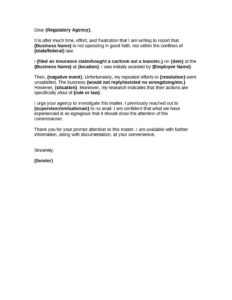
Letter Reporting Business To Regulatory Agency
Use our free Letter Reporting Business to Regulatory Agency template to file a clear, documented complaint with authorities; free download in PDF and DOCX.
DOCX
0
likes
Download Files
- DOCX
A Letter Reporting Business to Regulatory Agency is a formal written complaint that notifies a government body or industry regulator about a business’s suspected misconduct, unsafe practices, or violation of rules. People most often use it when informal contact with the company has failed and they want an official record on file with the proper authority. You can download this template free in PDF and DOCX formats, with no signup required.
What Is a Letter Reporting Business to Regulatory Agency?
A Letter Reporting Business to Regulatory Agency is a document sent by a consumer, employee, competitor, or member of the public to an oversight body such as a state licensing board, consumer protection office, health department, or financial regulator. It describes a specific concern about a business, supplies supporting facts and dates, and requests that the agency investigate or take action. Unlike a letter sent directly to the company, this letter is addressed to a regulator whose job is to enforce laws or standards. It creates a paper trail, triggers a possible review, and may protect others from similar harm.
When Do You Need a Letter Reporting Business to Regulatory Agency?
- A company billed you for goods or services you never received, and refused to refund you after repeated requests.
- You witnessed unsafe food handling, health code violations, or hazardous conditions at a place of business.
- A licensed professional or contractor performed work that breached the standards their licensing board enforces.
- A business engaged in deceptive advertising, false claims, or hidden fees that you believe violate consumer protection rules.
- As an employee, you observed wage violations, discrimination, or workplace safety hazards you want reported to the relevant labor or safety agency.
- A financial firm or lender ignored disclosure requirements or engaged in practices you suspect are unlawful.
Types of Regulatory Complaints
The right agency depends on the nature of the problem. Consumer disputes often go to a state attorney general’s office or consumer protection division. Health and safety issues go to local or state health departments or occupational safety agencies. Licensing concerns about doctors, contractors, or accountants go to the relevant professional board. Financial complaints may go to a banking, securities, or insurance regulator. Identifying the correct recipient before you send the letter dramatically improves the chance of a meaningful response, so research which body has jurisdiction over the specific business and conduct.
What a Reporting Letter Should Have
A complete and credible regulatory complaint letter includes several core elements that help an investigator act quickly:
- Your full name, mailing address, phone number, and email so the agency can follow up.
- The name, address, and any license or registration number of the business being reported.
- The date of the letter and the dates of the events you are describing.
- A clear, factual account of what happened, written chronologically.
- The specific rule, standard, or harm you believe is at issue, described in plain terms.
- A list of any attached evidence, such as receipts, contracts, photos, emails, or witness names.
- A direct statement of what action you are requesting from the agency.
How to Fill Out a Letter Reporting Business to Regulatory Agency
- Enter the current date at the top of the letter so the agency can log when the complaint was filed.
- Add the regulatory agency’s name and full mailing address, along with a department or attention line if you know which division handles your issue.
- Fill in your own name and complete contact details, including phone and email, so investigators can reach you.
- Identify the business clearly: legal name, trade name if different, physical address, and any license or registration number.
- Write an opening line that states your purpose, for example that you are reporting the business for a specific concern.
- In the body, describe the events in chronological order, sticking to verifiable facts and exact dates rather than opinions.
- Reference the rule, standard, or type of harm involved, keeping the description plain and accurate.
- List the documents you are attaching as supporting evidence.
- State exactly what you want the agency to do, such as investigate or contact you.
- Close with a professional sign-off, then print your name and sign the letter.
Tips for Writing an Effective Complaint
Stick to facts you can prove and avoid exaggerated or emotional language, which can undermine your credibility with an investigator. Keep the letter to one or two pages and use short paragraphs so a busy reviewer can grasp the issue quickly. Attach copies of your evidence, never originals, and number or label them so they match the references in your letter. Send the letter by a method that gives you proof of delivery, such as certified mail, and keep a complete copy of everything you submit. If the agency has an online complaint form or intake email, your letter can serve as the written summary you attach.
What Happens After You Send the Letter
Most agencies acknowledge receipt and assign a case or reference number, which you should record for follow-up. Some will open an investigation, others may forward your complaint to a more appropriate office, and a few may simply file it for tracking patterns. Response times vary widely, so be patient but keep notes of every contact. If you do not hear back within a reasonable period, a polite follow-up referencing your original letter and any case number is appropriate. Remember that a single complaint can be combined with others to reveal a pattern that prompts broader action.
Common Mistakes to Avoid
- Sending the letter to the wrong agency, which delays any response and may require you to start over.
- Including insults, threats, or speculation instead of clear, documented facts.
- Forgetting to identify the business precisely, leaving the agency unable to locate it.
- Submitting originals of your evidence rather than copies you can afford to lose.
- Leaving out your own contact information, so investigators cannot follow up with questions.
- Failing to keep a dated copy of the letter and proof of how and when you sent it.
Frequently Asked Questions
What is a Letter Reporting Business to Regulatory Agency? It is a formal complaint letter addressed to a government or industry oversight body that describes a business’s suspected wrongdoing and asks the agency to review or investigate. It is used when you want an official record and possible enforcement action rather than just a response from the company itself.
How do I fill out the letter? Add the date, the agency’s address, and your contact details, then identify the business and describe what happened in factual, chronological order. List your supporting evidence, state what action you want, and sign at the bottom. Our free template provides every section so you only fill in the blanks.
Does this letter need to be notarized? Notarization is generally not required for a routine regulatory complaint, since most agencies accept a signed letter as a standard submission. Some sworn complaints or formal affidavits may require notarization, so check the specific agency’s instructions if it mentions a verified statement.
Is reporting a business legally protected? In many situations, filing a good-faith complaint with a regulator is protected activity, and some laws specifically shield whistleblowers from retaliation. Protections vary by jurisdiction and context, so if you are an employee or face possible retaliation, consider consulting a professional before filing.
How much does this template cost? Nothing — you can download the Letter Reporting Business to Regulatory Agency free from Business Forms Pro in both PDF and DOCX formats, with no account or signup required. You may edit and reuse it as often as you need.
Should I contact the business before reporting it? In many consumer situations, agencies prefer that you first attempt to resolve the issue directly with the company and keep records of those efforts. However, for serious safety hazards or suspected fraud, you can report directly to the regulator without waiting, depending on the agency’s guidelines.
This template is a general example provided for informational purposes only and is not legal, financial, or regulatory advice. Reporting procedures, protections, and the appropriate agency vary by jurisdiction and circumstance, so consult a qualified professional or the relevant agency for guidance specific to your situation.
Related Forms
- Price Adjustment Request Letter
- Loan Comparison Chart
- Close Unauthorized Account Letter
- Delivery Demand
- Credit Card Dispute Letter
- Information on Refused Credit
Browse more in Customer Letters.