
Payroll Statement
Download a free Payroll Statement template in PDF and DOCX to itemize employee earnings, deductions, and net pay clearly — free download, no signup.
PDF
DOC
2 downloads
0
likes
Download Files
- DOC
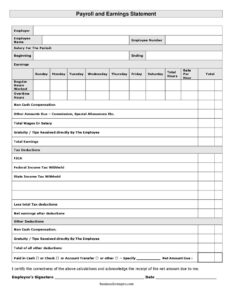
A Payroll Statement is a document an employer gives an employee that itemizes earnings, taxes, other deductions, and the final net pay for a specific pay period. People most often use it to give workers a clear, signed record of how their take-home pay was calculated. You can download this Payroll Statement free in both PDF and DOCX formats, with no signup required.
What Is a Payroll Statement?
A Payroll Statement — sometimes called an earnings statement or pay slip — is issued by an employer to an employee each pay cycle. It documents the gross wages earned, the hours worked, any extra compensation, the taxes withheld, and any additional deductions, ending with the net amount actually paid. It serves as proof of income and a transparent breakdown of where each dollar went. This particular template also includes an employee certification line, where the worker confirms the calculations are correct and acknowledges receiving the net amount due. That signed acknowledgment makes it useful as both a payroll record and a simple receipt of payment.
When Do You Need a Payroll Statement?
This form fits a wide range of pay situations, especially for small businesses that handle payroll manually. Common scenarios include:
- Paying an hourly employee who logs both regular and overtime hours and needs to see how the totals were reached.
- Issuing a salaried employee a periodic statement showing salary for the period plus any commissions or allowances.
- Documenting tips or gratuities an employee received directly, so tax withholding is recorded accurately.
- Providing proof of income an employee can use for a loan, lease, or visa application.
- Keeping an internal record when wages are paid in cash, by check, or by account transfer.
- Reconciling FICA, federal, and state withholding amounts at the end of a quarter or year.
What a Payroll Statement Should Have
A complete Payroll Statement leaves no ambiguity about how net pay was calculated. It should clearly identify the employer and employee, define the exact pay period with beginning and ending dates, and list every component of earnings separately. Deductions must be broken out by type — FICA, federal income tax, state income tax, and any other withholdings — so the math from gross to net is fully transparent. It should also note the payment method and the final net amount due. Finally, an employee signature and date line transforms the document from a simple calculation sheet into an acknowledged receipt, protecting both parties if a pay dispute ever arises.
How to Fill Out a Payroll Statement
- Enter the employer name and the employee name, then add the employee number if your business assigns one.
- For salaried staff, record the salary for the period; fill in the beginning and ending dates of the pay period.
- Under earnings, list regular hours worked and overtime hours, plus any non-cash compensation.
- Add other amounts due such as commission and special allowances, then total these into total wages or salary.
- Record any gratuity or tips received directly by the employee, then sum everything into total earnings.
- List tax deductions: FICA, federal income tax withheld, and state income tax withheld, then enter the total tax deductions.
- Subtract taxes to show net earnings after deductions, then list any other deductions and their total.
- Indicate the payment method — cash, check, or account transfer — and enter the final net amount due.
- Have the employee sign and date the certification line to acknowledge receipt.
Understanding Gross-to-Net Calculations
The heart of any Payroll Statement is the path from gross earnings down to net pay. Gross earnings combine all wages, overtime, commissions, allowances, non-cash compensation, and reported tips. From that figure you subtract mandatory tax deductions — FICA covers Social Security and Medicare, while federal and state income tax withholding depends on the employee’s filing details and applicable rates. The result is net earnings after deductions. Then any voluntary or court-ordered amounts, such as benefit contributions, retirement savings, or garnishments, come out as “other deductions.” The remaining figure is the net amount due — the money the employee actually receives. Showing each layer separately helps employees understand their pay and makes year-end reconciliation far easier.
Cash, Check, or Transfer: Recording the Payment Method
This template lets you mark exactly how the net amount was delivered, which matters more than many employers realize. When wages are paid in cash, a signed statement is often the only proof the payment was made and received, so the acknowledgment line is especially valuable. For checks, you can note the check number alongside the form; for account transfers, the statement pairs neatly with a bank record. Keeping a consistent format across every pay period builds a reliable audit trail that supports both your bookkeeping and the employee’s income records.
Common Mistakes to Avoid
- Leaving the beginning and ending dates blank, which makes it unclear which period the pay covers.
- Combining regular and overtime hours instead of listing them separately, hiding how overtime was calculated.
- Forgetting to record tips received directly by the employee, which can cause tax-withholding errors.
- Mislabeling tax deductions or lumping FICA together with income tax instead of itemizing each.
- Skipping the employee signature and date, leaving you without an acknowledged receipt.
- Failing to keep a copy for your records, so you have nothing to reference during an audit or pay dispute.
Frequently Asked Questions
What is a Payroll Statement used for? It is used to give an employee a clear, itemized breakdown of their earnings, tax and other deductions, and final net pay for a specific period. It also doubles as a signed receipt confirming the employee received the net amount due. Employers keep it as a payroll record, and employees often use it as proof of income.
Is a Payroll Statement legally required? Many jurisdictions require employers to provide some form of itemized pay statement to employees, but the exact required fields vary widely by state and country. This template covers the common elements most rules expect, but you should confirm what your local labor laws mandate. When in doubt, include more detail rather than less.
How do I fill out the earnings section correctly? Start with regular hours and overtime hours, then add non-cash compensation, commission, and special allowances to reach total wages or salary. Add any tips the employee received directly to get total earnings. Listing each component separately keeps the gross-to-net math transparent and easy to verify.
Does the employee need to sign the Payroll Statement? The certification line on this template asks the employee to confirm the calculations are correct and to acknowledge receiving the net amount due. While a signature is not always legally required, it provides valuable protection by documenting that the employee received and accepted the payment. It is especially important when wages are paid in cash.
What’s the difference between gross and net pay on this form? Gross pay is the total earnings before anything is taken out, shown here as total earnings. Net pay, or the net amount due, is what remains after FICA, federal and state income tax, and any other deductions are subtracted. The statement walks through every step so both figures are clearly visible.
How much does this Payroll Statement template cost? Nothing — it is completely free to download in both PDF and DOCX formats with no signup required. You can fill out the PDF directly or edit the DOCX version in your word processor to match your business. Reuse it for every pay period as often as you need.
This Payroll Statement template is a general example provided for informational purposes only and is not legal, financial, or tax advice. Payroll and pay-statement requirements vary by jurisdiction and change over time. Consult a qualified payroll professional, accountant, or attorney to ensure your statements comply with the laws that apply to you.
Official resource: for the rules that apply to your situation, see the U.S. Department of Labor.
Related Forms
- Jury Duty Employee Work Excusal
- Shift Trade Tracker
- Paycheck Authorization Form
- Hazard Assessment
- Overtime Authorization Form
- Employee Complaint Form
Browse more in Employment.