
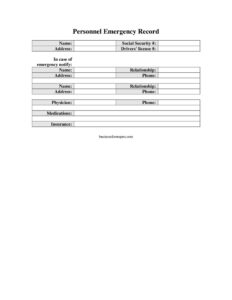
Personnel Emergency Contact Record
Download a free Personnel Emergency Contact Record template in PDF and DOCX to collect employee emergency details quickly — free download, no signup.
PDF
DOCX
2 downloads
0
likes
Download Files
- DOCX
A Personnel Emergency Contact Record is a simple HR form that captures who to call and what medical details matter if an employee is hurt, falls ill, or cannot speak for themselves at work. Employers most often use it to keep critical contact and health information on file so they can act fast in a crisis. You can download this Personnel Emergency Contact Record free in both PDF and DOCX formats, with no signup required.
What Is a Personnel Emergency Contact Record?
A Personnel Emergency Contact Record is a confidential employee document that lists the people to notify in an emergency along with key identifying and medical information. It is usually issued by an employer’s human resources or safety department and completed by the employee during onboarding. The record documents the worker’s name, address, identification numbers, designated emergency contacts, and relevant health details such as physician, medications, and insurance. Its purpose is to give supervisors, first responders, and HR the information they need to reach family members and provide accurate details to medical personnel. Because it contains sensitive data, the completed form is typically stored securely and updated whenever an employee’s circumstances change.
When Do You Need a Personnel Emergency Contact Record?
This form belongs in nearly every workplace, but a few situations make it essential:
- New employee onboarding — collected alongside tax forms and the I-9 so the file is complete from day one.
- Workplace injuries or sudden illness — when a worker is unconscious or unable to communicate, the record tells responders who to call and what medications they take.
- Industries with higher physical risk — construction, manufacturing, warehousing, and field service teams need fast access to emergency details.
- Off-site work and travel — for employees who drive company vehicles, visit client locations, or work remotely.
- Annual HR reviews — refreshing records so phone numbers and contacts stay current.
- Safety audits and compliance checks — demonstrating that the company maintains accessible emergency information for staff.
What a Personnel Emergency Contact Record Should Have
A complete record balances enough detail to be useful with respect for employee privacy. At minimum it should identify the employee, list at least one (ideally two) emergency contacts with current phone numbers, and capture medical basics that could affect emergency treatment. The form should clearly label the relationship of each contact, provide a space for the employee’s physician, and note any medications and health insurance. Including identification fields such as a driver’s license number helps confirm identity, while a dated signature line (or at least a completion date) shows when the information was last verified. The document should also state that the information is confidential and used only for emergency purposes.
How to Fill Out a Personnel Emergency Contact Record
- Name: Enter the employee’s full legal name exactly as it appears in payroll records.
- Address: Provide the employee’s current home address, including city, state, and ZIP code.
- Social Security #: Add the Social Security number if your employer requires it for identification; otherwise leave blank per company policy.
- Driver’s License #: Record the license number and, where helpful, the issuing state.
- In case of emergency, notify — Name: Write the full name of the primary emergency contact.
- Address: Enter that contact’s home or mailing address.
- Relationship: State how the contact is related to the employee, such as spouse, parent, sibling, or friend.
- Phone: Provide the most reliable number to reach the contact, including a mobile or alternate line if space allows.
- Physician: List the employee’s primary care doctor and a phone number.
- Medications: Note current prescriptions, dosages if known, and any drug allergies that responders should be aware of.
- Insurance: Record the health insurance carrier and policy or group number for hospital intake.
Keeping the Record Confidential and Current
Emergency records contain some of the most sensitive information an employer holds, so handling matters as much as collecting. Store completed forms in a locked file or a restricted-access digital folder, and limit viewing to HR staff and supervisors who would actually use the information in an emergency. Avoid leaving Social Security or driver’s license numbers visible on shared printouts. Set a routine — yearly is common — to ask employees to confirm or update their record, since contacts move, change phone numbers, or start new medications. When an employee leaves the company, follow your retention and disposal policy so the data is not kept longer than necessary.
How This Differs From a Medical or Personnel File
An emergency contact record is intentionally narrow: it answers “who do we call and what should responders know right now?” It is not a substitute for a full personnel file or detailed medical records. Many employers keep health-related details, including medications and physician information, separate from general HR documents to respect privacy expectations. Think of this form as a quick-reference sheet that lives where it can be grabbed in seconds, while deeper records stay in their own protected systems.
Common Mistakes to Avoid
- Listing only one contact — always try to include a backup in case the first person can’t be reached.
- Outdated phone numbers — a disconnected line defeats the purpose; verify contacts periodically.
- Skipping medication and allergy details — these can be life-saving information for paramedics.
- Storing the form openly — sensitive identifiers must be kept secure, not pinned to a bulletin board.
- Forgetting to date the form — without a date, no one knows whether the information is still accurate.
- Collecting more data than needed — only request identifiers your organization genuinely uses.
Frequently Asked Questions
What is a Personnel Emergency Contact Record used for? It is used by employers to quickly reach an employee’s designated contacts and share key medical details if the worker is injured, becomes ill, or cannot communicate. It keeps essential information in one accessible place so HR and first responders can act without delay.
Is this form legally required? Most jurisdictions do not mandate a specific emergency contact form, but maintaining one is a widely recommended safety best practice. Some industries and safety programs effectively expect it, so check your local rules and any applicable regulations.
Does the employee have to provide a Social Security number? Not necessarily — collect it only if your organization has a clear, documented need and complies with privacy laws. Many employers leave this field optional or omit it entirely to reduce the sensitivity of the record.
How often should the record be updated? Review it at least once a year and whenever an employee reports a move, a new phone number, a change in physician, or new medications. Keeping it current is what makes the form genuinely useful in an emergency.
Who is allowed to see the completed form? Access should be limited to HR personnel and supervisors who would use it during an emergency. Because it includes health and identifying details, it should be stored securely and shared only on a need-to-know basis.
Is this template really free to download? Yes. You can download the Personnel Emergency Contact Record free in PDF and DOCX formats with no signup, and edit it to match your company’s onboarding and safety procedures.
This template is a general example provided for informational purposes only and is not legal, medical, or HR compliance advice. Privacy and recordkeeping requirements vary by jurisdiction and industry — consult a qualified professional before adopting it in your workplace.
Official resource: for the rules that apply to your situation, see the U.S. Department of Labor.
Related Forms
- Employee Disciplinary Notice
- Attendance Record
- Harassment Log
- Hourly Wage Chart
- Leave Of Absence Form
- Manual Timecard Semi-Monthly Mini
Browse more in Employment.