
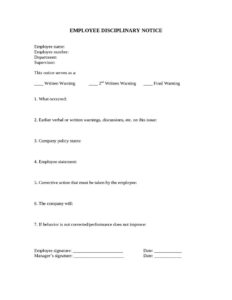
Employee Disciplinary Notice
Download a free Employee Disciplinary Notice template to document warnings, corrective action, and next steps fairly — free PDF and DOCX download.
DOCX
1 downloads
0
likes
Download Files
- DOCX
An Employee Disciplinary Notice is a written record that documents a workplace performance or conduct problem, the corrective action expected, and the consequences if the issue continues. Employers and HR teams most often use it to formally communicate a written warning and keep a paper trail. You can download this template free in PDF and DOCX with no signup required.
What Is an Employee Disciplinary Notice?
An Employee Disciplinary Notice is a formal document issued by a manager, supervisor, or HR representative to an employee whose behavior or performance has fallen below expectations. It records exactly what happened, references the relevant company policy, captures the employee’s response, and spells out the corrective steps required. The notice typically marks a stage in a progressive discipline process — for example, a first written warning, a second written warning, or a final warning. Beyond communicating expectations clearly to the employee, the notice creates a consistent, dated record that protects both parties. If the same issue recurs or leads to termination, this documentation shows that the employee was warned, given a chance to improve, and treated fairly.
When Do You Need an Employee Disciplinary Notice?
This form is useful any time a verbal conversation isn’t enough and the situation calls for a formal, documented step. Common scenarios include:
- An employee repeatedly arrives late or has excessive unexcused absences after a verbal reminder.
- Performance has slipped below standards despite earlier coaching or feedback.
- A worker violated a company policy — safety rules, dress code, attendance, or acceptable use of company property.
- Conduct issues such as insubordination, unprofessional behavior toward coworkers or customers, or failure to follow instructions.
- You are moving an employee to the next stage of progressive discipline, such as escalating from a first to a second or final warning.
- You need clear documentation in case the matter later results in termination or a dispute.
Types of Warnings on This Notice
The template includes checkboxes to mark the notice as a Written Warning, a 2nd Written Warning, or a Final Warning. These reflect a progressive discipline approach, where consequences increase if the problem isn’t resolved. A first written warning often follows one or more verbal discussions. A second written warning signals the issue has continued and is being taken more seriously. A final warning makes clear that further occurrences may lead to termination. Selecting the correct level matters: it sets the tone, shows the employee where they stand, and keeps your records consistent if you need to demonstrate that discipline was applied step by step.
What an Employee Disciplinary Notice Should Have
A complete notice identifies the employee, describes the incident factually, ties it to a specific policy, and documents the path forward. Key elements include the employee’s name and department, the type of warning, an objective description of what occurred, any prior warnings on the same issue, the relevant policy language, a space for the employee’s own statement, the corrective action required, what the company will do to support improvement, and the consequences of not improving. Signatures and dates from both the employee and the manager close out the record.
How to Fill Out an Employee Disciplinary Notice
- Enter the employee name, employee number, department, and supervisor at the top so the notice is clearly tied to the right person.
- Check the box that identifies whether this is a Written Warning, 2nd Written Warning, or Final Warning.
- Under “What occurred,” describe the incident factually — dates, times, and specifics — without opinion or emotion.
- In “Earlier verbal or written warnings,” note any prior discussions on the same issue and when they happened.
- For “Company policy states,” quote or reference the specific rule or standard that was not met.
- Give the employee space to add their statement so their side is recorded.
- In “Corrective action that must be taken,” list clear, measurable steps the employee must complete and by when.
- Under “The company will,” describe any support, training, or monitoring the employer will provide.
- In “If behavior is not corrected,” state the consequences of continued issues.
- Have both the employee and manager sign and date the form.
Tips for Delivering the Notice Fairly
How you deliver the notice matters as much as what it says. Hold the conversation privately and calmly, focus on facts rather than personality, and give the employee a genuine chance to respond before finalizing the document. If the employee declines to sign, note that their signature confirms receipt — not agreement — and record the refusal with a witness if needed. Be consistent: apply the same standards and process to similar situations across your team to reduce the risk of perceived unfairness. Keep the completed notice in the employee’s confidential personnel file, and follow up on the corrective action and timeline you set. A disciplinary notice should be part of a constructive process aimed at improvement, not simply a step toward termination.
Common Mistakes to Avoid
- Writing vague descriptions like “bad attitude” instead of specific, observable facts and dates.
- Failing to reference the actual company policy that was violated.
- Skipping the employee statement, which removes their opportunity to respond.
- Leaving corrective actions undefined or without a deadline, so improvement can’t be measured.
- Applying discipline inconsistently among employees in similar situations.
- Forgetting signatures and dates, which weakens the document’s value as a record.
Frequently Asked Questions
What is an Employee Disciplinary Notice used for? It is used to formally document a performance or conduct problem, communicate the corrective action expected, and record the consequences of not improving. It creates a dated, consistent paper trail that supports fair treatment and protects both the employer and the employee.
Does the employee have to sign the disciplinary notice? An employee’s signature usually confirms they received the notice, not that they agree with it. If an employee refuses to sign, note the refusal on the form and consider having a witness present so the record still shows the notice was delivered.
Is an Employee Disciplinary Notice legally binding? The notice itself is an internal record rather than a contract, but it can carry significant weight in disputes or wrongful termination claims. Following a clear, consistent disciplinary process and documenting it properly helps demonstrate that the employer acted fairly.
What’s the difference between a written warning and a final warning? A written warning is typically an early formal step that follows verbal discussions, while a final warning signals that the issue is serious and that further occurrences may lead to termination. This template lets you check the level so the employee understands where they stand.
How much does this disciplinary notice template cost? Nothing — it is completely free to download in both PDF and DOCX formats with no signup or account required. You can edit the DOCX version to match your company’s policies and branding.
Should I let the employee respond before finalizing the notice? Yes. The form includes an employee statement field for exactly this purpose. Allowing the employee to explain their perspective supports a fair process and can surface context that affects how you handle the situation.
This template is a general example provided for informational purposes only and is not legal, HR, or employment advice. Disciplinary and employment requirements vary by jurisdiction and by company policy — consult a qualified HR or legal professional before relying on this document.
Official resource: for the rules that apply to your situation, see the U.S. Department of Labor.
Related Forms
- Employee Turnover Rate
- Interview Invitation
- Job Acceptance Letter
- Job Application Form
- Key Assignment Form
- Employee Separation Form
Browse more in Employment.