
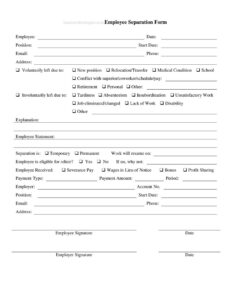
Employee Separation Form
Download a free Employee Separation Form template to document voluntary or involuntary terminations, final pay, and rehire eligibility — free PDF and DOCX.
PDF
DOCX
5 downloads
0
likes
Download Files
- DOCX
An Employee Separation Form is the document an employer completes when an employee leaves the company, recording the reason for departure, the type of separation, final pay details, and whether the worker is eligible for rehire. Most organizations use it to create a clear, consistent record at the end of employment. You can download it free here in both PDF and DOCX formats with no signup required.
What Is an Employee Separation Form?
An Employee Separation Form is an HR document that formally records the end of an employment relationship. It is issued by the employer — usually the HR department or a direct manager — and captures who left, when, why, and under what circumstances. The form distinguishes between voluntary departures (the employee chose to leave) and involuntary ones (the employer ended the relationship), and it documents practical details such as final wages, severance, and whether the separation is temporary or permanent. It serves as an internal reference, supports payroll and benefits processing, and provides a paper trail should questions about the separation arise later.
When Do You Need an Employee Separation Form?
This form is useful any time an employment relationship ends, regardless of the reason. Common situations include:
- Resignation: An employee voluntarily leaves for a new position, relocation, retirement, school, or personal reasons.
- Termination for cause: An employer ends employment due to tardiness, absenteeism, insubordination, or unsatisfactory work.
- Layoffs and restructuring: A position is eliminated, the role changes, or there is a lack of available work.
- Medical or disability separations: An employee cannot continue due to a medical condition or disability.
- Temporary leave with a return date: A seasonal or furloughed worker is expected to resume work on a known date.
- Mutual or contract-end separations: A fixed-term assignment concludes and both parties acknowledge the close.
What an Employee Separation Form Should Have
A complete separation form ties together identity, reason, timing, and money. It should clearly identify the employee and their role, the precise reason for leaving categorized as voluntary or involuntary, and an explanation that adds context. It should state whether the separation is temporary or permanent and note any return date. A rehire eligibility decision protects future hiring choices, and a final pay summary documents severance, wages in lieu of notice, bonuses, and profit sharing. Finally, signature lines for both the employee and employer confirm that the record was reviewed and acknowledged.
How to Fill Out an Employee Separation Form
- Employee details: Enter the employee’s name, the current Date, their Position, Start Date, Email, Phone, and Address.
- Voluntary reason: If the employee left on their own, check the applicable box — new position, relocation/transfer, medical condition, school, conflict with a superior/coworker/schedule/pay, retirement, personal, or other.
- Involuntary reason: If the employer ended the role, select tardiness, absenteeism, insubordination, unsatisfactory work, job eliminated/changed, lack of work, disability, or other.
- Explanation and statement: Write a brief Explanation of the circumstances, and capture the Employee Statement if the worker wishes to add their account.
- Separation type: Mark whether the separation is Temporary or Permanent, and if temporary, note the date work will resume.
- Rehire eligibility: Indicate Yes or No; if No, explain why not.
- Final pay: Record amounts the employee received — severance pay, wages in lieu of notice, bonus, profit sharing — along with payment type, payment amount, and period.
- Employer details and signatures: Add the employer’s name, account number, position, start date, contact info, then have both parties sign and date.
Voluntary vs. Involuntary Separation
Drawing a clear line between voluntary and involuntary separation matters for several reasons. A voluntary departure — resignation, retirement, or a move for personal reasons — generally reflects the employee’s own decision and is documented with their statement and reason code. An involuntary separation is initiated by the employer, whether for performance issues like unsatisfactory work and insubordination or for business reasons like job elimination and lack of work. The category you select can influence unemployment claims, final-pay obligations, and rehire considerations, so choose the box that genuinely reflects what happened and back it up in the Explanation field. When the line is blurry, describe the facts plainly rather than guessing at a label.
Handling Final Pay and Return Dates
The final pay section exists to confirm that everything owed has been accounted for. List each component separately — severance pay, wages in lieu of notice, bonus, and profit sharing — and record the payment type, amount, and pay period so payroll has an unambiguous record. If the separation is temporary, the “work will resume on” date is important: it tells HR, scheduling, and benefits administrators that the relationship is paused rather than ended, which can affect how leave and benefits are treated. For permanent separations, leave the return date blank and make sure the rehire-eligibility answer is completed.
Common Mistakes to Avoid
- Leaving the reason vague: Selecting “other” without an explanation makes the record hard to interpret later.
- Mixing up voluntary and involuntary: Miscategorizing the separation can create payroll and unemployment complications.
- Skipping the rehire decision: Failing to mark Yes or No — and to explain a No — leaves future hiring teams without guidance.
- Incomplete final pay details: Omitting amounts, payment type, or pay period can delay the employee’s final settlement.
- Missing signatures or dates: An unsigned form is weaker as a record; both parties should sign and date it.
- Forgetting the return date on temporary separations: This causes confusion about whether the employee is expected back.
Frequently Asked Questions
What is an Employee Separation Form used for? It documents the end of an employment relationship, including the reason for leaving, whether it was voluntary or involuntary, the final pay provided, and whether the employee is eligible for rehire. Employers use it to keep a consistent record and to support payroll, benefits, and HR processes.
Who fills out the Employee Separation Form? Typically HR or the employee’s manager completes the form, recording the separation details and employer information. The departing employee may add their own statement and signs to acknowledge the record before the employer signs as well.
Does this form need to be signed by both the employee and employer? The template includes signature and date lines for both parties because mutual acknowledgment strengthens the record. If an employee declines to sign — which can happen in contentious separations — note that on the form and have the employer representative sign.
What is the difference between temporary and permanent separation? A temporary separation means the employee is expected to return, so you record a “work will resume on” date. A permanent separation ends the relationship, and in that case the rehire-eligibility question becomes especially important for future hiring decisions.
Is the Employee Separation Form legally binding? The form is primarily a record-keeping document rather than a contract; it captures facts about the separation and any final payments. Severance or release agreements that carry legal obligations are usually separate documents, so confirm your full process with a qualified professional.
How much does this template cost? It is completely free to download here in both PDF and DOCX formats, with no signup required. You can fill out the PDF directly or edit the DOCX version to match your company’s branding and specific policies.
This Employee Separation Form template is a general example provided for informational purposes only and is not legal, financial, or tax advice. Employment laws and final-pay requirements vary by jurisdiction, so consult a qualified HR professional or attorney before relying on this document.
Official resource: for the rules that apply to your situation, see the U.S. Department of Labor.
Related Forms
- Employee Checkout
- Job Interview Schedule
- Employee Name Change Notification
- Employee Tracker
- Job Application Form
- Weekly Time Card With Approval
Browse more in Employment.