
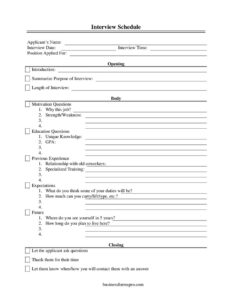
Interview Schedule
Use this free Interview Schedule template to plan structured candidate interviews with ready-made questions and timing — free PDF and DOCX download.
PDF
DOCX
5 downloads
0
likes
Download Files
- DOCX
An Interview Schedule is a structured guide that lays out the questions, timing, and flow for a job interview so every candidate is evaluated fairly and consistently. Hiring teams use it most often to keep interviews on track and to make sure no important topic gets skipped. You can download this template free in both PDF and DOCX formats — no signup required.
What Is an Interview Schedule?
An Interview Schedule is a planning document used by hiring managers, recruiters, and interview panels to organize how a conversation with a job applicant will unfold. Rather than improvising, the interviewer follows a written outline that records the applicant’s name, the position, the date and time, and a sequence of prepared questions grouped by theme. It documents the structure of the meeting from opening introduction to closing remarks. The goal is consistency: when every candidate for the same role answers similar questions in a similar order, comparisons become fairer and decisions become easier to defend. It also serves as a note-taking framework the interviewer can reference later.
When Do You Need an Interview Schedule?
This template is useful any time a structured, repeatable conversation matters. Common scenarios include:
- Interviewing several candidates for the same opening and needing to compare them on equal footing.
- Training a new manager or panel member who has never conducted an interview before.
- Filling a role with specific physical or technical requirements, such as lifting capacity or typing speed.
- Documenting your hiring process to support fair, non-discriminatory practices.
- Coordinating a panel interview where multiple interviewers each cover assigned sections.
- Scheduling back-to-back interviews in a single day and needing to control the length of each session.
What an Interview Schedule Should Have
A complete Interview Schedule captures both logistics and content. At the top it identifies the applicant’s name, the interview date and time, and the position applied for. It states an opening introduction and a brief summary of the interview’s purpose, plus the expected length so everyone manages time well. The body groups questions into clear themes — motivation, education, previous experience, expectations, and future plans — so the conversation flows logically. Finally, it includes a closing section that invites the applicant’s questions, thanks them, and explains the next steps. Built this way, the form doubles as both a roadmap and a record of what was asked.
How to Fill Out an Interview Schedule
- Enter the Applicant’s Name, Interview Date, and Interview Time at the top, then record the Position Applied For.
- Write a short Opening Introduction — how you will greet the candidate and introduce yourself and the company.
- Under Summarize Purpose of Interview, note what you hope to learn, and set the expected Length of Interview.
- In the Motivation block, prepare the “Why this job?” question and a “Strength/Weakness” prompt.
- For Education, list questions about unique knowledge and the candidate’s GPA where relevant.
- In Previous Experience, ask about relationships with former coworkers and any specialized training.
- Under Expectations, ask what duties they anticipate and any physical or skill requirements such as how much they can carry, lift, or type.
- In the Future section, include “Where do you see yourself in 5 years?” and any relocation or longevity questions.
- Finish with the Closing: let the applicant ask questions, thank them, and tell them when and how you’ll follow up.
Types of Interview Questions to Include
This template organizes prompts into recognizable categories, and understanding each helps you use them well. Motivation questions reveal why the candidate wants this specific role and how self-aware they are about their strengths and weaknesses. Education and knowledge questions confirm credentials and surface unique expertise beyond a resume. Experience questions explore how the person worked with past colleagues and what specialized training they bring. Expectation questions check whether the candidate’s understanding of the role matches reality, including any physical or technical demands. Future-oriented questions gauge ambition and stability. Mixing these categories gives you a rounded view of the person rather than a one-dimensional snapshot.
Tips for a Fair and Effective Interview
A schedule only helps if you use it consistently. Ask each candidate for the same role the same core questions so your comparisons hold up. Focus questions on the job itself and on skills the role genuinely requires — for example, lifting capacity only matters for physically demanding positions. Be cautious with personal questions: asking how long someone plans to “live here” or about family plans can stray into territory that varies by jurisdiction and may be restricted. Take brief notes in each section while answers are fresh, and reserve real time at the end for the applicant’s own questions, which often reveal how seriously they have considered the role.
Common Mistakes to Avoid
- Skipping the planning step and improvising, which leads to inconsistent and hard-to-compare interviews.
- Asking different candidates wildly different questions, undermining fairness.
- Letting the conversation run far past the planned length and rushing the closing.
- Forgetting to tell the applicant when and how they will hear back.
- Including questions about personal matters that aren’t job-related and may raise legal concerns.
- Failing to leave time for the candidate to ask their own questions.
Frequently Asked Questions
What is an Interview Schedule used for? It is a planning and note-taking guide that structures a job interview from introduction to closing. It helps the interviewer ask consistent, relevant questions and keep the conversation on time. It also creates a record of what was covered.
Is an Interview Schedule legally required? No, it is not legally required, but using a structured schedule supports fair and consistent hiring practices. Standardized questions make it easier to compare candidates objectively and to demonstrate that your process treats applicants equally. Employment rules vary by jurisdiction, so review local guidance on permissible interview questions.
How long should an interview be? There is no fixed rule, but most structured interviews run between 30 and 60 minutes depending on the role’s complexity. Use the “Length of Interview” field to set a target and pace yourself through each question block. Building in time at the end for the candidate’s questions is important.
Can I change the questions on this template? Yes. The template is fully editable in DOCX, so you can add, remove, or reword questions to match the specific position. Tailor the technical and physical questions to what the job actually requires, and keep the rest job-related.
Should I ask every candidate the same questions? For the core questions, yes — consistency makes your evaluations fairer and easier to defend. You can still ask natural follow-up questions based on individual answers. The shared structure ensures everyone is measured against the same baseline.
How much does this Interview Schedule template cost? It is completely free to download from Business Forms Pro in both PDF and DOCX formats, with no signup required. You can use it as-is or customize it for your hiring needs. There are no hidden fees or watermarks.
This template is a general example provided for informational purposes only and does not constitute legal, HR, or employment advice. Laws governing interview questions and hiring practices vary by jurisdiction and change over time. Consult a qualified employment professional or attorney to ensure your interview process complies with applicable regulations.
Official resource: for the rules that apply to your situation, see the U.S. Department of Labor.
Related Forms
- Check Driving Record
- Weekly Time Card With Approval
- Interview Invitation
- Employee Name Change Notification
- Shift Trade Tracker
- Lactation Accommodation Request
Browse more in Employment.