
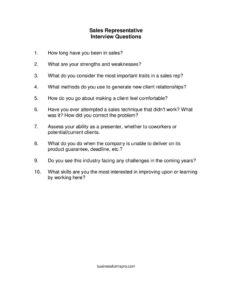
Sales Representative Interview Questions
Download a free Sales Representative Interview Questions template to structure consistent, fair hiring conversations and evaluate top sales talent.
PDF
DOCX
1 downloads
0
likes
Download Files
- DOCX
A Sales Representative Interview Questions template is a ready-made list of focused questions hiring managers use to assess a candidate’s selling skills, experience, and culture fit during a sales job interview. People most often use it to run structured, consistent interviews so every candidate is evaluated fairly against the same criteria. It’s free to download here in both PDF and DOCX formats, with no signup required.
What Is a Sales Representative Interview Questions Template?
A Sales Representative Interview Questions template is a prepared set of behavioral and skill-based questions that an interviewer asks candidates applying for a sales role. It is typically used by hiring managers, sales directors, HR coordinators, or small business owners who need to evaluate a candidate’s ability to prospect, build rapport, present, and close. The document organizes the conversation around proven sales competencies — relationship building, resilience after rejection, presentation ability, and industry awareness — so the interviewer can compare answers across multiple applicants. Rather than improvising on the spot, the interviewer follows a tested script that surfaces both hard skills and soft traits, making it easier to identify the strongest performers.
When Do You Need a Sales Representative Interview Questions Template?
This template is useful any time you’re bringing a new salesperson into your organization or refining your hiring process. Common situations include:
- Hiring a new outside or inside sales representative for a growing team and wanting a repeatable interview process.
- Screening multiple candidates for the same role and needing a consistent benchmark to compare them fairly.
- Training a new hiring manager who has never interviewed sales candidates before.
- Replacing a top performer and trying to find someone with comparable prospecting and closing ability.
- Building a junior sales bench and assessing candidates more on attitude, coachability, and potential than on prior experience.
- Standardizing interviews across several branches or regions so every location evaluates talent the same way.
What a Strong Sales Interview Questionnaire Should Have
An effective set of sales interview questions balances several categories. It should probe experience (how long the candidate has sold and in what markets), self-awareness (strengths and weaknesses), and core sales philosophy (which traits matter most). It should also dig into prospecting methods, rapport-building, and resilience — how the candidate handles a technique that failed or a promise the company couldn’t keep. Finally, strong questions test presentation ability, industry awareness, and growth mindset. The ten questions in this template cover each of these areas, giving you a well-rounded picture of both competence and character without overwhelming the conversation.
How to Use This Sales Representative Interview Questions Template
Work through the questions in order, taking notes on each response so you can compare candidates later:
- Open by asking how long they’ve been in sales to establish their experience level and the types of products or cycles they know.
- Ask about strengths and weaknesses to gauge self-awareness and honesty.
- Explore the most important traits in a sales rep to understand their selling philosophy.
- Probe methods for generating new client relationships to test prospecting skill.
- Ask how they make a client feel comfortable to assess rapport and emotional intelligence.
- Use the question about a sales technique that didn’t work to evaluate resilience and problem-solving.
- Have them assess their presentation ability to coworkers and clients.
- Ask how they respond when the company can’t deliver on a guarantee or deadline to judge integrity under pressure.
- Discuss challenges facing the industry to measure market awareness.
- Close with skills they want to improve or learn to reveal coachability and ambition.
How to Evaluate the Answers
The questions are only half the process — knowing what a strong answer looks like is what makes the interview valuable. When candidates describe how they generate new client relationships, listen for specific, repeatable tactics like referrals, networking, social selling, or disciplined cold outreach, rather than vague claims about being a “people person.” For the question about a technique that failed, the best candidates own the mistake, explain what they learned, and describe a concrete correction — a sign of resilience and accountability. When discussing a missed company guarantee or deadline, look for honesty and proactive communication instead of blame-shifting. Strong answers about industry challenges show the candidate reads the market and thinks ahead. Score each response on a simple scale and capture a few direct quotes so your team can compare notes objectively after the round.
Tips for Running a Better Sales Interview
Let the candidate do most of the talking and use silence to draw out fuller answers. Follow up open-ended questions with “Can you give me a specific example?” to move from theory to real behavior. Many hiring managers add a short role-play — asking the candidate to pitch a product or handle an objection live — alongside these questions to see selling skills in action. Keep your notes factual and tied to the questions so your hiring decision is consistent and defensible, and avoid questions about protected characteristics such as age, religion, family status, or national origin.
Common Mistakes to Avoid
- Asking questions inconsistently across candidates, which makes fair comparison impossible.
- Accepting vague answers without following up for a concrete example or result.
- Talking too much yourself and not leaving room for the candidate to demonstrate their thinking.
- Focusing only on past sales numbers and ignoring coachability, integrity, and culture fit.
- Forgetting to take notes, then relying on memory when several candidates blur together.
- Drifting into illegal or irrelevant personal questions instead of staying with job-related topics.
Frequently Asked Questions
What is a Sales Representative Interview Questions template? It is a prepared list of questions designed to evaluate a sales candidate’s experience, prospecting ability, rapport-building, presentation skills, and mindset. Hiring managers use it to keep interviews structured and consistent. This template includes ten proven questions you can ask in order.
How do I use these interview questions effectively? Ask each question in sequence, take notes on the responses, and follow up with “give me a specific example” when an answer feels general. Use the same questions with every candidate so you can compare them on equal footing. Combine the questions with a short role-play if you want to see selling skills firsthand.
Can I customize the questions for my company? Yes. The DOCX version is fully editable, so you can add product-specific scenarios, adjust the wording to match your sales cycle, or insert questions about your CRM and tools. Many teams add their own scoring scale next to each question.
How many questions should a sales interview include? Ten focused questions, like the set in this template, is enough for a thorough first-round conversation of roughly 45 to 60 minutes. You can trim the list for a quick phone screen or expand it for a final-round panel interview.
Are there questions I should never ask a sales candidate? Yes — avoid questions about age, race, religion, marital or family status, disability, or national origin, as these can be discriminatory and are unlawful in many places. Keep every question tied to job performance and the skills the role requires. The questions in this template are all job-related.
How much does this template cost? It is completely free to download from Business Forms Pro in both PDF and DOCX formats, with no account or signup required. You can use it as-is or edit it to fit your hiring process.
This template is provided as a general example for informational purposes only and does not constitute legal, HR, or employment advice. Hiring and interview requirements vary by jurisdiction and employer. Consult a qualified human resources or legal professional to ensure your interview process complies with applicable laws.
Official resource: for the rules that apply to your situation, see the U.S. Department of Labor.
Related Forms
- Landscaper Interview Questions
- Hotel Front Desk Staff Interview Questions
- Teacher Interview Questions
- Catering Assistant Interview Questions
- Business Development Manager Interview Questions
- Physical Therapist Interview Questions
Browse more in Interview Questions.