
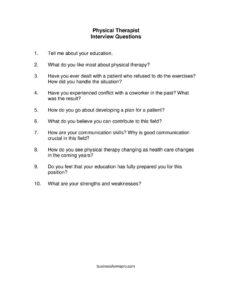
Physical Therapist Interview Questions
Download a free Physical Therapist Interview Questions template to screen PT candidates with proven questions on skills, communication, and patient care.
PDF
DOCX
2 downloads
0
likes
Download Files
- DOCX
The Physical Therapist Interview Questions template is a ready-made list of structured questions hiring managers use to evaluate physical therapy candidates fairly and thoroughly. Clinics, hospitals, and rehabilitation centers rely on it to compare applicants on clinical judgment, communication, and patient rapport. It’s free to download in PDF and DOCX, with no signup required.
What Is a Physical Therapist Interview Questions Template?
A Physical Therapist Interview Questions template is a prepared set of questions an interviewer asks every PT candidate during the hiring process. It is typically used by clinic directors, rehabilitation managers, HR coordinators, and lead therapists who need a consistent way to assess education, hands-on experience, and bedside manner. The document gathers the core topics worth covering — training background, treatment planning, conflict handling, and views on the profession — into one organized sheet. By asking the same questions of each applicant, the interviewer documents responses, reduces bias, and makes it easier to compare candidates side by side after the interviews wrap up.
When Do You Need a Physical Therapist Interview Questions Template?
This template is useful any time you are screening or hiring physical therapy professionals. Common situations include:
- Filling a staff PT position at an outpatient clinic, hospital, or sports rehab facility and needing a repeatable interview format.
- Building a hiring panel where several interviewers must ask consistent questions and score answers fairly.
- Hiring a new graduate and wanting to probe whether their education has prepared them for real caseloads.
- Evaluating an experienced therapist on how they develop treatment plans and handle difficult patients.
- Replacing a departing team member on short notice without time to draft questions from scratch.
- Standardizing your recruiting process so every candidate is measured against the same criteria.
What a Physical Therapist Interview Questions Sheet Should Have
An effective interview sheet blends several question types so you see the whole candidate. The strongest versions include a mix of background questions (education and training), behavioral questions (how they handled a refusing patient or a coworker conflict), clinical questions (how they build a treatment plan), and forward-looking questions (how they see the field changing). It should leave room to note each candidate’s answers, and it should keep the questions open-ended so applicants explain their reasoning rather than giving yes-or-no replies. Space for follow-up prompts and a scoring or impressions column also makes post-interview comparison far easier.
How to Use This Physical Therapist Interview Questions Form
- Open the “Tell me about your education” question to warm up the candidate and confirm their degree, clinical rotations, and licensure path.
- Ask “What do you like most about physical therapy?” to gauge genuine motivation and passion for the work.
- Use the question about a patient who refused to do exercises to assess patience, motivation techniques, and adherence strategies.
- Cover the coworker conflict question to learn how they navigate team dynamics and resolve friction professionally.
- Move to “How do you develop a plan for a patient?” — the key clinical question revealing their assessment and goal-setting process.
- Ask what they can contribute to the field to surface unique skills, specialties, or perspectives.
- Explore communication skills and why communication matters, since clear instructions drive patient outcomes.
- Discuss how physical therapy is changing with evolving healthcare to test awareness and adaptability.
- Confirm whether their education prepared them for the role, then close with strengths and weaknesses. Record notes beside each answer.
How to Interpret the Answers
The value of these questions comes from listening for substance, not rehearsed phrases. When you ask how a candidate develops a treatment plan, strong applicants describe an evaluation step, measurable goals, and a willingness to adjust as the patient progresses — not a single canned protocol. On the patient-refusal question, look for empathy paired with practical motivation tactics: explaining the “why” behind an exercise, breaking it into smaller steps, or finding alternatives the patient will actually do. The coworker conflict answer reveals self-awareness; the best candidates take responsibility for their part and focus on resolution rather than blame. For the strengths and weaknesses question, honest, specific answers with a plan for improvement usually beat polished non-answers.
Tips for a Better Interview
Use the listed questions as a backbone, but follow up. If an answer is vague, ask “Can you give me a specific example?” Take notes during the conversation rather than relying on memory, especially when interviewing several people in one day. Allow silence after a question so candidates have time to think. Where appropriate, blend in a brief scenario based on your actual caseload — a post-surgical knee, a stroke recovery, or a chronic-pain patient — to see how the candidate reasons through a real situation. Finally, give candidates time to ask their own questions; what they want to know often tells you as much as their answers.
Common Mistakes to Avoid
- Asking only yes-or-no questions — the open-ended format here works best, so resist shortening prompts into closed questions.
- Skipping follow-ups and accepting surface-level answers without asking for concrete examples.
- Letting questions vary wildly between candidates, which makes fair comparison impossible.
- Talking more than the candidate instead of listening and taking notes.
- Ignoring soft skills like communication and conflict resolution in favor of credentials alone.
- Asking anything illegal or discriminatory — keep questions focused on the job, not protected personal characteristics.
Frequently Asked Questions
What is a Physical Therapist Interview Questions template? It is a prepared list of questions used to interview candidates for physical therapy roles. It covers education, clinical judgment, communication, and how the candidate handles patients and coworkers, helping interviewers assess applicants consistently.
How do I use this template effectively? Ask each candidate the same core questions, take notes on their answers, and use follow-up prompts to dig deeper into vague responses. Afterward, compare your notes across candidates so the strongest applicant stands out objectively.
Can I edit or add my own questions? Yes. The DOCX version is fully editable, so you can add clinic-specific scenarios, remove questions that don’t apply, or tailor the list to a new-grad versus an experienced therapist. Treat the template as a customizable starting point.
Are these questions suitable for new graduates? They work well for both new graduates and experienced therapists. Questions about education and whether training prepared them for the role are especially useful for recent grads, while plan-development and conflict questions reveal hands-on experience.
How much does this template cost? It is completely free to download here in both PDF and DOCX formats, with no signup or payment required. You can use it immediately for your next round of interviews.
Should I ask the same questions to every candidate? Yes, asking a consistent core set of questions is best practice. It keeps the process fair, makes candidates easier to compare, and helps you avoid bias. You can still add a few role-specific follow-ups as each conversation develops.
This template is provided as a general example for informational purposes only and does not constitute legal, HR, or employment advice. Hiring and interview requirements vary by jurisdiction and employer, so consult a qualified human resources or legal professional to ensure your interview process complies with applicable laws.
Official resource: for the rules that apply to your situation, see the U.S. Department of Labor.
Related Forms
- Hairstylist Interview Questions
- Childcare Provider Interview Questions
- Business Systems Analyst Interview Questions
- Hostess Interview Questions
- Registered Nurse ER Interview Questions
- Quality Assurance Engineer Interview Questions
Browse more in Interview Questions.