
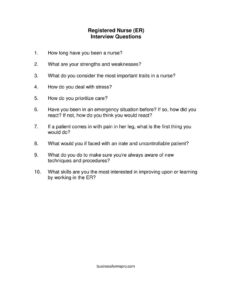
Registered Nurse ER Interview Questions
Use this free Registered Nurse ER interview questions template to structure consistent, fair emergency nursing interviews — free download in PDF and DOCX.
PDF
DOCX
0
likes
Download Files
- DOCX
The Registered Nurse ER interview questions template is a ready-made list of structured questions for assessing candidates applying for emergency room nursing roles. Hiring managers and nurse recruiters use it most often to keep interviews consistent, fair, and focused on the clinical judgment and composure an ER demands. It’s free to download in both PDF and DOCX, with no signup required.
What Is a Registered Nurse ER Interview Questions Template?
A Registered Nurse ER interview questions template is a standardized set of prompts designed to evaluate a nurse’s suitability for the high-pressure emergency department environment. It’s typically used by nurse managers, charge nurses, HR teams, and interview panels during the hiring process. Rather than improvising, interviewers work from the same ten questions for every applicant, covering experience, personal strengths, stress management, care prioritization, and clinical decision-making. The result is a documented, repeatable conversation that produces comparable notes across candidates. Because the questions probe both behavior and technical reasoning, the template helps surface how a nurse actually thinks and reacts when seconds matter — not just what their resume says.
When Do You Need a Registered Nurse ER Interview Questions Template?
- You’re hiring a new emergency room RN and want every candidate evaluated against the same benchmarks.
- A hospital or clinic is staffing up a busy ER and needs to screen multiple applicants efficiently.
- You’re building a structured panel interview and want each interviewer to cover assigned questions.
- A nurse manager wants to assess clinical reasoning beyond credentials, using scenario-based prompts.
- You need documented, defensible interview records to support fair, consistent hiring decisions.
- An RN candidate wants to practice and prepare thoughtful answers before an ER interview.
What a Good ER Nursing Interview Should Cover
A strong emergency room interview goes beyond a checklist of certifications. It balances three things: experience and background, personal traits and resilience, and clinical judgment under pressure. The questions in this template do exactly that. Early items establish tenure and self-awareness, middle questions explore stress tolerance and prioritization, and the scenario-based items reveal how a candidate triages a real complaint or manages a difficult patient. Rounding out the set are questions about staying current with new techniques and what the candidate hopes to learn — signals of growth mindset and long-term fit. Together these dimensions give a fuller picture than any single question could.
How to Fill Out the Registered Nurse ER Interview Questions Template
- Ask “How long have you been a nurse?” to establish overall experience and note any ER-specific tenure.
- Use “What are your strengths and weaknesses?” to gauge self-awareness; record concrete examples, not generic answers.
- Ask “What do you consider the most important traits in a nurse?” to see what the candidate values.
- With “How do you deal with stress?”, look for healthy, specific coping strategies relevant to ER chaos.
- For “How do you prioritize care?”, listen for triage logic and patient-safety reasoning.
- The emergency-situation question reveals real reactions; note composure and decision steps.
- For the leg-pain scenario, assess the candidate’s first-action thinking — assessment before intervention.
- The irate-patient question tests de-escalation and safety awareness.
- Ask about staying current with techniques to measure continuing-education habits.
- Close with skills they want to improve to gauge motivation and fit. Write notes and a rating beside each answer.
Scoring and Comparing Candidates
To get the most from this template, decide on a simple rating scale before interviews begin — for example, 1 to 5 on each question — and have every interviewer use it. Note specific quotes or examples rather than relying on memory; “described prioritizing airway and circulation first” is far more useful later than “good answer.” After all interviews, lay the completed sheets side by side so you can compare candidates on the same criteria. Pay particular attention to the scenario questions (the leg-pain and irate-patient items), since these often differentiate strong clinical reasoning from rehearsed responses. Structured scoring also helps reduce unconscious bias and creates a clear record supporting your final decision.
Tips for a Productive ER Interview
Treat the listed questions as a foundation, then ask natural follow-ups: “What happened next?” or “Why did you choose that step?” These probes reveal depth. Allow silence so candidates can think through scenario answers rather than rushing. For the emergency-situation question, give new graduates room to reason hypothetically — strong instincts matter even without a long track record. Keep the tone conversational; an ER candidate who feels at ease is more likely to show their genuine problem-solving style. Finally, leave time at the end for the candidate’s own questions, since how a nurse interviews you can reveal their priorities and engagement.
Common Mistakes to Avoid
- Asking questions in a different order or wording for each candidate, which makes answers hard to compare.
- Focusing only on credentials and skipping the behavioral and scenario questions that reveal real judgment.
- Failing to take written notes, leaving you reliant on memory after a long day of interviews.
- Accepting vague answers without follow-up; “I handle stress well” needs a concrete example.
- Letting one impressive answer overshadow weak responses on safety-critical scenario questions.
- Adding questions about protected characteristics (age, family status, health) instead of sticking to job-relevant prompts.
Frequently Asked Questions
What is a Registered Nurse ER interview questions template? It’s a structured set of ten interview prompts designed to evaluate candidates for emergency room nursing positions. It covers experience, personal traits, stress management, care prioritization, and clinical scenarios. Using the same questions for everyone makes the hiring process consistent and fair.
How do I use this template in an interview? Print or open the template, then ask each question in order while recording the candidate’s answers and a rating beside each one. Add natural follow-up questions to explore depth, especially on the scenario items. Afterward, compare your completed sheets across candidates to support an objective decision.
Can a candidate use this to prepare for an ER nursing interview? Absolutely. Reviewing these questions in advance lets you rehearse clear, example-driven answers about your experience, stress strategies, and triage reasoning. Practicing the scenario questions — like the leg-pain and irate-patient prompts — helps you respond calmly and methodically during the real interview.
Are these the exact questions I’ll be asked in every ER interview? Not necessarily. Every hospital and manager varies their questions, and many add role-specific or behavioral follow-ups. However, this template reflects common, widely used themes for emergency nursing, so preparing for these will help you handle most interviews well.
Is this template legally compliant for hiring? The questions focus on job-relevant skills and judgment, which is good interviewing practice. Employers should still avoid questions about protected characteristics and follow their local employment laws. Requirements vary by jurisdiction, so review your organization’s hiring policies before use.
How much does this template cost? It is completely free to download in both PDF and DOCX formats, with no signup or payment required. You can edit the DOCX version to add your own questions, rating scale, or organization branding.
This template is provided as a general example for informational purposes only and does not constitute legal, HR, or employment advice. Hiring rules and interview regulations vary by jurisdiction. Consult a qualified HR or legal professional to ensure your interview process complies with applicable laws.
Official resource: for the rules that apply to your situation, see the U.S. Department of Labor.
Related Forms
- Dental Hygienist Interview Questions
- Quality Assurance Engineer Interview Questions
- Hairstylist Interview Questions
- Store Manager Interview Questions
- Home Healthcare Assistant Interview Questions
- Car Salesperson Interview Questions
Browse more in Interview Questions.