
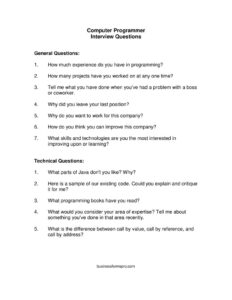
Computer Programmer Interview Questions
Use this free Computer Programmer Interview Questions template to screen developers consistently and fairly — free download in PDF and DOCX.
PDF
DOCX
4 downloads
0
likes
Download Files
- DOCX
A Computer Programmer Interview Questions form is a ready-made list of general and technical questions hiring managers use to evaluate software developer candidates in a consistent, structured way. It’s most commonly used to keep interviews focused, fair, and comparable across multiple applicants. You can download it free in PDF and DOCX — no signup required.
What Is a Computer Programmer Interview Questions Form?
A Computer Programmer Interview Questions form is a structured interview guide that pairs behavioral and background questions with role-specific technical questions for a programming position. It’s typically used by hiring managers, technical leads, recruiters, and HR staff to run a developer interview from start to finish. The document captures both the soft-skill side — motivation, teamwork, career goals — and the hard-skill side, such as language knowledge, code reading, and core computer-science concepts. By writing the questions down in advance, the interviewer ensures every candidate is assessed against the same criteria, which reduces bias and makes side-by-side comparison far easier. It serves as a script, a note-taking template, and a record of what was asked.
When Do You Need a Computer Programmer Interview Questions Form?
This template is useful any time you are formally evaluating someone for a coding or development role. Common situations include:
- Filling a software developer vacancy where you want every applicant asked the same baseline questions.
- Conducting first-round phone or video screens to quickly gauge experience and fit before a deeper technical session.
- Running panel interviews where several interviewers need a shared, agreed-upon question set.
- Training a new hiring manager who needs a reliable framework instead of improvising questions.
- Comparing internal candidates for a promotion into a more senior programming role.
- Contract or freelance hiring, where you must quickly verify a programmer’s real-world skill and communication ability.
What a Good Programmer Interview Should Have
A strong interview form balances two categories. The general questions reveal experience level, work history, motivation, and how the candidate handles conflict and growth. The technical questions probe genuine depth — opinions about a language, the ability to read and critique real code, knowledge of fundamental concepts, and continued self-education. A complete form should also leave space for the interviewer to score or note responses, identify follow-up questions, and record an overall recommendation. The best forms move from easy, open-ended prompts to harder, more specific ones, letting the candidate warm up before tackling the toughest material.
How to Fill Out a Computer Programmer Interview Questions Form
Work through the form in order, taking notes after each answer:
- Start with the General Questions. Ask how much programming experience the candidate has and how many projects they typically juggle at once to gauge workload tolerance.
- Ask how they’ve handled a problem with a boss or coworker, then why they left their last position — these reveal communication style and red flags.
- Move to motivation: why they want to work for your company and how they think they could improve it. Note specificity versus generic answers.
- Ask which skills and technologies they most want to learn or improve, signaling growth mindset.
- Transition to the Technical Questions. Ask what parts of Java they dislike and why, to test critical thinking.
- Hand them a sample of your existing code and have them explain and critique it — this is the single most revealing question.
- Ask what programming books they’ve read, what their area of expertise is with a recent example, and finally the difference between call by value, call by reference, and call by address.
Tips for Getting Honest, Useful Answers
Open-ended questions work best when you give candidates room to think. After asking why they left their last position, resist the urge to fill silence — pauses often produce the most candid answers. When presenting your code sample, choose a real snippet with a deliberate weakness or two so you can see whether the candidate spots it. Pay attention to how they explain technical concepts like call by reference, not just whether they get it right; clear teaching ability is a strong predictor of collaboration. Take written notes during, not after, the interview so details stay accurate when you compare candidates later.
Adapting the Template for Different Languages and Levels
The included technical questions lean toward Java, but the structure transfers easily. Swap “What parts of Java don’t you like?” for Python, C#, JavaScript, or whichever stack the role demands. For junior roles, weight the general questions and ease up on deep concepts; for senior roles, add system-design and architecture prompts and lean harder on the code-critique exercise. The call-by-value-versus-reference question is a good fundamentals check across most languages, but tailor the code sample to your actual codebase so the conversation reflects the work the person will really do.
Common Mistakes to Avoid
- Asking only technical questions and ignoring teamwork, motivation, and conflict-handling — soft skills make or break developers on a team.
- Skipping the code-critique exercise, which is far more revealing than abstract trivia.
- Letting different interviewers ask wildly different questions, making candidates impossible to compare fairly.
- Reading questions like a checklist without listening, probing, or following up on interesting answers.
- Failing to take notes during the interview and relying on memory afterward.
- Asking questions that have nothing to do with the actual role or the technology the team uses day to day.
Frequently Asked Questions
What is a Computer Programmer Interview Questions form? It is a structured list of general and technical questions used to interview candidates for a programming or software development position. It helps interviewers stay consistent, cover both behavioral and technical ground, and compare applicants fairly. You can download it free here in PDF and DOCX.
How do I use this template? Print or open the file, ask the general questions first to learn about the candidate’s background and motivation, then move into the technical questions. Take notes after each answer and add your own follow-ups or scoring as needed. You can edit the DOCX version to swap in your own languages, code samples, and role-specific questions.
Can I customize the questions for languages other than Java? Yes. The template is fully editable in DOCX, so you can replace the Java-specific question with one about Python, C#, JavaScript, Go, or whatever stack your team uses. You should also swap in a code sample from your own codebase so the critique exercise reflects real work.
Should I ask the technical or general questions first? Most interviewers start with general questions to build rapport and ease the candidate in before moving to harder technical material. This order helps nervous candidates settle and gives you a sense of their communication style early. You can reorder the sections to fit your interview flow.
Is this interview form legally binding? No. It is an internal interview guide, not a contract or legal document. That said, follow your local employment laws and avoid questions about protected characteristics such as age, race, religion, or family status — keep questions focused on the job.
How much does this template cost? Nothing. The Computer Programmer Interview Questions template is completely free to download in both PDF and DOCX formats, with no account or signup required. You’re welcome to reuse and adapt it for every developer interview you run.
This template is provided as a general example for informational purposes only and does not constitute legal, HR, or employment advice. Hiring and interviewing rules vary by jurisdiction and employer — consult a qualified HR or legal professional to ensure your interview process complies with applicable laws.
Official resource: for the rules that apply to your situation, see the U.S. Department of Labor.
Related Forms
- Business Development Manager Interview Questions
- Floral Designer Interview Questions
- Dental Hygienist Interview Questions
- Physical Therapist Interview Questions
- Website Designer Interview Questions
- Childcare Provider Interview Questions
Browse more in Interview Questions.