
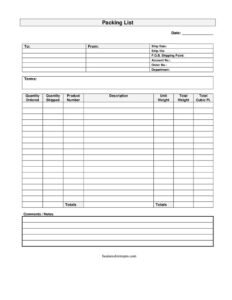
Packing List
Download a free packing list template to itemize shipped goods, verify quantities, and streamline deliveries — free download in PDF and DOCX, no signup.
PDF
DOCX
21 downloads
1
likes
Download Files
- DOCX
A packing list is a shipping document that itemizes exactly what is inside a shipment, including product numbers, quantities ordered versus quantities shipped, and weights. Businesses use it most often so the receiver can verify that every item ordered actually arrived in the box. You can download this template free in both PDF and DOCX formats, with no signup required.
What Is a Packing List?
A packing list is a detailed inventory of the contents of a shipment, prepared by the seller or shipper and included with the goods or sent to the buyer. Unlike an invoice, it focuses on physical details — what is in the package, how many units, and how much it weighs — rather than prices and payment. Warehouse staff, freight carriers, customs officials, and receiving clerks all rely on it to confirm a delivery is complete and accurate. This template captures shipping logistics such as ship date, carrier, F.O.B. terms, and total cubic footage, making it suitable for both domestic and outbound shipments where contents must be documented clearly.
When Do You Need a Packing List?
A packing list accompanies almost any physical shipment of goods between businesses. Common situations include:
- Fulfilling a wholesale or bulk order where the buyer must check received quantities against what was ordered.
- Shipping freight by truck, rail, or sea, where carriers need weight and cubic footage to plan loads.
- Sending goods to a retailer’s distribution center that requires a packing slip for receiving.
- Documenting partial shipments, so the customer knows which line items shipped now and which are backordered.
- Supporting customs clearance on international shipments that need an itemized contents declaration.
- Providing a paper trail for returns, claims, or disputes when items arrive damaged or missing.
What a Packing List Should Have
A complete packing list ties the shipment back to the original order and describes its physical contents in enough detail for anyone to verify it. The essential elements are the parties involved (the to and from addresses), reference numbers that link to the order and account, shipping logistics like carrier and ship date, and an itemized table of products. Each line should show quantity ordered, quantity shipped, a product number, a description, and weight. Totals for quantity, weight, and cubic footage let the carrier and receiver confirm the whole shipment at a glance. A comments area handles special instructions or notes about backordered items.
How to Fill Out a Packing List
- Enter the date the packing list is prepared.
- Fill in the to field with the recipient’s name and shipping address, and the from field with your company’s details.
- Record the ship date and the ship via carrier or method (for example, UPS Ground or LTL freight).
- Note the F.O.B. shipping point to clarify when ownership and freight responsibility transfer to the buyer.
- Add reference numbers: the account no., order no., and the department placing or receiving the order.
- State the terms if relevant to the shipment.
- For each item, list the quantity order, the quantity shipped, the product number, and a clear description.
- Enter the unit weight and calculate the total weight per line.
- Record the total cubic ft. for volume-based freight.
- Add up the totals row for quantities, weight, and cubic footage.
- Use the comments/notes field for backorders, handling instructions, or special remarks.
Packing List vs. Invoice
People often confuse a packing list with an invoice, but they serve different purposes. A packing list describes the physical contents of a shipment — what is in the box, how many, and how heavy — so the receiver can verify the delivery. An invoice is a request for payment, listing prices, taxes, totals, and payment terms. The two documents usually share reference numbers like the order number and account number so they can be matched, but the packing list intentionally omits pricing. Many companies include both with a shipment: the packing list inside or on the package for receiving, and the invoice sent to accounts payable. Keeping them separate helps warehouse staff focus on quantities while the finance team handles billing.
Tips for Accurate Shipping Documentation
Accuracy on a packing list prevents disputes and speeds up receiving. Always reconcile quantity shipped against quantity ordered before the truck leaves, and flag any backordered items clearly in the comments. Use consistent product numbers that match your catalog and the customer’s purchase order so line items can be cross-checked instantly. Double-check unit and total weights, since carriers bill by weight and a discrepancy can trigger reweigh fees. For freight shipments, confirm cubic footage so the carrier can allocate space correctly. Finally, keep a copy of every packing list on file — it becomes valuable evidence if the customer reports a shortage or files a damage claim.
Common Mistakes to Avoid
- Leaving the quantity shipped blank or copying it from quantity ordered without verifying the actual count.
- Omitting the order number or account number, which makes it hard to match the shipment to the buyer’s records.
- Forgetting to note backordered or partially shipped items in the comments section.
- Recording inaccurate weights or cubic footage, leading to carrier reweigh charges or load planning errors.
- Using vague product descriptions that the receiving clerk cannot identify against the order.
- Failing to clarify F.O.B. terms, which can create confusion about who is responsible for freight and risk in transit.
Frequently Asked Questions
What is the difference between a packing list and a packing slip? The terms are often used interchangeably, and both itemize the contents of a shipment. A packing slip is typically the simpler customer-facing document placed inside or on the box, while a packing list may include extra logistics like weight, cubic footage, and F.O.B. terms for carriers and customs. This template covers both uses.
Does a packing list include prices? No, a standard packing list focuses on physical contents — quantities, product numbers, descriptions, and weights — not pricing. Prices, taxes, and payment terms belong on the invoice. The two documents are usually matched using the shared order and account numbers.
What does F.O.B. shipping point mean on this form? F.O.B. (Free On Board) shipping point indicates that ownership and freight responsibility transfer to the buyer once the goods leave the seller’s location. It signals who bears the cost and risk during transit. Confirm the agreed terms with your customer before completing this field.
Do I need to fill in cubic footage? Only if your carrier requires it. Cubic footage matters for freight that is priced or planned by volume, such as LTL and full truckload shipments. For small parcel deliveries, you can leave the total cubic ft. field blank and focus on weight.
Is this packing list legally binding? A packing list is primarily a shipping and verification document rather than a contract, but it can serve as important evidence in delivery disputes, shortage claims, and customs reviews. Keeping accurate, signed copies strengthens its value if a disagreement arises about what was actually shipped.
Is this packing list template really free? Yes. You can download this packing list template completely free in both PDF and DOCX formats, with no signup or account required. Use the DOCX version if you want to customize the fields, add your logo, or adjust the layout for your products.
This packing list template is provided as a general example for informational purposes only and does not constitute legal, financial, or shipping compliance advice. Documentation and customs requirements vary by jurisdiction and carrier — consult a qualified professional or your freight provider to ensure your shipments meet all applicable rules.
Need to work out sales tax? Use our free Sales Tax Calculator to add or remove sales tax from any amount in seconds.
Official resource: for the rules that apply to your situation, see the U.S. Small Business Administration.
Related Forms
- Lost Orders Tracker
- Features Comparison Chart
- Business Quote Form
- Invoice
- Outstanding Invoices
- Avoid Verbal Orders AVO Form
Browse more in Invoices and Order Forms.