
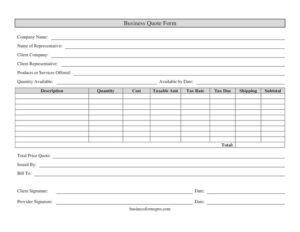
Business Quote Form
Download a free Business Quote Form template to give clients clear, itemized price quotes with tax, shipping, and totals — free PDF and DOCX download.
PDF
DOCX
1 downloads
0
likes
Download Files
- DOCX
A Business Quote Form is a document a provider sends to a prospective client that itemizes products or services, quantities, costs, taxes, shipping, and a final total price quote. People use it most often to give a customer a clear, written price before any work begins or an order is placed. You can download this Business Quote Form free in PDF and DOCX — no signup required.
What Is a Business Quote Form?
A Business Quote Form is a formal price estimate issued by a company to a potential client. It is typically prepared by a business representative and presented to a client representative for review before a purchase or contract. The form lists each item or service being offered, the quantity available, the date it can be delivered, and a line-by-line breakdown of cost, taxable amount, tax rate, tax due, shipping, and subtotal. By spelling out the full total price quote in writing, it helps both sides agree on scope and price up front. Unlike an invoice, which requests payment for work already delivered, a quote proposes terms before any commitment is made.
When Do You Need a Business Quote Form?
This form is useful any time a buyer asks “How much will this cost?” and you need to put a clear, professional answer in writing. Common situations include:
- A client requests pricing on a bulk order of products and wants quantities, unit costs, and shipping clearly broken out.
- A service provider — a contractor, agency, or consultant — needs to estimate a project before being hired.
- A buyer is comparing several vendors and needs an apples-to-apples quote that shows taxable amounts and tax rates.
- A company wants to lock in a price that is valid until a specific “Available by” date.
- A wholesale supplier responds to a request for quote (RFQ) and must confirm what quantity is available.
- A small business wants a paper trail and a signature line so both parties acknowledge the proposed terms.
What a Business Quote Form Should Have
A complete quote leaves no room for confusion about who is offering what and at what price. The essential elements are: the provider’s company name and representative; the client company and client representative; a clear description of the products or services offered; quantity available and the date it can be delivered; an itemized table with description, quantity, and cost; the taxable amount, tax rate, and tax due; shipping charges; a subtotal and total; and a clearly stated total price quote. Signature and date lines for both the client and the provider round out the document so each side can confirm acceptance. Including “Issued By” and “Bill To” details keeps the parties unambiguous.
How to Fill Out a Business Quote Form
- Enter your Company Name and the Name of Representative preparing the quote.
- Add the Client Company and the Client Representative you are quoting to.
- Describe the Products or Services Offered in plain language so the client knows exactly what is included.
- Note the Quantity Available and the Available by Date so the client knows supply and timing.
- For each line, fill in the Description, Quantity, and Cost.
- Enter the Taxable Amt, apply the correct Tax Rate, and record the resulting Tax Due.
- Add any Shipping charges, then total the items into the Subtotal and the overall Total.
- State the final Total Price Quote prominently.
- Complete the Issued By and Bill To fields, then have the Provider Signature and Client Signature signed and dated.
Quote vs. Estimate vs. Invoice
These three documents are often confused, but they serve different purposes. A quote is a firm, written price the provider commits to for a defined scope and period — that is what this form delivers. An estimate is a looser, approximate figure that may change as work progresses. An invoice comes later and demands payment for goods or services already provided. Because a quote can become the basis of a binding agreement once both parties sign, it is worth being precise with quantities, the tax rate, and the available-by date. If your quote should expire, state that clearly near the total so there is no expectation that the price holds indefinitely.
Tips for a Quote That Wins the Job
A well-built quote does more than show numbers — it builds confidence. Keep line-item descriptions specific so clients understand the value behind each cost. Break out taxes and shipping rather than hiding them in one lump figure; transparency reduces back-and-forth. Make the total price quote easy to find at a glance. Where relevant, add a short note about what is excluded so there are no surprises later. Finally, deliver the quote promptly — speed often signals reliability and can be the difference between landing the work and losing it to a faster competitor.
Common Mistakes to Avoid
- Leaving the Available by Date blank, which lets a client assume the price and supply will last indefinitely.
- Applying the wrong Tax Rate or forgetting to separate the Taxable Amt from non-taxable items.
- Omitting Shipping so the Total looks lower than the client will actually pay.
- Vague line Descriptions that cause disputes about what was promised.
- Failing to capture both the Provider Signature and Client Signature, leaving acceptance unconfirmed.
- Math errors between the Subtotal, Tax Due, and Total Price Quote that undermine your credibility.
Frequently Asked Questions
What is a Business Quote Form used for? It is used to give a prospective client a clear, written price for products or services before any order or work begins. It itemizes quantities, costs, taxes, shipping, and a final total so both sides understand the proposed terms. This makes it easier for the client to approve the purchase or compare offers.
How do I fill out a Business Quote Form? Start with your company and representative details, then the client’s company and representative. List each product or service with its description, quantity, and cost, add the taxable amount, tax rate, tax due, and shipping, then total everything into the total price quote. Finish with the Issued By, Bill To, and signature fields.
Is a signed quote legally binding? Once both the provider and client sign and date the form, the quote can form the basis of a binding agreement to the stated terms and price. The exact effect depends on your wording and local contract law, so include any expiration date or conditions clearly. Consult a professional if the amounts are significant.
What is the difference between a quote and an invoice? A quote proposes a price before any work or order is committed, while an invoice requests payment for goods or services already delivered. This form is a quote, designed to present pricing for approval. After the client accepts, you would typically follow up with an invoice.
Should the quote include taxes and shipping? Yes — separating the taxable amount, tax rate, tax due, and shipping gives the client an accurate picture of the real total. Hiding these in one figure often causes disputes later. Listing them transparently builds trust and reduces follow-up questions.
How much does this Business Quote Form cost? Nothing — this template is completely free to download in both PDF and DOCX, with no signup required. You can fill out the PDF directly or edit the DOCX version to add your logo, terms, and branding. Reuse it for as many clients and quotes as you need.
This Business Quote Form template is a general example provided for informational purposes only and is not legal, financial, or tax advice. Requirements for quotes, taxes, and contracts vary by jurisdiction and situation — consult a qualified professional before relying on this document.
Need to work out sales tax? Use our free Sales Tax Calculator to add or remove sales tax from any amount in seconds.
Official resource: for the rules that apply to your situation, see the U.S. Small Business Administration.
Related Forms
- Letter to Confirm Verbal Order
- Rain Check Long
- Accounts Payable Invoice
- Restaurant Order Pad
- Trade Credit Discount Calculator
- Bill of Materials
Browse more in Invoices and Order Forms.