
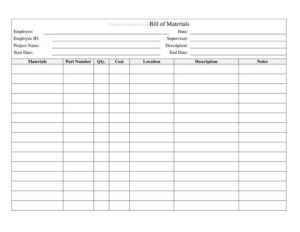
Bill of Materials
Download a free Bill of Materials template to list every part, quantity, and cost for a project, available as a free PDF and DOCX download.
PDF
DOCX
1 downloads
0
likes
Download Files
- DOCX
A Bill of Materials (often shortened to BOM) is a structured list of every part, component, and material needed to build, assemble, or complete a project. People most often use it to make sure nothing is missed before production or purchasing begins. You can download this Bill of Materials template free in both PDF and DOCX formats, with no signup required.
What Is a Bill of Materials?
A Bill of Materials is a detailed inventory document that lists the raw materials, sub-components, parts, and quantities required to manufacture a product or carry out a project. It is typically created by an engineer, project manager, or production planner and shared with purchasing, assembly, and accounting teams. The BOM ties each item to a part number, quantity, and unit cost so everyone works from the same source of truth. This particular template also captures who prepared it, the supervising authority, project timing, and storage location — turning a simple parts list into a working planning and procurement record that supports accurate ordering, costing, and assembly.
When Do You Need a Bill of Materials?
A BOM is useful any time a project depends on having the right materials in the right quantities at the right time. Common situations include:
- Manufacturing or assembly runs — defining every component before a production batch begins so the line never stalls waiting on a missing part.
- Construction and fabrication jobs — listing lumber, fasteners, fixtures, and hardware tied to a specific project and timeline.
- Purchasing and procurement — giving buyers exact part numbers, quantities, and costs to request quotes or place orders.
- Cost estimating and budgeting — totaling material costs up front to bid a job or check it against a budget.
- Inventory and warehouse planning — recording the storage location of each material so stock can be staged and tracked.
- Engineering change control — documenting which parts a revision adds, removes, or replaces so the team builds the correct version.
What a Bill of Materials Should Have
A complete BOM removes guesswork. The strongest versions identify every material unambiguously and connect it to a cost and a quantity. At minimum, a usable Bill of Materials should include the project it belongs to, who prepared and approved it, the dates the work covers, and a line-by-line breakdown of each material. Each line should carry a clear description, a unique part number, the quantity needed, the unit or extended cost, and where the material is stored or sourced. A notes field rounds it out, leaving room for specifications, substitutions, or special handling instructions that do not fit neatly into the columns.
How to Fill Out a Bill of Materials
- Employee: Enter the name of the person preparing the BOM so questions can be routed back to the right author.
- Date: Record the date you created or last revised the document, which helps track versions.
- Employee ID: Add the preparer’s internal identifier for record-keeping and accountability.
- Supervisor: Name the manager or lead who reviews and approves the materials list.
- Project Name: Identify the project, product, or job this BOM supports.
- Description: Summarize the overall scope or purpose of the build at the top.
- Start Date / End Date: Enter the planned timeframe so materials can be scheduled for delivery.
- Materials: List the name of each material or component on its own line.
- Part Number: Add the unique identifier for each item to prevent ordering errors.
- Qty.: State how many units of each material are required.
- Cost: Record the unit or line cost so totals can be calculated.
- Location: Note where each material is stored, staged, or sourced.
- Description / Notes: Use the line description and notes for specs, grades, substitutions, or handling instructions.
Tips for an Accurate and Useful BOM
Treat the Bill of Materials as a living document rather than a one-time list. Assign a version number or revision date each time you change a line so the assembly and purchasing teams always work from the current version. Use consistent units of measure — be clear whether a quantity is each, per foot, per box, or per kilogram — because a mismatch here is one of the most common causes of over- or under-ordering. Group related components together, and keep part numbers identical to those used by your suppliers and your inventory system. Whenever possible, include a small buffer note for materials with high scrap rates so the order quantity reflects real-world waste.
How a BOM Differs from a Purchase Order or Invoice
A Bill of Materials is easy to confuse with other order documents, but its role is distinct. A BOM defines what is needed to build something and is an internal planning and engineering record. A purchase order is a request sent to a supplier to actually buy specific items, often generated from the BOM. An invoice is the supplier’s request for payment after goods are delivered. In short, the BOM comes first and drives the others: it tells you what to order, the purchase order commits to buying it, and the invoice closes out the transaction. Keeping these documents linked by project name and part number makes auditing and reconciliation far simpler.
Common Mistakes to Avoid
- Missing or duplicate part numbers — without a unique identifier per line, ordering the wrong component becomes almost inevitable.
- Inconsistent units of measure — mixing “each” and “per box” in the quantity column leads to costly ordering errors.
- Forgetting to update revisions — building from an outdated BOM means assembling the wrong version of the product.
- Leaving costs blank — an incomplete cost column makes accurate budgeting and bid pricing impossible.
- Vague descriptions — “bracket” tells a buyer nothing; specify size, material, finish, and grade.
- No supervisor sign-off — skipping approval removes a key check before money is spent on materials.
Frequently Asked Questions
What is a Bill of Materials used for? A Bill of Materials lists every part, component, and quantity needed to build a product or complete a project. Teams use it for purchasing, cost estimating, inventory staging, and assembly so everyone works from the same accurate list of materials.
How do I fill out a Bill of Materials template? Start with the header details — employee, date, employee ID, supervisor, project name, and project dates — then add one line per material. For each line, enter the description, part number, quantity, cost, storage location, and any notes. Review and total the costs before sharing it with purchasing.
Is a Bill of Materials a legally binding document? On its own, a BOM is an internal planning and engineering record rather than a binding contract. It becomes part of binding agreements when it is referenced in a purchase order, supplier contract, or manufacturing specification, so accuracy still matters greatly.
What is the difference between a BOM and a purchase order? A Bill of Materials defines what is needed to build something and is created first as an internal reference. A purchase order is generated afterward to actually buy specific items from a supplier, often drawing its line items directly from the BOM.
Does a Bill of Materials need to be signed? There is no legal requirement to sign a BOM, but most organizations have a supervisor or engineer approve it before materials are ordered. The supervisor field in this template provides space for that internal sign-off and accountability.
How much does this Bill of Materials template cost? Nothing — it is completely free to download from Business Forms Pro in both PDF and DOCX formats with no signup required. You can edit the DOCX version to match your project, part numbering, and column needs.
This Bill of Materials template is provided as a general example for informational purposes only and does not constitute legal, financial, or engineering advice. Material specifications, procurement rules, and documentation requirements vary by industry and jurisdiction, so consult a qualified professional before relying on this form for a specific project.
Need to work out sales tax? Use our free Sales Tax Calculator to add or remove sales tax from any amount in seconds.
Official resource: for the rules that apply to your situation, see the U.S. Small Business Administration.
Related Forms
- Numbered Purchase Order
- Letter to Confirm Verbal Order
- Proforma Invoice
- Avoid Verbal Orders AVO Form
- Rain Check Long
- Tax Invoice Statement Book
Browse more in Invoices and Order Forms.