
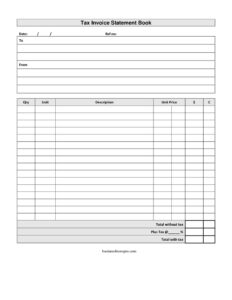
Tax Invoice Statement Book
Download a free Tax Invoice Statement Book template to record sales, charge tax, and track payments in PDF and DOCX — free download, no signup needed.
PDF
DOCX
1 downloads
0
likes
Download Files
- DOCX
A Tax Invoice Statement Book is a sequential record of tax invoices a business issues to customers, used most often to bill for goods or services while clearly showing the tax charged on each sale. It keeps every invoice numbered, dated, and accounted for in one place, and you can download it free here in both PDF and DOCX formats with no signup required.
What Is a Tax Invoice Statement Book?
A Tax Invoice Statement Book is a bound or printable collection of tax invoice pages, each capturing a single transaction between a seller and a buyer. Businesses, sole traders, freelancers, and retailers use it to document what was sold, how much tax applied, and the total owed. Unlike a plain receipt, a tax invoice itemizes the supply and separates the tax amount so the customer can claim it and the seller can report it. The “book” format means invoices are pre-numbered in sequence, which prevents gaps and duplicates. It serves as both a billing document handed to the customer and an internal sales register used for bookkeeping, tax filing, and reconciliation at month or year end.
When Do You Need a Tax Invoice Statement Book?
Any business that charges tax on its sales benefits from a consistent invoicing record. Common situations include:
- Retail and counter sales — issuing a numbered tax invoice to a walk-in customer who needs proof of purchase and the tax breakdown.
- Service providers and tradespeople — billing clients for labor and materials after completing a job, with tax shown separately.
- Wholesale or B2B supply — providing business buyers a tax invoice they can use to reclaim input tax.
- Recurring or account customers — generating monthly statements that summarize multiple invoices and outstanding balances.
- Market stalls, pop-ups, and field work — a physical book lets you write invoices on the spot without power or internet.
- Tax season and audits — handing your accountant an organized, sequential set of invoices for filing and review.
What a Tax Invoice Statement Book Should Have
Each page should be self-contained and clear enough to stand alone as a legal billing document. A complete tax invoice typically includes the seller’s business name, address, and tax registration number; the words “Tax Invoice” or “Invoice”; a unique invoice number and the date of issue; the customer’s name and contact details; an itemized description of goods or services with quantities and unit prices; the tax rate and tax amount; the subtotal, total tax, and grand total; and the payment terms or due date. A running statement section may also list previous balances, payments received, and the current amount owing. Space for a signature or stamp adds a layer of confirmation.
How to Fill Out a Tax Invoice Statement Book
- Enter your business details at the top — name, address, phone, email, and your tax or registration number so the invoice is traceable to you.
- Assign the invoice number and date. Use the next number in sequence and record the issue date; never skip numbers.
- Add the customer information — their name, business name if applicable, billing address, and any account or reference number.
- Itemize each line. Write a clear description, the quantity, and the unit price for every product or service supplied.
- Calculate the subtotal by adding the line amounts before tax.
- Apply the tax. Enter the applicable tax rate, calculate the tax amount on the taxable items, and show it on its own line.
- Record the grand total — subtotal plus tax — as the amount due.
- Note payment terms such as due date, accepted methods, and any deposit or balance carried over from the statement section.
- Sign or stamp the invoice and give the customer their copy while retaining yours in the book.
Tax Invoice vs. a Plain Receipt or Quote
It helps to know how this document differs from related ones. A quote or estimate is issued before a sale and is not a demand for payment. A receipt is proof that payment has already been made. A tax invoice sits in the middle: it requests payment and, crucially, breaks out the tax so both parties can account for it correctly. The statement element of the book layers on a summary view — useful for ongoing account customers — by carrying forward prior balances and showing what remains unpaid. Using the right document at the right stage keeps your records clean and avoids confusion about whether money is owed.
Keeping Your Invoice Records Organized
The value of a Tax Invoice Statement Book comes from discipline. Always issue invoices in strict numerical order so gaps are obvious if a page goes missing. Keep a copy of every invoice, including voided ones — mark a canceled invoice clearly rather than tearing it out. Reconcile the book against your bank deposits regularly so payments line up with invoices. Store completed books somewhere safe and dry, and consider scanning pages periodically for backup. At tax time, a tidy, sequential book makes preparing returns and answering questions far simpler. Retention periods vary, so check how many years your jurisdiction requires you to keep invoices.
Common Mistakes to Avoid
- Skipping or reusing invoice numbers — this breaks the audit trail and raises red flags during a review.
- Omitting the tax breakdown — failing to show the tax rate and amount separately can make the invoice invalid for the buyer.
- Leaving off your registration number — buyers often cannot claim the tax without it.
- Vague line descriptions like “services rendered” — be specific so the customer and tax authority understand the charge.
- Math errors — double-check that line totals, subtotal, tax, and grand total add up correctly.
- Forgetting to keep your copy — handing over the only record leaves you with nothing to reconcile or report.
Frequently Asked Questions
What is a Tax Invoice Statement Book used for? It is used to issue numbered tax invoices to customers and keep a running record of sales and the tax charged on each one. Businesses rely on it for billing, bookkeeping, and tax reporting. The statement portion also tracks outstanding balances for account customers.
How do I fill out a tax invoice correctly? Start with your business and tax details, add a sequential invoice number and date, then enter the customer’s information. Itemize each product or service with quantity and price, calculate the subtotal, show the tax rate and amount separately, and total the invoice including tax. Finish with payment terms and your signature or stamp.
Does a tax invoice need to show the tax separately? In most places, yes — a valid tax invoice must display the tax rate and the tax amount distinctly from the net price. This lets the buyer claim the tax where eligible and lets you report it accurately. Exact requirements vary by jurisdiction, so confirm your local rules.
Is a Tax Invoice Statement Book legally binding? A completed tax invoice serves as a formal request for payment and a record of the transaction, and it can be relied upon as evidence of the sale. Its enforceability depends on the underlying agreement and local laws. Keeping accurate, sequential copies strengthens its value as documentation.
How long should I keep completed invoice books? Most tax authorities require businesses to retain invoices for several years, though the exact period differs by country and region. Store them securely and consider digital backups. Check your local tax agency’s record-keeping requirements to be sure.
How much does this template cost? Nothing — this Tax Invoice Statement Book template is completely free to download in both PDF and DOCX formats with no signup required. You can print the book as is or open the DOCX to add your logo and customize the fields. Use it for as many invoices as you need.
This template is a general example provided for informational purposes only and is not legal, financial, or tax advice. Invoicing and tax requirements vary by jurisdiction and by business type. Consult a qualified accountant or tax professional to ensure your invoices meet the rules that apply to you.
Need to work out sales tax? Use our free Sales Tax Calculator to add or remove sales tax from any amount in seconds.
Official resource: for the rules that apply to your situation, see the U.S. Small Business Administration.
Related Forms
- Accounts Payable Invoice
- Numbered Purchase Order
- Purchase Order
- Avoid Verbal Orders AVO Form
- Packing List
- Proforma Invoice
Browse more in Invoices and Order Forms.