
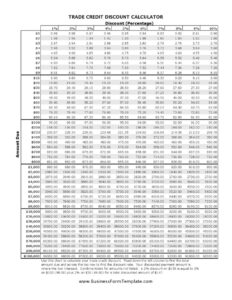
Trade Credit Discount Calculator
Use our free Trade Credit Discount Calculator template to compare early-payment discounts and financing costs—free download in PDF and DOCX.
PDF
0
likes
Download Files
A Trade Credit Discount Calculator is a simple worksheet that helps buyers and finance staff decide whether to pay a supplier invoice early to capture a cash discount or hold the cash until the due date. The most common reason people use it is to translate a term like “2/10, net 30” into a true annualized cost of credit so they can make a smart cash-flow decision. You can download it free in PDF and DOCX, with no signup required.
What Is a Trade Credit Discount Calculator?
A Trade Credit Discount Calculator is a structured form used by accounts payable teams, small-business owners, controllers, and bookkeepers to evaluate early-payment discount offers on supplier invoices. It documents the invoice amount, the discount percentage, the discount window, and the full credit period, then converts those inputs into the effective annual cost of forgoing the discount. In plain terms, it answers one question: is paying early worth it? Suppliers often grant discounts to accelerate their own collections, and buyers who understand the math can earn an implied return that frequently beats short-term borrowing rates. The form keeps the comparison consistent across invoices so decisions are data-driven rather than guesswork.
When Do You Need a Trade Credit Discount Calculator?
This worksheet is useful any time a supplier offers terms that include an early-payment incentive. Common situations include:
- Reviewing an invoice with terms like 2/10, net 30 and deciding whether to pay on day 10 or day 30.
- Comparing the implied return of taking a discount against the interest rate on a line of credit or business credit card.
- Standardizing accounts payable decisions when multiple suppliers offer different discount structures.
- Building a monthly cash-flow plan and identifying which early payments produce the best yield on available cash.
- Negotiating new payment terms with a vendor and modeling several discount scenarios side by side.
- Training new bookkeeping or AP staff on how to evaluate trade credit consistently.
Understanding Common Trade Credit Terms
Trade credit is usually written as a shorthand such as 2/10, net 30. The first number is the discount percentage, the second is the number of days you have to claim it, and “net” followed by a number is the total days allowed before the full balance is due. So “2/10, net 30” means a 2% discount if paid within 10 days, otherwise the full amount is due in 30 days. Other examples include 1/15, net 45 or 3/10, net 60. The calculator turns these terms into an apples-to-apples annual figure so a 1% discount and a 3% discount can be ranked fairly, even when their windows differ.
What a Trade Credit Discount Calculator Should Have
A complete version of this form captures every variable needed to compute and compare the cost of credit:
- The supplier or invoice reference so the analysis ties back to a specific bill.
- The gross invoice amount before any discount.
- The discount percentage offered.
- The discount period (days to qualify for the discount).
- The net credit period (full days allowed before payment is due).
- Calculated fields for the discount dollar amount, the net amount due if paying early, and the effective annual cost of not taking the discount.
- A decision line or notes section for the recommended action.
How to Fill Out a Trade Credit Discount Calculator
Work through the form one field at a time:
- Enter the supplier name and invoice number so the calculation is traceable to a real bill.
- Record the invoice amount—the gross total before any discount is applied.
- Enter the discount percentage offered, for example 2 for a 2% discount.
- Enter the discount period in days—the deadline to qualify, such as 10 days.
- Enter the net (full credit) period in days, such as 30 days.
- Calculate the discount amount: invoice amount multiplied by the discount percentage.
- Calculate the net amount due if paying early: invoice amount minus the discount.
- Compute the effective annual cost using: discount % ÷ (100 − discount %) × (365 ÷ (net period − discount period)). For 2/10, net 30 this works out to roughly 37%.
- Compare that figure to your borrowing rate, then record your decision and notes at the bottom.
How to Interpret the Result
The effective annual cost tells you the implied return on paying early. If that number is higher than the rate you would pay to borrow the cash (or higher than what the cash earns sitting idle), taking the discount is usually the better choice. The classic “2/10, net 30” example yields an effective annual cost near 37%, which almost always beats a line of credit—so capturing the discount makes financial sense. When the discount is small or the gap between the discount day and the due date is large, the implied return shrinks and holding your cash may be smarter. Run the calculator on several invoices and you will quickly spot which payments deserve priority.
Tips for Getting the Most From the Calculator
Always base the calculation on the invoice date or the date the goods were received, depending on how your supplier defines the clock—mismatched start dates lead to missed discount windows. Keep a copy of each completed worksheet with the invoice for your records and audit trail. If you process many invoices, build the formula once into a spreadsheet using the DOCX as a guide so the math is automatic. And revisit your most frequent suppliers periodically; even a modest discount captured consistently across the year adds up to a meaningful saving.
Common Mistakes to Avoid
- Confusing the discount period with the net period and applying the formula incorrectly.
- Forgetting that the discount only applies if payment actually clears within the window—mailing time and processing delays count.
- Comparing the raw discount percentage instead of the annualized cost, which understates the value of short discount windows.
- Ignoring your own cost of capital, so you take low-yield discounts while carrying high-interest debt.
- Using the gross invoice amount for the early payment instead of the discounted net amount.
- Failing to record the decision, leaving no audit trail for why an invoice was paid early or late.
Frequently Asked Questions
What does “2/10, net 30” mean? It means you may take a 2% discount if you pay the invoice within 10 days; otherwise the full amount is due within 30 days. The calculator converts these terms into an effective annual cost so you can judge whether paying early is worthwhile. For this example, the implied return is roughly 37% annually.
How do I calculate the effective annual cost of trade credit? Use the formula: discount % ÷ (100 − discount %) × (365 ÷ (net period − discount period)). Plug in the values from your invoice terms, and the result is the annualized cost of skipping the discount. Compare that figure to your borrowing rate to decide.
Is taking an early-payment discount always the right choice? Not always—it depends on your cash position and cost of capital. If the implied annual return exceeds what you pay to borrow or what your cash could otherwise earn, the discount is usually worth taking. When cash is tight or the implied return is low, holding the cash until the due date can be the wiser move.
Does this form need to be signed or notarized? No. A Trade Credit Discount Calculator is an internal analysis tool, not a contract or legal instrument, so it requires no signatures or notarization. You may still want an approver to initial the decision line for internal controls.
Can I use this for accounts receivable as well as payable? Yes. Sellers can use the same math to understand the cost of offering a discount and to set terms that balance faster collections against the revenue given up. Simply reverse the perspective—the discount you offer is a cost to you and a benefit to the buyer.
Is this template really free? Yes, the Trade Credit Discount Calculator is completely free to download in PDF and DOCX with no signup required. Edit the DOCX to add your company logo, supplier list, or built-in formulas, and reuse it across as many invoices as you like.
This template is provided as a general example for informational purposes only and does not constitute financial, accounting, or tax advice. Calculation conventions and term definitions can vary by supplier and industry, and your individual circumstances differ—consult a qualified accountant or financial professional before making payment decisions.
Need to work out sales tax? Use our free Sales Tax Calculator to add or remove sales tax from any amount in seconds.
Official resource: for the rules that apply to your situation, see the U.S. Small Business Administration.
Related Forms
- Contractor Change Form
- Construction Invoice
- Rain Check Wide
- Bill of Materials
- Job Invoice
- Tailor Alterations Form
Browse more in Invoices and Order Forms.