
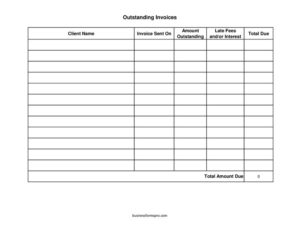
Outstanding Invoices
Track unpaid bills with our free Outstanding Invoices template — list client name, amount due, and late fees in PDF or DOCX, free download.
PDF
DOCX
XLSX
9 downloads
0
likes
Download Files
- DOCX
- XLSX
An Outstanding Invoices form is a simple statement that lists every bill a customer has not yet paid, along with the amount still owed and any late fees or interest. Businesses use it most often to remind a client of overdue balances and to keep an accurate record of accounts receivable. You can download this template free in PDF and DOCX, with no signup required.
What Is an Outstanding Invoices Form?
An Outstanding Invoices form is a summary document that consolidates one or more unpaid invoices for a single client into a clear running total. It is typically issued by a business, freelancer, or accounts receivable team and sent to a customer who has missed a payment due date. Rather than re-sending each original invoice individually, this form documents what was billed, when it was sent, how much remains outstanding, and what additional charges (such as late fees or interest) have accrued. It serves as both an internal tracking tool and an external reminder, helping both parties agree on exactly how much is due before the balance is settled.
When Do You Need an Outstanding Invoices Form?
This form is useful any time a payment slips past its due date or when you need a clean snapshot of what a client owes. Common situations include:
- Following up on a missed payment — a client’s invoice is past due and you want to send a polite, itemized reminder.
- Month-end accounts receivable review — you need to total all unpaid balances to forecast incoming cash flow.
- Applying late fees or interest — a contract allows penalties on overdue amounts, and you need to show the original sum plus the added charges.
- Consolidating multiple invoices — a customer has several unpaid bills and wants one combined statement of the total due.
- Before sending an account to collections — you document the outstanding balance as part of your final-notice process.
- Reconciling disputed amounts — a client questions what they owe, and you provide a written breakdown to resolve the discrepancy.
What an Outstanding Invoices Form Should Have
A complete outstanding invoices statement leaves no room for confusion about who owes what. At minimum it should clearly identify the client, reference the original invoice and the date it was sent, and break the balance into its parts. Listing the original amount outstanding separately from late fees or interest makes the math transparent and easier to dispute or verify. A prominent total due figure ensures the client knows the exact amount required to clear the account. Including your business name, contact details, and accepted payment methods (even if handwritten) turns the document from a passive record into an actionable reminder that prompts faster payment.
How to Fill Out an Outstanding Invoices Form
- Client name — Enter the full legal or business name of the customer who owes the balance, exactly as it appears on the original invoice and any agreement.
- Invoice sent on — Record the date the original invoice was issued or delivered. If you are consolidating several invoices, list each send date so the client can match them to their own records.
- Amount outstanding — Write the unpaid principal — the original billed amount that has not yet been received, before any penalties.
- Late fees and/or interest — Add any penalty charges that have accrued under your payment terms or contract. Show how the figure was calculated if interest is involved.
- Total due — Combine the amount outstanding with any late fees and interest for this line or invoice.
- Total amount due — Enter the grand total across all listed invoices. This is the single number the client must pay to bring the account current.
Calculating Late Fees and Interest Correctly
Late fees and interest should only be applied when your original invoice, contract, or terms of service authorized them. A flat late fee is a fixed dollar amount added once a payment becomes overdue, while interest is usually charged as a percentage of the outstanding balance per month or per year. To keep the form credible, state the basis for the charge — for example, the percentage rate and the number of days late — so the client can verify it. Many jurisdictions cap how much interest a business may charge on overdue commercial accounts, so it is wise to confirm the maximum allowable rate before adding penalties. Transparent calculations reduce disputes and make the statement more likely to be paid promptly.
Tips for Getting Outstanding Invoices Paid Faster
A well-presented statement does more than record a debt — it encourages action. Send the form as soon as a payment becomes overdue rather than waiting weeks, since older debts are harder to collect. Keep the tone professional and factual, attach copies of the original invoices, and clearly state a new payment due date. Offering convenient payment options and a direct contact for questions removes friction. If a balance remains unpaid after a reminder, escalate gradually with a second notice before considering formal collection, and always keep a dated copy of every statement you send for your own records.
Common Mistakes to Avoid
- Mixing principal with penalties — combining the original amount and late fees into one figure makes the statement impossible to verify and easy to dispute.
- Omitting the original invoice date — without the “invoice sent on” date, the client cannot match the balance to their records.
- Applying unauthorized charges — adding late fees or interest that were not agreed in the contract can invalidate your claim.
- Math errors in the total due — always double-check that the totals add up across every listed invoice.
- Vague client identification — using a nickname or partial name instead of the full billed name can cause confusion in larger organizations.
- Failing to keep a copy — not retaining a dated record of the statement weakens your position if the debt is contested later.
Frequently Asked Questions
What is an Outstanding Invoices form used for? It is used to summarize and remind a client of unpaid bills, showing the original amount owed, any late fees or interest, and the total due. Businesses use it for follow-up reminders, accounts receivable tracking, and resolving payment disputes.
How do I fill out an Outstanding Invoices form? Enter the client’s full name, the date the original invoice was sent, and the amount still outstanding. Then add any late fees or interest, calculate the total due for each invoice, and write the combined total amount due at the bottom.
Can I add late fees and interest to an outstanding balance? You can only add late fees or interest if your original invoice, contract, or terms of service authorized them. Show the rate and how the charge was calculated, and be aware that many jurisdictions cap the maximum allowable interest on overdue accounts.
Is an Outstanding Invoices form legally binding? The form itself is a statement of amounts owed rather than a contract; the obligation to pay comes from the underlying invoice or agreement. It serves as supporting documentation of the debt and can strengthen your records if a balance is later disputed or pursued.
Does this form need to be notarized or witnessed? No. An outstanding invoices statement is a routine business document and does not require notarization or witnesses. You simply complete it accurately and send it to the client with copies of the original invoices.
How much does this Outstanding Invoices template cost? It is completely free to download here in both PDF and DOCX formats, with no signup or payment required. You can edit the DOCX version to add your business name, logo, and payment instructions before sending.
This Outstanding Invoices template is a general example provided for informational purposes only and does not constitute legal, financial, or tax advice. Rules on late fees, interest, and debt collection vary by jurisdiction — consult a qualified professional before relying on this document for your specific situation.
Need to work out sales tax? Use our free Sales Tax Calculator to add or remove sales tax from any amount in seconds.
Official resource: for the rules that apply to your situation, see the U.S. Small Business Administration.
Related Forms
- Numbered Purchase Order
- Features Comparison Chart
- Avoid Verbal Orders AVO Form
- Statement Form
- Construction Invoice
- Order Form
Browse more in Invoices and Order Forms.