
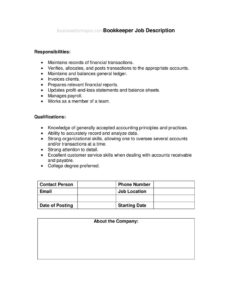
Bookkeeper Job Description
Use this free Bookkeeper job description template to define responsibilities, qualifications, and hiring criteria, available as a free PDF and DOCX download.
PDF
DOCX
3 downloads
0
likes
Download Files
- DOCX
A Bookkeeper job description is a document that outlines the duties, responsibilities, and qualifications required for a bookkeeping role within an organization. Most employers use it to attract qualified candidates and set clear expectations before hiring. This template is free to download in both PDF and DOCX formats, with no signup required.
What Is a Bookkeeper Job Description?
A Bookkeeper job description is a written summary that defines the role of a person responsible for recording and maintaining a company’s financial transactions. It is typically created by a hiring manager, business owner, or human resources team. The document explains what the bookkeeper will do day to day, such as managing ledgers, reconciling accounts, and processing invoices, along with the skills, education, and experience the employer expects. A clear job description serves as the foundation for a job posting, an interview guide, and even a future performance review. It helps both the company and applicants understand the scope of the position before any commitment is made.
When Do You Need a Bookkeeper Job Description?
This document is useful any time a business is defining, advertising, or evaluating a bookkeeping role. Common scenarios include:
- Posting a new opening — when a growing company needs to advertise a bookkeeper position on job boards or its careers page.
- Replacing a departing employee — when an existing bookkeeper leaves and you need to document the role accurately for a new hire.
- Hiring your first bookkeeper — when a small business owner moves financial tasks off their own plate for the first time.
- Clarifying an existing role — when duties have shifted over time and the position needs to be redefined or restructured.
- Working with a staffing agency — when a recruiter needs a precise breakdown of responsibilities and qualifications to source candidates.
- Conducting performance reviews — when a manager wants a documented standard against which to measure an employee’s work.
What a Bookkeeper Job Description Should Have
A complete and effective bookkeeper job description usually contains several core elements. While this template focuses on two essential sections, a strong final document brings them together clearly:
- A job title and brief role summary describing where the position fits in the organization.
- A responsibilities section listing the specific financial and administrative duties the bookkeeper will perform.
- A qualifications section detailing the education, certifications, experience, and software skills required.
- Reporting structure indicating who the bookkeeper reports to and any team they support.
- Employment details such as full-time or part-time status, location, and whether the role is remote or on-site.
How to Fill Out a Bookkeeper Job Description
This template centers on two main fields — Responsibilities and Qualifications — that form the heart of any job description. Follow these steps to complete it:
- Add a job title and summary at the top, even though the template is brief. State that the role is a Bookkeeper and add one or two sentences about your company.
- Complete the Responsibilities section by listing concrete duties: recording daily transactions, maintaining the general ledger, reconciling bank statements, processing accounts payable and receivable, preparing invoices, and supporting month-end closing.
- Include reporting and collaboration duties, such as assisting the accountant or controller and preparing financial reports for management.
- Fill in the Qualifications section with required education (for example, an associate degree in accounting), years of experience, and any certifications like a bookkeeping credential.
- List software and technical skills, such as proficiency in QuickBooks, Excel, or other accounting platforms.
- Add soft skills like accuracy, attention to detail, and discretion with confidential information.
- Review and tailor the entire document to match your specific business needs before publishing.
Responsibilities vs. Qualifications: Getting the Balance Right
Many employers blur the line between what a bookkeeper will do and what they must already know. Keep these sections distinct. The Responsibilities section answers “What does the job involve?” and should use action verbs like record, reconcile, process, and prepare. The Qualifications section answers “Who is the right fit?” and covers the background and abilities a candidate brings on day one. Separating them clearly helps applicants self-assess and helps you filter resumes efficiently. It also reduces confusion during interviews, because you can probe qualifications separately from the candidate’s understanding of the day-to-day work.
Tips for a Stronger Bookkeeper Job Posting
To attract the right applicants, distinguish between requirements that are mandatory and those that are merely preferred. Use bullet points so candidates can scan the role quickly. Be honest about the volume and complexity of the books — a sole proprietor’s needs differ greatly from a multi-entity company’s. Mention growth opportunities or the chance to work closely with leadership, which often appeals to detail-oriented finance professionals. Finally, keep the language inclusive and avoid jargon that might exclude qualified candidates from non-traditional backgrounds.
Common Mistakes to Avoid
- Listing vague duties like “handle finances” instead of specific, measurable tasks.
- Overloading qualifications with so many “required” items that strong candidates self-select out.
- Confusing a bookkeeper with an accountant — bookkeepers record transactions, while accountants typically analyze and interpret them.
- Omitting software requirements, leaving you with applicants unfamiliar with your accounting system.
- Forgetting employment details such as hours, pay range expectations, and reporting structure.
- Copying a generic template without tailoring it to your actual business size and workflows.
Frequently Asked Questions
What does a bookkeeper job description include? It typically includes a job title, a role summary, a list of responsibilities such as recording transactions and reconciling accounts, and a qualifications section covering education, experience, and software skills. This template focuses on the responsibilities and qualifications, which are the two most important parts. You can expand it with reporting details and employment terms.
How do I fill out this template? Start by adding a clear job title and a short company summary, then complete the Responsibilities section with specific duties and the Qualifications section with required skills and experience. Be concrete and use bullet points. Review the final version to ensure it matches your company’s actual bookkeeping workload.
Is a bookkeeper the same as an accountant? No. A bookkeeper primarily records and organizes daily financial transactions, while an accountant generally interprets, analyzes, and reports on that data. Your job description should reflect the level of responsibility you actually need, since the two roles often require different credentials.
Is this job description legally binding? A job description itself is generally not a legally binding contract; it is a descriptive document used for hiring and management. However, employment laws vary by jurisdiction, so you should review wording carefully if it could imply guaranteed terms of employment.
How much does this template cost? Nothing. This Bookkeeper job description template is completely free to download in both PDF and DOCX formats, with no signup or payment required. You can edit the DOCX version to fit your needs.
Can I customize this template for a part-time or remote bookkeeper? Yes. The template is fully editable, so you can specify part-time hours, remote or hybrid arrangements, and adjust the responsibilities and qualifications to match the scope of the role. Tailoring it helps attract candidates who fit your exact situation.
This template is a general example provided for informational purposes only and does not constitute legal, financial, or human resources advice. Employment and hiring requirements vary by jurisdiction and industry. Consult a qualified professional before relying on this document.
Official resource: for the rules that apply to your situation, see the U.S. Department of Labor.
Related Forms
- Handyman Job Description
- Website Designer Job Description
- Dental Hygienist Job Description
- Pet Sitter Job Description
- Valet Driver Job Description
- Sales Representative Job Description
Browse more in Job Descriptions.