
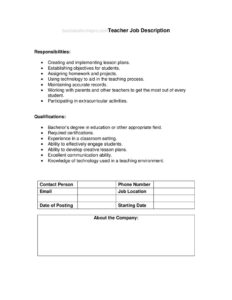
Teacher Job Description
Use our free Teacher Job Description template to outline responsibilities and qualifications for any teaching role, with a free download in PDF and DOCX.
PDF
DOCX
2 downloads
0
likes
Download Files
- DOCX
A Teacher Job Description is a structured document that defines the responsibilities, qualifications, and expectations for a teaching position, most commonly used by schools and districts to attract and screen qualified candidates. It is free to download here in both PDF and DOCX formats, with no signup required, so you can post a role or build an internal record in minutes.
What Is a Teacher Job Description?
A Teacher Job Description is a written summary that explains what a teaching role involves and who is suited to fill it. It is typically issued by a school administrator, principal, human resources team, or hiring committee, and it documents the day-to-day duties a teacher will perform alongside the education, certifications, and skills required. The document serves as the foundation for a job posting, an interview rubric, and the new hire’s understanding of their role. By clearly separating Responsibilities from Qualifications, it gives applicants a transparent picture of the job while helping employers evaluate candidates consistently and fairly.
When Do You Need a Teacher Job Description?
This form is useful any time a teaching role needs to be defined, advertised, or clarified. Common situations include:
- Posting an open teaching vacancy on a school website, job board, or recruitment platform.
- Preparing for interviews so the hiring panel can score candidates against the same set of duties and credentials.
- Onboarding a newly hired teacher who needs a clear written summary of expectations from day one.
- Conducting performance reviews where the original responsibilities serve as a benchmark.
- Restructuring a department and needing to redefine roles, grade levels, or subject assignments.
- Documenting roles for accreditation, compliance, or internal HR records.
Whether you are filling a full-time elementary classroom position, hiring a part-time substitute, or recruiting a subject-area specialist, a clear description keeps everyone aligned.
Types of Teaching Roles This Template Covers
The same two-part structure adapts to almost any teaching position. You might use it for an elementary classroom teacher responsible for a single group of students across multiple subjects, a secondary subject teacher focused on math, science, English, or history, a special education teacher who develops individualized learning plans, or an ESL or language instructor. It also works for substitute teachers, teaching assistants, and instructional coaches. Simply tailor the responsibilities and qualifications to reflect the grade level, subject, and certification requirements of the specific role you are defining.
What a Teacher Job Description Should Have
A complete and effective Teacher Job Description usually includes the following elements:
- A clear job title and, ideally, the grade level or subject area.
- A Responsibilities section listing the concrete duties the teacher will perform.
- A Qualifications section detailing required education, certifications, and skills.
- Any preferred or “nice-to-have” attributes that distinguish strong candidates.
- Reporting lines, such as who the teacher reports to and who they collaborate with.
- Employment details where relevant, such as full-time, part-time, or contract status.
The two core sections in this template — Responsibilities and Qualifications — do the heavy lifting, while the surrounding context makes the role easy to understand at a glance.
How to Fill Out a Teacher Job Description
Follow these steps to complete the template using the fields provided:
- Begin by adding a clear job title at the top, such as “Third Grade Teacher” or “High School Biology Teacher,” so readers immediately know the role.
- Move to the Responsibilities section. List the day-to-day duties in concise bullet points: planning lessons, delivering instruction, assessing student progress, managing classroom behavior, communicating with parents, and collaborating with colleagues.
- Be specific about subject matter and grade level so the duties reflect the actual position rather than a generic teaching role.
- Include administrative and supervisory tasks where they apply, such as recording grades, supervising activities, or attending staff meetings.
- Next, complete the Qualifications section. State the minimum education required, such as a bachelor’s degree in education or a related field.
- List required licensing or certification, noting that specific credentials vary by location.
- Add essential skills and experience, such as classroom management ability, familiarity with curriculum standards, or years of teaching experience.
- Separate required qualifications from preferred ones so candidates understand which are mandatory.
- Review the finished document for clarity, then save and export it as a PDF or DOCX for posting or filing.
Tips for Writing Responsibilities and Qualifications
Strong job descriptions are specific and measurable. Under Responsibilities, start each line with an action verb — “develop,” “deliver,” “assess,” “communicate” — so the duties read as concrete activities rather than vague ideas. Aim for six to ten clear bullets rather than a long, overwhelming list. Under Qualifications, distinguish between what is truly required and what is merely preferred; setting the bar too high can discourage capable applicants, while setting it too low can flood you with unqualified ones. Use inclusive, neutral language throughout, and avoid jargon that only insiders would recognize. Finally, keep the tone welcoming — a description that conveys the school’s values and culture often attracts better-fit candidates than a dry list of demands.
How It Differs From a Job Posting
It is worth distinguishing a job description from a job advertisement. The job description is the internal, factual blueprint of the role: it can live in HR files, inform performance reviews, and remain stable over time. A job posting is the public, marketing-oriented version that draws on the description but adds salary information, application instructions, and persuasive language about the school. This template gives you the durable foundation; you can adapt it into a posting whenever you need to recruit, while keeping the original on file for reference.
Common Mistakes to Avoid
- Writing vague responsibilities like “teach students” instead of specifying subjects, grade levels, and concrete duties.
- Listing excessive or unrealistic qualifications that screen out otherwise excellent candidates.
- Confusing required credentials with preferred ones, leaving applicants unsure whether to apply.
- Forgetting to mention reporting relationships or who the teacher collaborates with.
- Copying a generic template without tailoring it to the actual position and school context.
- Using outdated certification language — requirements change, so verify current local rules before publishing.
Frequently Asked Questions
What is a Teacher Job Description? It is a document that outlines the responsibilities and qualifications for a teaching position. Schools and districts use it to advertise roles, screen applicants, onboard new hires, and set clear performance expectations.
How do I fill out the Responsibilities and Qualifications sections? List concrete duties under Responsibilities using action verbs, and list required education, certifications, and skills under Qualifications. Tailor both sections to the specific grade level and subject so the description accurately reflects the role.
Is a Teacher Job Description legally binding? A job description is generally a guiding document rather than a binding contract, though it can become part of an employment agreement depending on how it is used. Employment terms and requirements vary by jurisdiction and employer, so confirm how the document fits into your hiring process.
What qualifications should I include for a teacher? Typical qualifications include a relevant degree, a teaching license or certification, classroom management skills, and subject-area knowledge. Specific licensing requirements vary by state or country, so always reference your local education authority’s current standards.
Can I edit this template for different teaching roles? Yes. The two-part structure works for elementary, secondary, special education, ESL, substitute, and assistant roles. Simply adjust the responsibilities and qualifications to match the grade, subject, and credentials of the position you are defining.
How much does this template cost? It is completely free to download here in both PDF and DOCX formats, with no signup or payment required. You can edit it as many times as you need for different positions.
This template is a general example provided for informational purposes only and is not legal, employment, or HR advice. Hiring requirements, certification standards, and employment laws vary by jurisdiction. Consult a qualified human resources or legal professional to ensure your job description meets applicable rules and your organization’s needs.
Official resource: for the rules that apply to your situation, see the U.S. Department of Labor.
Related Forms
- Bartender Job Description
- Technical Writer Job Description
- Hairstylist Job Description
- Attorney Job Description
- Home Healthcare Assistant Job Description
- Dispatcher Job Description
Browse more in Job Descriptions.