
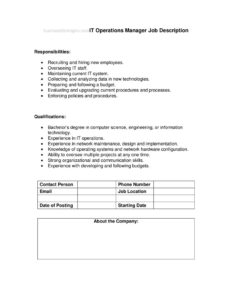
IT Operations Manager Job Description
Download a free IT Operations Manager job description template to attract qualified candidates and define responsibilities and qualifications clearly.
PDF
DOCX
0
likes
Download Files
- DOCX
An IT Operations Manager job description is a hiring document that defines the role, responsibilities, and qualifications for the person who keeps an organization’s technology infrastructure running reliably. Companies use it most often to post an accurate job ad and screen candidates against a clear standard. You can download this template for free in PDF and DOCX with no signup required.
What Is an IT Operations Manager Job Description?
An IT Operations Manager job description is a structured outline that communicates exactly what the role involves and who is qualified to perform it. It is typically issued by a hiring manager, HR department, or IT director, and it documents two essential things: the responsibilities the manager will own and the qualifications a candidate must bring. The document serves recruiters writing job postings, applicants deciding whether to apply, and interviewers evaluating fit. Internally, it also becomes a reference point for performance reviews and onboarding. Because the IT Operations Manager sits at the intersection of systems administration, team leadership, and service reliability, the description must capture both the technical depth and the management scope of the position.
When Do You Need an IT Operations Manager Job Description?
- You are hiring a new IT Operations Manager and need a posting for job boards, LinkedIn, or your careers page.
- A growing company is formalizing its IT department and splitting responsibilities away from a generalist sysadmin or IT director.
- HR needs a documented role definition to set salary bands, leveling, and approval before opening the requisition.
- An existing employee is being promoted into operations management and the duties need to be written down clearly.
- You are restructuring the IT team and want to compare overlapping roles such as IT Manager, Infrastructure Manager, and DevOps Lead.
- Recruiters or staffing agencies need a precise brief to source and screen qualified candidates.
What an IT Operations Manager Job Description Should Have
A complete description gives candidates a realistic picture of the job and gives hiring teams a consistent screening tool. Strong versions include a short role summary, a detailed Responsibilities section, and a clear Qualifications section that separates required from preferred criteria. Beyond the two core sections in this template, well-rounded postings often add a company overview, reporting relationships, the systems and tools used, on-call expectations, and details on compensation, benefits, and work location. The most useful descriptions are specific: instead of “manage IT,” they name the infrastructure, the team size, the service-level targets, and the outcomes the manager is accountable for. Specificity attracts better-matched applicants and reduces wasted interview time.
How to Fill Out an IT Operations Manager Job Description
- Add a role summary. Before the listed sections, write two or three sentences naming the title, department, who the role reports to, and the core mission.
- Complete the Responsibilities section. List the day-to-day and strategic duties: overseeing servers, networks, cloud environments, and help desk operations; managing uptime and service-level agreements; leading and scheduling the IT operations team; handling incident response and disaster recovery; managing vendors and budgets; and enforcing security and compliance standards.
- Complete the Qualifications section. Specify required education (such as a degree in computer science or equivalent experience), years of IT operations and management experience, technical proficiencies (Windows/Linux, virtualization, networking, cloud platforms like AWS or Azure), and any certifications such as ITIL, CompTIA, or PMP. Note preferred qualifications separately.
- Add logistics. Include location, remote or on-site status, on-call or shift expectations, salary range, and benefits.
- Review and finalize. Confirm the responsibilities and qualifications align, remove jargon, and have HR approve before posting.
Tailoring the Responsibilities and Qualifications
The two sections in this template do the heavy lifting, so invest time in making them match your actual environment. Under Responsibilities, anchor each bullet to a measurable outcome where possible — for example, “maintain 99.9% uptime across production systems” or “reduce average incident resolution time.” This signals to candidates that the role is accountable and helps you evaluate results later. Under Qualifications, distinguish must-haves from nice-to-haves. Overloading the required list with every conceivable skill discourages strong applicants who meet most criteria, while a tight required list paired with a preferred list widens your pool without lowering the bar. If the role manages a team, state the team size and whether the position is hands-on technical, primarily managerial, or a blend of both.
How It Differs from Related IT Roles
An IT Operations Manager is sometimes confused with an IT Manager, Infrastructure Manager, or DevOps Manager. Operations management emphasizes the reliability, monitoring, and day-to-day running of existing systems and services, along with team and vendor management. By contrast, an Infrastructure Manager may focus more narrowly on hardware and network architecture, while a DevOps Manager leans toward automation and the software delivery pipeline. Clarifying these boundaries in your description prevents overlapping expectations across the department and helps candidates understand where this role fits. If your company is small, the role may absorb several of these functions — say so explicitly so applicants are not surprised by the breadth of the job.
Common Mistakes to Avoid
- Vague responsibilities. “Oversee IT” tells candidates nothing; name the systems, teams, and outcomes the manager owns.
- Unrealistic qualification lists. Requiring ten years of experience plus a dozen certifications shrinks your applicant pool unnecessarily.
- Mixing required and preferred criteria. Keep them in separate lists so candidates can self-assess accurately.
- Omitting on-call and shift details. IT operations often involves after-hours coverage; hiding it leads to early turnover.
- Leaving out reporting structure. Candidates want to know whether they report to the CIO, CTO, or IT Director and who reports to them.
- Copying a generic template without customizing. A boilerplate description attracts mismatched applicants and weakens your employer brand.
Frequently Asked Questions
What does an IT Operations Manager do? An IT Operations Manager oversees the daily running of an organization’s technology systems, including servers, networks, cloud services, and help desk support. They manage uptime and service levels, lead the operations team, handle incidents and disaster recovery, and coordinate vendors and budgets. The exact scope varies by company size and industry.
How do I write an IT Operations Manager job description? Start with a brief role summary and reporting line, then fill in the Responsibilities section with specific, outcome-focused duties. Complete the Qualifications section with required education, experience, technical skills, and certifications, separating must-haves from preferred items. Finish by adding location, compensation, and on-call expectations before HR review.
What qualifications should an IT Operations Manager have? Most employers look for a degree in computer science or a related field (or equivalent experience), several years of IT operations and management experience, and proficiency with operating systems, networking, virtualization, and cloud platforms. Certifications such as ITIL, PMP, or relevant vendor credentials are commonly preferred. Adjust the list to match your environment.
Is a job description a legally binding contract? A job description is generally a descriptive hiring and management document, not an employment contract. It outlines expectations but does not by itself create binding obligations or guarantee terms of employment. Employment terms are typically governed by a separate offer letter or contract, and rules vary by jurisdiction.
Can I edit this template to fit my company? Yes. The template is fully editable in DOCX, so you can add a company overview, reporting structure, salary range, benefits, and your specific tools and systems. Customizing the Responsibilities and Qualifications sections to your real environment produces far better applicant matches.
How much does this template cost? It is completely free to download from Business Forms Pro in both PDF and DOCX formats, with no signup or payment required. You can reuse and adapt it for as many roles and postings as you need.
This template is a general example provided for informational purposes only and does not constitute legal, HR, or employment advice. Job description requirements and employment regulations vary by jurisdiction and industry. Consult a qualified HR or legal professional before finalizing or posting any job description.
Official resource: for the rules that apply to your situation, see the U.S. Department of Labor.
Related Forms
- Fitness Instructor Job Description
- Bartender Job Description
- Pet Sitter Job Description
- Accountant Job Description
- Line Cook Job Description
- Delivery Driver Job Description
Browse more in Job Descriptions.