
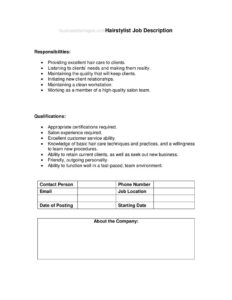
Hairstylist Job Description
Write a clear hairstylist job description with our free template covering responsibilities and qualifications — free download in PDF and DOCX.
PDF
DOCX
0
likes
Download Files
- DOCX
A hairstylist job description is a written document that outlines the duties, skills, and qualifications expected of a hairstylist in a salon or barbershop setting. Salon owners and managers most often use it to attract qualified applicants and set clear expectations before hiring. You can download it free in PDF and DOCX formats — no signup required.
What Is a Hairstylist Job Description?
A hairstylist job description is a structured summary of the role a stylist will fill within a salon, spa, or barbershop. It documents the day-to-day responsibilities the position involves and the qualifications a candidate must have to perform the job well. Salon owners, recruiters, and hiring managers issue it as part of a job posting, an internal role definition, or an employee onboarding packet. The document serves three purposes at once: it markets the opening to potential applicants, it screens out unqualified candidates, and it gives the eventual hire a reference point for what success in the role looks like. A well-written version keeps everyone aligned from the first interview onward.
When Do You Need a Hairstylist Job Description?
You may need a hairstylist job description in a variety of situations across the life of a salon business. Common scenarios include:
- Posting a new opening — when you list a stylist position on a job board, salon website, or social media and need a clear, professional description.
- Expanding your team — when a busy salon adds chairs and wants consistent expectations across multiple new hires.
- Hiring for a specialty — when you need a colorist, men’s grooming specialist, or extension expert and must spell out the specific skills required.
- Replacing a departing stylist — when a chair opens up and you want to refine the role before recruiting a replacement.
- Setting performance standards — when you formalize what existing staff are responsible for during reviews or onboarding.
- Defining a booth-rental or commission role — when the work arrangement affects which duties and qualifications apply.
What a Hairstylist Job Description Should Have
A complete hairstylist job description includes a job title, a short overview of the role, a detailed list of responsibilities, and a clear set of qualifications. The responsibilities section should describe the technical services the stylist performs — cutting, coloring, styling, and treatments — along with client-facing and housekeeping duties. The qualifications section should list required licenses, experience levels, and soft skills. Strong descriptions also note the work environment, schedule expectations, and compensation structure where relevant. The clearer and more specific each element is, the easier it becomes to attract the right candidates and avoid mismatched applications. Use plain, active language and group related duties so the document is easy to scan.
How to Fill Out a Hairstylist Job Description
This template centers on two core sections — Responsibilities and Qualifications. Follow these steps to complete it:
- Add a job title and overview. At the top, name the position (for example, “Senior Hairstylist”) and write one or two sentences summarizing the role and salon.
- List the responsibilities. In the Responsibilities section, write each core duty as a separate bullet: consulting with clients, cutting and styling hair, applying color and treatments, recommending products, maintaining a clean station, and managing bookings.
- Prioritize the duties. Lead with the most important services so applicants quickly understand the focus of the role.
- List the qualifications. In the Qualifications section, specify the required cosmetology license, years of experience, technical skills, and any specialties.
- Add soft skills. Include traits like communication, reliability, and customer service.
- Note logistics. Mention schedule, pay structure, and benefits if you want to include them.
- Review and finalize. Proofread for clarity and accuracy before posting.
Types of Hairstylist Roles to Tailor the Description For
One template can support several variations of the role depending on your salon’s needs. A general stylist handles a broad mix of cuts, colors, and styling for all clients. A colorist focuses on highlights, balayage, corrective color, and toning, so the qualifications should emphasize advanced color training. A barber or men’s grooming specialist concentrates on clipper work, fades, and beard care. A junior or assistant stylist may shampoo, prep clients, and support senior staff while building experience. By adjusting the Responsibilities and Qualifications sections to match the specific role, you communicate exactly what the job involves and avoid attracting applicants whose skills don’t fit. Tailoring the description also helps current employees understand how each role differs within your team.
Tips for Writing a Description That Attracts Talent
To make your posting stand out, describe what makes your salon a desirable place to work — a loyal clientele, ongoing education, a supportive team, or a flexible schedule. Be specific about the compensation model, since stylists weigh commission, hourly pay, and booth rental differently. Use action verbs and keep bullets short so the description reads quickly on a phone. Avoid vague phrases like “team player” without context; instead, tie each quality to a concrete part of the job. Finally, include a clear next step so interested candidates know how to apply, whether that’s emailing a resume or stopping by the salon for a trade test.
Common Mistakes to Avoid
- Being too vague. Listing only “cut and style hair” tells applicants little; spell out the full range of services.
- Omitting license requirements. Always state that a valid cosmetology or barber license is required where applicable.
- Mixing duties and qualifications. Keep responsibilities and required skills in separate sections for clarity.
- Overloading the list. Twenty bullet points overwhelm readers; focus on the essentials.
- Ignoring compensation. Leaving out pay structure leads to wasted interviews with mismatched expectations.
- Forgetting to update it. Reusing an outdated description for a changed role creates confusion and poor hires.
Frequently Asked Questions
What is a hairstylist job description? It is a document that defines the responsibilities and qualifications of a hairstylist position. Salon owners use it to recruit, screen, and onboard candidates, and it gives new hires a clear picture of what the role involves.
How do I fill out this hairstylist job description template? Add a job title and short overview, then complete the two core sections by listing each duty under Responsibilities and each required skill or credential under Qualifications. Keep entries clear and specific, and add schedule or pay details if you wish.
What should I list under qualifications? Include the required cosmetology or barber license, the level of experience you expect, technical skills like cutting and coloring, and any specialties. You can also add soft skills such as strong communication and reliability.
Is a job description a legally binding contract? No, a job description is generally not an employment contract. It describes the role and expectations, but the terms of employment are set out separately in an offer letter or contract.
Does the description need to mention licensing? If your jurisdiction requires a cosmetology or barber license to perform the work, you should state that clearly so only licensed candidates apply. Licensing requirements vary by location, so check your local rules.
How much does this template cost? It is completely free to download from Business Forms Pro in both PDF and DOCX formats, with no signup required. You can edit it freely to match your salon and the specific role you’re hiring for.
This template is a general example provided for informational purposes only and is not legal, financial, or employment advice. Hiring and licensing requirements vary by jurisdiction, so consult a qualified professional before relying on this document.
Official resource: for the rules that apply to your situation, see the U.S. Department of Labor.
Related Forms
- Retail Team Member Job Description
- Catering Assistant Job Description
- Web Developer Job Description
- Canvasser Job Description
- Call Center Operator Job Description
- Controller Job Description
Browse more in Job Descriptions.