
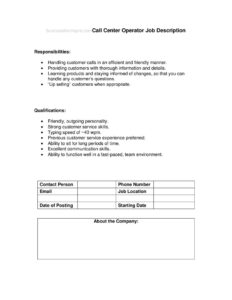
Call Center Operator Job Description
Use this free Call Center Operator Job Description template to attract qualified candidates and define duties clearly — free download in PDF and DOCX.
PDF
DOCX
0
likes
Download Files
- DOCX
A Call Center Operator Job Description is a written document that outlines the duties, skills, and expectations for someone who answers, routes, and resolves customer calls. Employers use it most often to advertise an open role and screen applicants consistently, and it doubles as a reference point for onboarding and performance reviews. This template is free to download in both PDF and DOCX, with no signup required.
What Is a Call Center Operator Job Description?
A Call Center Operator Job Description is a structured summary of a customer-facing telephone role, typically issued by a hiring manager, HR team, or recruiter. It documents the core responsibilities the operator will handle — answering inbound calls, placing outbound calls, logging information, and escalating issues — alongside the qualifications candidates must bring. The document gives applicants a clear picture of what the job involves and gives the employer a benchmark for evaluating fit. In practice it sits at the center of the hiring process: it powers the job posting, shapes interview questions, and later becomes the foundation for setting goals and measuring an operator’s performance once they are hired.
When Do You Need a Call Center Operator Job Description?
This template earns its keep across the full employee lifecycle, not just at the moment of hiring. Common situations include:
- Posting a new opening — when you are advertising on job boards or your careers page and need a clear, professional listing.
- Expanding a support team — when call volume grows and you need to define several identical roles quickly.
- Replacing a departing operator — when you want the new posting to match the role the previous employee actually performed.
- Standardizing expectations — when multiple managers hire operators and you want one consistent definition of the job.
- Onboarding and training — when a new hire needs a written reference for what their day-to-day duties cover.
- Performance reviews — when you need a baseline of responsibilities to evaluate whether an operator is meeting expectations.
Types of Call Center Operator Roles
Although the template uses a single format, you can adapt it to the specific role you are filling. Inbound operators primarily receive calls — handling questions, complaints, and service requests. Outbound operators place calls for sales, surveys, appointment reminders, or collections. Blended operators do both. There are also tiers: a frontline operator resolves routine matters, while a senior or escalation operator handles complex or sensitive calls. Tailoring the Responsibilities and Qualifications sections to one of these variants makes your posting far more accurate and attracts the right candidates.
What a Call Center Operator Job Description Should Have
A complete job description balances enough detail to be useful with enough brevity to stay readable. At minimum it should include a clear job title, a short summary of the role’s purpose, a focused list of responsibilities written as action statements, and a list of required and preferred qualifications. Strong versions also note the reporting line, work schedule or shift structure, location or remote status, and any physical or technical requirements such as extended periods of seated phone work or familiarity with a specific CRM. Keeping the language concrete — “resolve customer billing questions” rather than “handle issues” — helps candidates self-select and reduces unqualified applications.
How to Fill Out a Call Center Operator Job Description
The template centers on two headed sections — Responsibilities and Qualifications — so most of your work is filling each with specific, role-accurate bullet points.
- Add the job title and summary at the top, e.g. “Call Center Operator” followed by one or two sentences describing the role’s purpose.
- Complete the Responsibilities section with action-led bullets: answering inbound calls, making outbound calls, identifying customer needs, logging call details, processing orders or requests, and escalating complex issues.
- Add daily and operational duties such as following call scripts, meeting handle-time or quality targets, and updating customer records in the system.
- Complete the Qualifications section with education (often a high school diploma or equivalent), required experience, and core skills like clear verbal communication, active listening, and patience.
- List preferred qualifications separately — bilingual ability, prior call center experience, or familiarity with specific software.
- Note logistics like shift availability, schedule, and reporting manager so candidates know what to expect.
- Review and trim so every line is true to the role you are actually hiring for.
Writing Responsibilities and Qualifications That Work
The strength of this document lives in how you write its two sections. For Responsibilities, start each line with a verb and describe an observable task; aim for six to ten bullets so the role feels defined but not overwhelming. Group related duties — call handling, documentation, and teamwork — so the list reads logically. For Qualifications, separate must-haves from nice-to-haves. Over-listing requirements can deter strong candidates who meet most criteria, so be honest about what is truly essential. Focus on transferable skills like composure under pressure and clear speech, which often predict success in this role better than a long résumé.
Common Mistakes to Avoid
- Vague responsibilities — bullets like “handle calls” tell candidates little; specify what kinds of calls and outcomes.
- Listing too many requirements — an inflated qualifications list discourages qualified applicants from applying.
- Ignoring the schedule — failing to mention shifts, weekends, or holidays leads to mismatched expectations and turnover.
- Mixing inbound and outbound without clarity — be explicit about which the role involves.
- Copying a generic template verbatim — leaving placeholder language makes the posting look careless.
- Using exclusionary or biased wording — keep language neutral and focused on job-related abilities.
Frequently Asked Questions
What does a call center operator do? A call center operator answers inbound calls and may also place outbound calls to assist customers, resolve issues, provide information, and log interactions. The exact mix of duties depends on whether the role is inbound, outbound, or blended, which you should specify in the Responsibilities section.
How do I fill out this job description template? Add a job title and short summary, then complete the Responsibilities section with clear action-led bullets and the Qualifications section with required and preferred skills. Tailor every line to the specific role and include schedule and reporting details so candidates know what to expect.
What qualifications should a call center operator have? Common requirements include a high school diploma or equivalent, strong verbal communication, active listening, patience, and basic computer skills. Preferred qualifications might include prior call center experience, bilingual ability, or familiarity with a specific CRM system.
Is a job description a legally binding contract? A job description is generally a descriptive document rather than an employment contract, but wording can carry legal weight depending on jurisdiction and how it is used. To keep expectations clear, many employers note that duties may evolve and consult HR or legal counsel when needed.
How long should the job description be? Aim for a concise, scannable document — typically a single page. Six to ten responsibilities and a focused qualifications list usually give candidates enough detail without overwhelming them.
How much does this template cost? Nothing. You can download the Call Center Operator Job Description free in PDF and DOCX directly from Business Forms Pro, with no signup or payment required.
This template is a general example provided for informational purposes only and is not legal, HR, or employment advice. Employment requirements and disclosure rules vary by jurisdiction, so consult a qualified professional before finalizing any hiring document.
Official resource: for the rules that apply to your situation, see the U.S. Department of Labor.
Related Forms
- Childcare Provider Job Description
- Delivery Driver Job Description
- Landscaper Job Description
- Website Designer Job Description
- Software Engineer Job Description
- Quality Assurance Engineer Job Description
Browse more in Job Descriptions.