
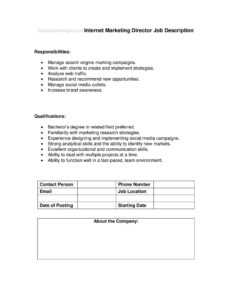
Internet Marketing Director Job Description
Download a free Internet Marketing Director job description template to define responsibilities and qualifications and hire faster with this free template.
PDF
DOCX
0
likes
Download Files
- DOCX
An Internet Marketing Director job description is a structured document that defines the responsibilities and qualifications for the senior leader who oversees a company’s online marketing strategy. Hiring managers and HR teams use it most often to attract qualified candidates and set clear expectations before posting a role or making an offer. You can download this template free in PDF and DOCX formats, with no signup required.
What Is an Internet Marketing Director Job Description?
An Internet Marketing Director job description is a hiring and role-definition document that outlines what a digital marketing leader is expected to do and what background they need to succeed. It is typically issued by a company’s human resources department, a hiring manager, or a recruiter. The document captures the position’s core duties — covering areas like SEO, paid advertising, email, social media, content, and analytics — alongside the skills, education, and experience required. Beyond recruiting, a well-written job description also supports performance reviews, compensation benchmarking, and internal clarity about where the marketing function reports and how it measures success. With this template’s Responsibilities and Qualifications sections, you can build a complete, professional posting quickly.
When Do You Need an Internet Marketing Director Job Description?
This document is useful at several points in the hiring and management lifecycle, not just when a role is empty. Consider using it in these situations:
- Posting a new role: You are expanding the marketing team and need a clear job ad to publish on job boards, your careers page, or LinkedIn.
- Replacing a departing leader: Your current marketing director is leaving and you want to capture the role accurately before recruiting a successor.
- Promoting from within: You are elevating a marketing manager and need to formalize the expanded scope and expectations of the director title.
- Restructuring the marketing function: A reorganization shifts digital responsibilities, and you need an updated definition of who owns what.
- Conducting performance reviews: Managers reference the documented responsibilities to evaluate whether goals and duties are being met.
- Benchmarking compensation: HR uses the qualifications and scope to compare the role against market salary data.
What an Internet Marketing Director Job Description Should Have
A strong job description balances clarity with completeness. While this template centers on two core sections, a finished posting should typically include the following elements:
- Job title and reporting line: The exact title and who the role reports to, such as a CMO or VP of Marketing.
- Position summary: A short overview of the role’s purpose and impact.
- Responsibilities: A detailed list of day-to-day and strategic duties across digital channels.
- Qualifications: Required and preferred education, experience, certifications, and skills.
- Performance metrics: The outcomes the role is accountable for, like lead growth, ROAS, or conversion rates.
- Logistics: Location, employment type, travel expectations, and any salary range if disclosed.
How to Fill Out an Internet Marketing Director Job Description
This template provides two primary fields — Responsibilities and Qualifications — that you customize to your company. Follow these steps:
- Add a header: At the top, enter the job title, your company name, the department, and the reporting relationship.
- Write a brief summary: Open with one or two sentences describing the role’s mission and how it fits your marketing goals.
- Complete the Responsibilities field: List the duties as bullet points. Cover strategy ownership, SEO and SEM, paid media budgets, email and social campaigns, content direction, web analytics, team leadership, and cross-department collaboration.
- Complete the Qualifications field: Specify required years of digital marketing experience, leadership background, relevant degrees, technical tool proficiency (such as Google Analytics or ad platforms), and any preferred certifications.
- Add logistics: Note location, full-time or contract status, and benefits.
- Review and finalize: Proofread for clarity, remove jargon, and confirm the duties match the seniority of a director-level hire.
Writing Responsibilities That Attract the Right Candidates
The Responsibilities section does the heaviest lifting in this document, so make each line action-oriented and outcome-focused. Strong directors want to know whether they will own strategy or simply execute, so be explicit about scope. Mention the channels they will lead — organic search, paid acquisition, marketing automation, social, and content — and whether they manage a team, a budget, or external agencies. Tie duties to measurable goals where possible, such as growing qualified leads or improving customer acquisition cost. Avoid an endless wish list; a focused set of eight to twelve meaningful responsibilities reads as a real role rather than a catch-all. Group related tasks together so candidates can quickly picture a typical week.
Setting Realistic Qualifications
The Qualifications field shapes who applies, so distinguish between must-haves and nice-to-haves. Listing too many hard requirements can scare off strong candidates, while too few attracts unqualified applicants. For a director-level position, it is reasonable to require several years of digital marketing experience, demonstrated leadership, and proficiency with core analytics and advertising tools. Treat advanced degrees and niche certifications as preferred rather than mandatory unless they are truly essential. Focusing on skills and demonstrated results — rather than rigid pedigree — typically widens your candidate pool and improves the quality of applicants.
Common Mistakes to Avoid
- Confusing director with manager duties: A director should own strategy and leadership, not just tactical execution — keep the responsibilities at the right altitude.
- Overloading the requirements: Demanding too many years of experience or too many specific tools narrows your pool unnecessarily.
- Vague responsibilities: Lines like “handle marketing” tell candidates nothing; be specific about channels and outcomes.
- Ignoring measurable goals: Without metrics, candidates cannot judge whether they can succeed in the role.
- Copying a generic template verbatim: Failing to tailor the duties to your actual business makes the posting feel impersonal.
- Leaving out reporting and logistics: Omitting who the role reports to or whether it is remote creates confusion and extra back-and-forth.
Frequently Asked Questions
What does an Internet Marketing Director do? An Internet Marketing Director leads a company’s overall digital marketing strategy, including SEO, paid advertising, email, social media, content, and analytics. They typically manage a team and a budget while reporting to senior leadership. Their goal is to drive measurable online growth such as leads, traffic, and revenue.
How do I fill out this job description template? Start by adding your company name, the job title, and reporting line at the top, then complete the Responsibilities and Qualifications sections with bullet points tailored to your needs. List strategic duties and required experience separately, and finish with logistics like location and employment type. The DOCX version is fully editable so you can adjust every field.
Is this template free to download? Yes. This Internet Marketing Director job description template is completely free to download in both PDF and DOCX formats, and no signup or account is required. You can edit it as many times as you need for different roles.
What’s the difference between a marketing director and a marketing manager? A director sets overall strategy, owns the budget, and leads multiple managers or teams, while a manager focuses more on executing specific campaigns and tactics. Director-level qualifications usually require more years of experience and proven leadership. Reflect this distinction clearly in the responsibilities you list.
Should I include a salary range? Including a salary range is increasingly expected and is legally required in some locations. Even where it is optional, listing a range can attract more applicants and reduce wasted interviews. Check your local pay-transparency rules before posting.
Can I use this for a remote or contract position? Absolutely. The template is flexible — simply note in the logistics section whether the role is remote, hybrid, or on-site, and whether it is full-time, part-time, or contract. Adjust the responsibilities and qualifications to match the scope you need.
This template is a general example provided for informational purposes only and is not legal, HR, or employment advice. Hiring and employment requirements vary by jurisdiction and by company. Consult a qualified HR or legal professional to ensure your job descriptions and postings comply with applicable laws.
Official resource: for the rules that apply to your situation, see the U.S. Department of Labor.
Related Forms
- Finance Manager Job Description
- Quality Assurance Engineer Job Description
- Fitness Instructor Job Description
- Canvasser Job Description
- Personal Assistant Job Description
- Teacher Job Description
Browse more in Job Descriptions.