
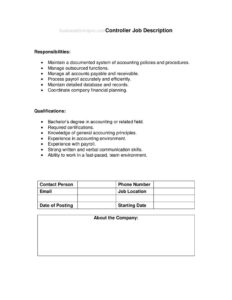
Controller Job Description
Download a free Controller job description template in PDF and DOCX to define responsibilities, qualifications, and hiring criteria for your finance team.
PDF
DOCX
0
likes
Download Files
- DOCX
A Controller job description is a document that defines the duties, responsibilities, and qualifications of a financial controller within an organization. Companies most often use it to recruit and hire a controller, set clear expectations for the role, and align the finance function with leadership goals. You can download this template free in PDF and DOCX formats — no signup required.
What Is a Controller Job Description?
A Controller job description is a structured outline that explains what a financial controller does and what an employer expects from candidates. Typically issued by a hiring manager, HR department, or CFO, it documents the core responsibilities of overseeing accounting operations, financial reporting, internal controls, and compliance, alongside the qualifications a strong applicant should bring. The document serves two audiences at once: job seekers who want to understand the role before applying, and internal stakeholders who need a consistent benchmark for performance reviews and compensation. By spelling out duties and requirements in plain language, it reduces hiring confusion and helps attract candidates who genuinely match the position’s demands.
When Do You Need a Controller Job Description?
This template is useful any time a business needs to formalize the controller role. Common situations include:
- Recruiting a new controller — posting an opening on job boards, your careers page, or with a recruiter and needing a clear, professional listing.
- Replacing a departing controller — capturing the role’s true scope so the next hire steps into well-defined responsibilities.
- Growing the finance team — a startup or expanding company that has outgrown a bookkeeper and now needs senior accounting oversight.
- Restructuring reporting lines — clarifying how the controller relates to the CFO, accounting staff, and external auditors.
- Conducting performance reviews — measuring an existing controller against documented expectations.
- Setting compensation bands — HR using the listed qualifications and duties to benchmark salary fairly against the market.
What a Controller Job Description Should Have
A complete controller job description balances two essential sections: Responsibilities and Qualifications. The responsibilities section should describe the day-to-day and strategic work — managing the general ledger, producing financial statements, overseeing month-end and year-end close, maintaining internal controls, supervising accounting staff, and supporting budgets and audits. The qualifications section should list education (often a degree in accounting or finance), professional credentials such as CPA or CMA, years of experience, software proficiency, and key competencies like leadership and attention to detail. Beyond these two core blocks, a strong listing usually adds a brief job summary, the reporting relationship, employment type, and a closing line about how to apply. Clarity and specificity matter more than length.
How to Fill Out a Controller Job Description
This template centers on two flexible fields — Responsibilities and Qualifications — that you customize for your organization. Follow these steps:
- Add a job title and summary. Above the main fields, confirm the title (Controller, Financial Controller, or Corporate Controller) and write a one-to-two sentence overview of the role’s purpose.
- Complete the Responsibilities field. List the controller’s core duties as bullet points: overseeing daily accounting operations, preparing accurate monthly and annual financial statements, managing the close process, ensuring GAAP compliance, coordinating audits and tax filings, and supervising the accounting team.
- Specify financial oversight tasks. Include budgeting, forecasting, cash flow management, and internal control design where relevant to your company.
- Complete the Qualifications field. State required education, certifications (CPA/CMA), minimum years of experience, ERP or accounting software skills, and soft skills like communication and leadership.
- Note the reporting structure. Indicate who the controller reports to and which roles report to them.
- Add logistics and a call to action. Include location, employment type, and how candidates should apply, then proofread before publishing.
Tailoring the Description to Your Company Size
The controller role varies widely depending on organization size, so adjust the template accordingly. In a small business, a controller may handle hands-on bookkeeping, payroll, and reporting personally, making practical software skills and versatility the priority. In a mid-sized company, the role leans toward supervising a small accounting team and standardizing processes. In a large enterprise, the controller is more strategic — overseeing multiple departments, managing complex consolidations, and partnering directly with the CFO. Edit the Responsibilities and Qualifications sections to match the seniority and scope you actually need. Listing duties that belong to a CFO or a junior bookkeeper will either scare off qualified applicants or attract a mismatch, so keep the description anchored to the real day-to-day work of the position you’re filling.
Controller vs. Related Finance Roles
It helps to distinguish the controller from neighboring positions when writing the description. A bookkeeper records transactions; a staff accountant handles specific accounting tasks; a controller owns the entire accounting function and the accuracy of financial reporting; and a CFO focuses on financial strategy, fundraising, and investor relations. Confusing these roles in a job description leads to misaligned expectations and compensation. Make clear in your listing that the controller is a senior, hands-on leader of accounting operations rather than a transaction-level employee or a purely strategic executive. This clarity also helps candidates self-select and improves the quality of your applicant pool.
Common Mistakes to Avoid
- Vague responsibilities — listing “manage finances” instead of concrete duties like “lead the monthly close and produce financial statements.”
- Overloading qualifications — demanding a CPA, MBA, and 15 years of experience for a small-business role you can’t compensate at that level.
- Ignoring the reporting line — leaving candidates unsure whether they report to a CFO, owner, or board.
- Copying a generic template verbatim — failing to reflect your industry, software stack, or company size.
- Mixing up roles — describing CFO strategy work or junior bookkeeping tasks under the controller title.
- Forgetting a call to action — omitting how and where to apply, which lowers response rates.
Frequently Asked Questions
What does a financial controller do? A controller oversees an organization’s accounting operations, including the general ledger, financial statement preparation, the month-end and year-end close, internal controls, and compliance. They often supervise accounting staff and coordinate audits and tax filings. The exact mix of duties depends on company size and structure.
How do I fill out this Controller job description template? Add a job title and short summary, then complete the Responsibilities field with concrete duties and the Qualifications field with required education, certifications, experience, and skills. Adjust the wording to match your company’s size and reporting structure, then add application instructions before posting.
What qualifications should a controller have? Most controller roles require a bachelor’s degree in accounting or finance and several years of progressive accounting experience. A CPA or CMA credential is commonly preferred, along with proficiency in accounting or ERP software and proven leadership skills. Tailor these requirements to the seniority your organization needs.
Is a job description a legally binding document? A job description is generally a guideline rather than a binding contract, though it can support hiring, performance, and compliance decisions. Employment laws and at-will rules vary by jurisdiction. If you have concerns about how a description ties into employment agreements, consult an HR or legal professional.
What’s the difference between a controller and a CFO? A controller focuses on accurate accounting, reporting, and controls — the operational backbone of finance. A CFO concentrates on financial strategy, capital, forecasting, and investor or board relations. In smaller companies one person may wear both hats, but the roles are distinct in larger organizations.
How much does this template cost? This Controller job description template is completely free to download from Business Forms Pro in both PDF and DOCX formats, with no signup required. You can edit it freely to fit your company and reuse it for future openings.
This Controller job description template is a general example provided for informational purposes only and does not constitute legal, financial, HR, or tax advice. Employment requirements and regulations vary by jurisdiction. Consult a qualified professional before using this document for hiring or employment decisions.
Official resource: for the rules that apply to your situation, see the U.S. Department of Labor.
Related Forms
- Bartender Job Description
- Childcare Provider Job Description
- HR Specialist Job Description
- Car Salesperson Job Description
- Secretary Job Description
- Restaurant Manager Job Description
Browse more in Job Descriptions.