
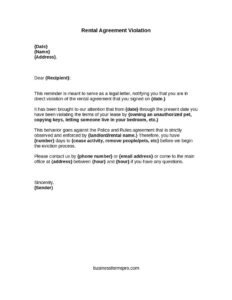
Rental Agreement Violation
Download a free Rental Agreement Violation letter template in PDF and DOCX to formally notify tenants of a lease breach and request prompt correction.
DOCX
0
likes
Download Files
- DOCX
A Rental Agreement Violation letter is a written notice a landlord or property manager sends to a tenant to formally document that the tenant has breached one or more terms of their signed lease. People most often use it to give a tenant clear, dated warning of a problem — like an unauthorized pet or unapproved occupant — and a deadline to fix it before eviction steps begin. You can download this template free in PDF and DOCX, with no signup required.
What Is a Rental Agreement Violation Letter?
A Rental Agreement Violation letter is a formal notice issued by a landlord, property owner, or management company to a tenant who has broken a condition of their lease. It identifies the specific rule that was violated, references the original signed rental agreement, and states what the tenant must do to come back into compliance. The letter creates a paper trail showing the tenant was notified and given an opportunity to correct the issue. While it is not a court document, a clearly written violation notice is often a required first step before a landlord can pursue eviction. It functions as both a reminder and a legal record that the problem was communicated in writing.
When Do You Need a Rental Agreement Violation Letter?
Landlords reach for this letter whenever a tenant’s conduct breaks a clearly stated term of the lease. Common situations include:
- Unauthorized pets — a tenant keeps a dog, cat, or other animal that the lease prohibits or that was never approved in writing.
- Unapproved occupants — someone is living in the unit who is not named on the lease, such as a partner, relative, or subletter staying long-term.
- Copying or sharing keys — the tenant duplicates keys or gives access to others in violation of the security terms.
- Noise, nuisance, or rules violations — repeated complaints about disturbances, smoking in a non-smoking unit, or improper use of common areas.
- Property damage or alterations — unauthorized painting, structural changes, or neglect that breaches the maintenance clause.
- Business or illegal activity — running a commercial operation from a residential unit, or activity that violates the policies and rules agreement.
What a Rental Agreement Violation Letter Should Have
For the notice to be effective and defensible, it should clearly include several core elements. Start with the date the letter is issued and the tenant’s full name and address. Reference the date the original lease was signed so there is no doubt about which agreement applies. Describe the specific violation in plain, factual language, and state the time period during which the behavior occurred. Cite the policy or rules section being broken. Then give a clear cure period — the number of days the tenant has to fix the problem — and state the consequence if they fail to act. Finally, include contact information and office hours so the tenant can respond or ask questions.
How to Fill Out a Rental Agreement Violation Letter
- Date: Enter the date you are sending the letter at the top, in the {Date} field.
- Tenant details: Fill in the tenant’s {Name} and {Address} so the notice clearly identifies who is receiving it.
- Salutation: Address the tenant in the {Recipient} line, using their name.
- Lease reference: In the {date} field, enter the date the tenant signed the rental agreement being violated.
- Violation period: State the {date} through the present that the conduct has been occurring, establishing a timeline.
- Describe the violation: Replace the example text (owning an unauthorized pet, copying keys, letting someone live in your bedroom, etc.) with the exact breach that applies.
- Identify the policy: Insert your {landlord/rental name} where the policies and rules agreement is referenced.
- Cure period: Enter the {number} of days the tenant has and what they must do (cease activity, remove people/pets, etc.).
- Contact info: Add your {phone number}, {email address}, office {address}, and the {hour} to {hour} window for questions.
- Signature: Sign as the {Sender}.
How to Deliver the Notice Properly
How you deliver the letter can matter as much as what it says. Many landlords send the notice by certified mail with return receipt requested so they have proof the tenant received it, while others deliver it in person or post it on the unit door where local rules allow. Keep a dated copy of the letter and any delivery confirmation in your tenant file. If the matter later moves toward eviction, this documentation shows a court that you notified the tenant and offered a chance to correct the problem. The number of days you grant should comply with whatever your local landlord-tenant rules require for a cure-or-quit notice.
Cure Notice vs. Eviction
This letter is generally a cure notice — it warns the tenant and gives them a deadline to fix the violation before further action. It is not itself an eviction. Eviction is a separate court-supervised process that typically cannot begin until the cure period has passed and the tenant has failed to comply. Sending a clear violation letter first demonstrates good faith and is often a legal prerequisite. If the tenant corrects the issue within the stated window, the matter usually ends there, and no eviction is needed.
Common Mistakes to Avoid
- Being vague about the violation — “you broke the rules” is too general; name the exact conduct and lease term.
- Leaving out the cure deadline — failing to state the number of days and what must change weakens the notice.
- Forgetting the lease signing date — without it, the tenant can claim uncertainty about which agreement applies.
- Using an unrealistic deadline — giving fewer days than local rules require can invalidate the notice.
- Skipping proof of delivery — not keeping a copy or delivery record leaves you without evidence later.
- Threatening language — keep the tone factual and professional; intimidation can undermine your position.
Frequently Asked Questions
What is a Rental Agreement Violation letter? It is a formal written notice from a landlord telling a tenant that they have broken a specific term of their lease. The letter documents the violation, references the signed agreement, and gives the tenant a deadline to correct the problem before further action such as eviction.
How do I fill out the violation letter? Enter the date, the tenant’s name and address, and the date the lease was signed. Then describe the exact violation and the dates it occurred, state the number of days to fix it, and add your contact details before signing as the sender.
Does this letter need to be notarized or witnessed? A Rental Agreement Violation letter typically does not require notarization or witnesses. What matters most is that it is clearly written, dated, and delivered in a way you can prove, such as certified mail or personal delivery, depending on your local rules.
Is a Rental Agreement Violation letter legally binding? The letter itself is a notice, not a contract, but it can carry legal weight as documentation that you formally notified the tenant. It is often a required first step before pursuing eviction, so following your local notice requirements is important.
How many days should I give the tenant to fix the violation? The cure period depends on your local landlord-tenant rules and the nature of the violation. The template lets you fill in the number of days; choose a deadline that meets or exceeds the minimum your jurisdiction requires.
How much does this template cost? This Rental Agreement Violation letter template is completely free to download from Business Forms Pro in both PDF and DOCX formats. There is no signup required, and you can edit it to fit your property and the specific violation.
This template is a general example provided for informational purposes only and is not legal advice. Landlord-tenant laws and notice requirements vary by jurisdiction, so consult a qualified attorney or local housing authority before relying on this document.
Official resource: for the rules that apply to your situation, see HUD.
Related Forms
- 30-Day Notice to Landlord
- Eviction Notice Letter
- Request for Tenant Repairs
- Landlord Proof of Residency
- Tenant Utilities Increase Letter
- Notice of Lease Termination
Browse more in Landlord Documents.