
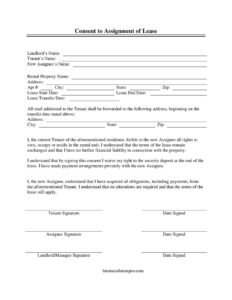
Consent To Assignment Of Lease
Use our free Consent to Assignment of Lease template to legally transfer a lease from an existing tenant to a new assignee — free PDF and DOCX download.
PDF
DOCX
4 downloads
1
likes
Download Files
- DOCX
A Consent to Assignment of Lease is a document in which a landlord formally approves the transfer of an existing lease from the current tenant to a new assignee who takes over the remaining term. People most often use it when a tenant needs to move out before the lease ends and has found someone willing to assume the agreement. You can download this template free in PDF and DOCX, with no signup required.
What Is a Consent to Assignment of Lease?
A Consent to Assignment of Lease is a written agreement signed by three parties — the existing tenant, the new assignee, and the landlord or property manager — that documents the landlord’s approval of a lease transfer. Unlike a sublease, where the original tenant remains responsible, an assignment with this consent typically releases the outgoing tenant from further obligation, transferring all rights and duties to the assignee. It records who is leaving, who is taking over, the property involved, and the key dates of the lease. Because most leases require the landlord’s written permission before any transfer, this form is the official record that consent was granted and that everyone understood the new arrangement.
When Do You Need a Consent to Assignment of Lease?
This form comes into play whenever a current tenant wants someone else to take over their lease with the landlord’s blessing. Common situations include:
- Relocation for work: a tenant accepts a job in another city and must leave before the lease term ends.
- Roommate changes: one occupant moves out and a new person assumes the full lease in their place.
- Financial hardship: a tenant can no longer afford the rent and finds a qualified assignee to take over payments.
- Buying a home: a renter who purchases property needs to exit an apartment lease cleanly.
- Business or personal life changes: marriage, family needs, or a return to school prompts an early move.
- Landlord-approved transfers: the landlord prefers a documented assignment over a broken lease and lost rent.
What a Consent to Assignment of Lease Should Have
A complete and useful consent form identifies all three parties clearly and ties them to a specific rental unit and lease term. It should state the landlord’s name, the outgoing tenant’s name, and the new assignee’s name. It must describe the property by name and full address, including apartment number, city, state, and ZIP. Crucial dates — lease start, lease end, and the transfer (assignment) date — anchor the agreement in time. The form should spell out that the outgoing tenant forfeits rights to occupy the unit and is released from financial liability, that the assignee accepts all obligations, and how the security deposit is handled. Finally, dated signatures from the tenant, assignee, and landlord/manager make the consent binding.
How to Fill Out a Consent to Assignment of Lease
- Enter the Landlord’s Name, the current Tenant’s Name, and the New Assignee’s Name so all three parties are clearly identified.
- Fill in the Rental Property Name and the complete Address, including Apt #, City, State, and Zip.
- Record the original Lease Start Date and Lease End Date exactly as they appear in the existing lease.
- Enter the Lease Transfer Date — the day the assignee assumes responsibility for the unit.
- Provide the tenant’s forwarding address (Address, City, State, Zip) so mail can be redirected starting on the transfer date.
- Have the outgoing tenant review the statement confirming they forfeit occupancy rights, have no further financial liability, and waive their claim to the security deposit, having arranged any private payment with the assignee.
- Have the assignee review the statement confirming they accept all obligations and that the lease terms remain unchanged.
- Collect three sets of signatures and dates: the Tenant Signature, the Assignee Signature, and the Landlord/Manager Signature.
Assignment vs. Sublease: Know the Difference
It’s easy to confuse an assignment with a sublease, but they work differently. In a sublease, the original tenant stays on the hook — they remain the landlord’s primary contact and are still liable if the subtenant fails to pay. In an assignment, the new assignee steps fully into the original tenant’s shoes, taking on all rights and obligations, and the outgoing tenant is typically released from liability. This template reflects an assignment: it states the tenant has “no further financial liability” and that the assignee “acquired all obligations.” Because this release of liability is significant, both parties should be certain the form matches their intent before signing.
Handling the Security Deposit
One detail that trips people up is the security deposit. This template specifies that the outgoing tenant waives their right to the deposit at lease end and has made private payment arrangements with the assignee. In practice, this usually means the assignee reimburses the original tenant for the deposit directly, then becomes entitled to its return when the lease eventually concludes. Document that private reimbursement separately so both parties have a record. Confirm with the landlord whether the deposit stays on file under the same account or is formally transferred to the assignee’s name.
Common Mistakes to Avoid
- Skipping landlord signature: without the landlord or manager signing, there is no valid consent and the transfer may breach the lease.
- Leaving the transfer date blank: this date determines when liability and occupancy shift; an empty field creates disputes.
- Forgetting the forwarding address: the tenant may miss important notices or a deposit refund without it.
- Not clarifying the security deposit: failing to document the private reimbursement leads to arguments later.
- Using vague names: use full legal names matching the original lease and government ID.
- Not keeping copies: each of the three parties should retain a signed copy for their records.
Frequently Asked Questions
What is a Consent to Assignment of Lease used for? It is used to document a landlord’s approval when a current tenant transfers their lease to a new assignee. The form releases the outgoing tenant from future obligations and confirms the assignee accepts all remaining lease terms. It protects all three parties by putting the arrangement in writing.
Does this form need to be notarized or witnessed? Most residential lease assignments do not require notarization to be effective, since the three signatures generally suffice. However, requirements vary by state and by the terms of the original lease, so check your local rules. If you want extra protection, having signatures notarized is never a bad idea.
Is a Consent to Assignment of Lease legally binding? Once all three parties — tenant, assignee, and landlord or manager — sign and date the form, it generally creates a binding agreement. It should be read alongside the original lease, whose terms remain unchanged. For complex or high-value tenancies, consider having an attorney review it first.
What happens to the security deposit? Under this template, the outgoing tenant waives their right to the deposit and arranges private reimbursement with the assignee. The assignee then typically becomes entitled to the deposit when the lease ends. Always document the reimbursement separately and confirm the arrangement with the landlord.
How is this different from subletting? With a sublease, the original tenant stays responsible to the landlord, while with an assignment the assignee takes over completely and the original tenant is released. This form is an assignment, so the outgoing tenant has no further financial liability. Choose the document that matches your actual intent.
How much does this template cost? This Consent to Assignment of Lease template is completely free to download from Business Forms Pro in both PDF and DOCX formats. There is no signup, subscription, or hidden fee. You can edit the DOCX version to fit your specific rental situation.
This template is a general example provided for informational purposes only and is not legal advice. Landlord-tenant laws and lease assignment requirements vary by jurisdiction, and individual lease agreements may impose their own conditions. Consult a qualified attorney or licensed professional before relying on this document.
Official resource: for the rules that apply to your situation, see HUD.
Related Forms
- Tenant Repair Deductible
- Tenant Lease Breaking Request Letter
- Request for Landlord Repairs
- Unauthorized Pet Notice
- Room Rental Agreement
- Notice Of Intent To Enter Dwelling
Browse more in Landlord Documents.