
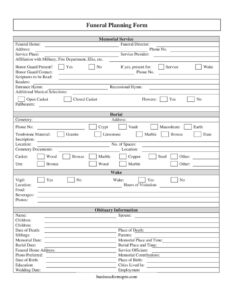
Funeral Planning Form
Organize memorial services, burial details, and obituary notes with this free Funeral Planning Form template, available as a free download in PDF and DOCX.
PDF
DOCX
7 downloads
0
likes
Download Files
- DOCX
A Funeral Planning Form is a single worksheet that gathers every detail needed to arrange a memorial service, wake, burial, and obituary in one place. Most people use it to record their own end-of-life wishes in advance, or to help a grieving family coordinate decisions with a funeral home quickly. It’s free to download here in both PDF and DOCX formats, with no signup required.
What Is a Funeral Planning Form?
A Funeral Planning Form is an organizational document used by individuals planning ahead, family members handling arrangements, or funeral directors collecting service information. It captures the practical and personal choices that go into a funeral, from the service location and presiding clergy to casket type, cemetery details, music selections, and obituary facts. Rather than scattering decisions across phone calls, notes, and memory, the form consolidates everything into one reference that anyone helping with the arrangements can follow. It is not a legal will or contract, but it serves as a clear roadmap that reduces stress, prevents overlooked details, and ensures the deceased’s preferences are honored during an emotional time.
When Do You Need a Funeral Planning Form?
This form is useful in a range of situations, whether you are planning ahead or responding to a recent loss:
- Pre-planning your own arrangements so loved ones aren’t left guessing about your wishes for the service, music, or burial.
- Coordinating with a funeral home after a death, providing the director with the funeral home address, service place, and contact details in one handoff.
- Organizing a military or organizational honor guard when the deceased had an affiliation with the military, a fire department, the Elks, or a similar group.
- Writing the obituary by collecting names of the spouse, children, siblings, parents, dates, and biographical milestones in advance.
- Choosing between burial and cremation and recording the casket, urn, crypt, vault, or earth-burial preference.
- Arranging a wake or vigil with visitation hours, food, beverages, and photo displays planned ahead of time.
What a Funeral Planning Form Should Have
A complete Funeral Planning Form should cover four broad areas: the memorial service (funeral home, director, presider, scriptures, hymns, casket choice, pallbearers, flowers), the burial or interment (cemetery, plot location, tombstone material and inscription, crypt or earth, casket or urn), the wake or vigil (location, visitation hours, food, beverages, photos), and the obituary information (full biographical and family details). It should also list contact numbers and addresses for everyone involved, so the family can act on the plan without hunting for information. The more specific each entry, the easier the arrangements become.
How to Fill Out a Funeral Planning Form
- Begin with the Memorial Service section: enter the funeral home name, funeral director, address, and phone number.
- Record the service place and service presider, and note any affiliation with the military, fire department, Elks, or other group.
- Indicate whether an honor guard will be present, whether for the service or wake, and add the honor guard contact and phone number.
- List the scriptures to be read and their readers, then the entrance hymn, recessional hymn, and any additional musical selections.
- Choose open or closed casket, whether flowers are wanted, and name the pallbearers.
- Complete the Burial section: cemetery name, address, phone, interment type (crypt, vault, mausoleum, or earth), tombstone material, inscription, plot location, and number of spaces.
- Specify the casket material or, for cremation, the urn material, and note where cemetery documents are stored.
- Fill the Wake details, then the full obituary information: name, family members, dates, places, education, and employment.
Burial, Cremation, and Interment Choices
This form accommodates both burial and cremation, so take care to complete only the relevant fields. For traditional burial, select the casket material (wood, bronze, marble, copper, steel, or other), the cemetery, and the interment method — a crypt, vault, mausoleum, or earth burial — along with the tombstone material such as granite, limestone, marble, bronze, or slate. Record the exact inscription wording and double-check the spelling of names and dates before it is engraved, since corrections are costly. If cremation is preferred, use the urn field instead and note the urn material. The number of spaces and cemetery documents location fields matter for families who own multiple plots or pre-purchased property, as the paperwork can be difficult to locate later.
Building the Obituary and Memorial Notice
The obituary section turns scattered memories into a publishable notice. Gather the full name, spouse, children, siblings, and parents, along with date and place of death, date and place of birth, education, cities lived in, wedding date, and employment history. Note the preferred photo and where memorial contributions should be directed. Listing the memorial date, place, and time plus the burial date, place, and time gives newspapers and online platforms everything they need. Completing this section in advance spares the family from reconstructing a life story under emotional pressure.
Common Mistakes to Avoid
- Leaving contact details blank — without the funeral home and cemetery phone numbers, the family loses time chasing information.
- Misspelling names or dates in the inscription or obituary, which leads to permanent engraving errors or printed corrections.
- Forgetting to note where cemetery documents are kept, leaving heirs unable to prove plot ownership.
- Filling out both burial and cremation fields when only one applies, creating confusion for the funeral director.
- Skipping the honor guard contact for veterans or members of fraternal organizations who are entitled to a ceremony.
- Storing the completed form where no one can find it — tell a trusted family member or executor exactly where it is.
Frequently Asked Questions
What is a Funeral Planning Form used for? It is used to organize every detail of a funeral, wake, burial, and obituary in one document. People complete it to record their own wishes ahead of time or to help family members coordinate arrangements with a funeral home after a death.
Is a Funeral Planning Form legally binding? No, this form is a planning and organizational tool, not a legal contract or a will. It expresses preferences and gathers information, but it does not by itself create binding obligations; for legally enforceable directives, consult an attorney about a will or advance directive.
Do I need to sign or notarize this form? Notarization is generally not required because the form is informational rather than legal. However, signing and dating it, and sharing it with a trusted family member or executor, helps confirm that it reflects your current wishes.
How do I fill out the obituary section? Gather the full name, spouse, children, siblings, parents, dates and places of birth and death, education, employment, and cities lived in. Add a preferred photo and a note about memorial contributions so the family or newspaper has a complete, ready-to-publish summary.
Can I use this form for cremation instead of burial? Yes. Skip the casket and cemetery plot fields if they do not apply and instead complete the urn material field, then record the memorial date, place, and time for any service you wish to hold.
How much does this Funeral Planning Form cost? The template is completely free to download here in both PDF and DOCX formats, with no signup or payment required. You can print it, fill it out by hand, or edit the DOCX version on your computer.
This Funeral Planning Form template is a general example provided for informational purposes only and is not legal, financial, or estate-planning advice. Funeral, burial, and cemetery requirements vary by jurisdiction and provider — consult a qualified professional, attorney, or your chosen funeral home to confirm what applies to your situation.
Related Forms
- Decision Tree
- Do Not Adjust Thermostat Sign
- Articles of Incorporation
- 6 S Work Sign
- Membership Cancellation Form
- Entry Form White
Browse more in Miscellaneous.