
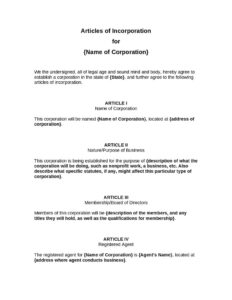
Articles of Incorporation
Free articles of incorporation template in PDF & DOCX. Learn what they are, what to include, and how to file with your state — download and edit today.
DOCX
4 downloads
0
likes
Download Files
- DOCX
Articles of incorporation are the founding document that legally creates a corporation and registers it with the state. They set out the company’s name, purpose, location, and leadership. Use the free template below in PDF or DOCX to draft yours before filing. No signup or email required.
What Are Articles of Incorporation?
Articles of incorporation — sometimes called a certificate of incorporation or corporate charter — are the paperwork you file with your state to bring a corporation into legal existence. They record the basic facts about the company: its name, address, purpose, and the people responsible for it. Once the state approves them, they become part of the public record and mark the official birth of the corporation. From that point, the business exists as a separate legal entity that can own property, sign contracts, and shield its owners from personal liability.
What Articles of Incorporation Include
While each state has its own form, almost all ask for a common set of details:
- The corporate name, including a required ending like “Inc.,” “Corporation,” or “Company.”
- The principal address and the state of incorporation.
- The purpose of the business.
- A registered agent — a person or service that accepts legal documents on the corporation’s behalf.
- The number of authorized shares for a stock corporation.
- The names of the incorporators and sometimes the initial directors.
Gathering these before you start makes the actual filing quick.
When Do You Need Articles of Incorporation?
- Forming a new corporation — C-corp, S-corp, or nonprofit — in any U.S. state
- Converting a sole proprietorship or partnership into a corporation
- Registering a nonprofit so it can apply for tax-exempt status
- Opening a corporate bank account or signing contracts that require proof of incorporation
- Establishing limited liability protection for the owners
How to Fill Out Articles of Incorporation
- Enter the name of the corporation exactly as you want it registered, including a required suffix like “Inc.” or “Corporation.”
- Name the state of incorporation and the corporation’s principal address.
- Describe the nature and purpose of the business — and note any statutes that apply to your type of corporation, such as nonprofit rules.
- List the board of directors or initial members and their roles.
- Add any extra articles your state requires, such as the number of authorized shares or your registered agent.
- Have the incorporators sign and date the document.
Articles of Incorporation vs. Articles of Organization
These two are easy to mix up. Articles of incorporation create a *corporation*. Articles of organization create a *limited liability company (LLC)*. They serve the same basic role — registering the business with the state — but apply to different entity types and ask for slightly different information. If you’re forming an LLC, you want articles of organization, not incorporation.
What to Do After You File
Filing is the start, not the finish. Most corporations then adopt bylaws (the internal rulebook), hold an initial board meeting, issue stock to the owners, and apply for an EIN from the IRS so they can open a bank account and hire employees. Keep a stamped copy of your approved articles with your permanent corporate records — banks, investors, and licensing agencies will ask to see it.
Common Mistakes to Avoid
- Choosing a name that’s already taken or missing the required corporate suffix
- Writing a purpose clause that’s too narrow for what the business will actually do
- Leaving out a registered agent when your state requires one
- Forgetting to authorize shares for a stock corporation
- Filing without checking your state’s specific form and fee
Choosing a Registered Agent
Most states require every corporation to name a registered agent — a person or company with a physical address in the state who can receive legal notices and official mail on the corporation’s behalf during business hours. You can act as your own agent if you have a reliable in-state address, appoint a trusted individual, or hire a commercial registered-agent service. The agent’s name and address become part of the public record, so many owners choose a service to keep their home address private and to make sure nothing important — like a lawsuit notice or a state renewal reminder — is ever missed. A missed legal notice can lead to a default judgment, so this choice matters more than it first appears.
Why Filings Get Rejected
States reject articles for predictable, avoidable reasons: a business name that’s already taken or missing its required suffix, a missing or invalid registered agent, an incomplete purpose statement, or the wrong filing fee. Some states also require specific language before a nonprofit can later qualify for tax-exempt status. Checking name availability on your Secretary of State’s website first, and using your state’s current official form, prevents most rejections and the delay that comes with refiling. If your filing is time-sensitive — for a bank account or a contract deadline — many states offer expedited processing for an extra fee.
Frequently Asked Questions
What are articles of incorporation? They’re the document filed with a state to legally create a corporation, listing its name, purpose, address, registered agent, and leadership.
How do you file articles of incorporation? Complete the document, then submit it to your state’s filing office — usually the Secretary of State — with the required fee, online or by mail.
Does an LLC need articles of incorporation? No. An LLC files articles of *organization* instead. Articles of incorporation are specifically for corporations.
What do articles of incorporation look like? A short document with numbered articles covering the company name, purpose, address, shares (if any), registered agent, and directors — like the template above.
How much do articles of incorporation cost? The template is free. State filing fees vary, commonly $50–$300, and are paid directly to the state.
How long does it take to form a corporation? It varies by state. Some approve online filings within a day or two, while mailed filings can take several weeks. Many states offer expedited processing for an extra fee if you’re working against a deadline, so check the options before you file.
Can I change my articles of incorporation later? Yes. If you need to change the company name, share structure, or other core details, you file an amendment — often called articles of amendment — with the same state office, along with a small fee.
Related Forms
LLC Operating Agreement · Corporate Minutes · Certified Copy of Resolution · Business Plan · Meeting Minutes
This template is provided for general informational purposes only and is not legal advice. Incorporation requirements differ by state — consult an attorney or your Secretary of State before filing.
Related Forms
- Corporate Minutes
- Class Reunion Registration
- RSVP List
- Letter to Legislator Showing Concern
- Fire Escape Plan Template
- Set List
Browse more in Miscellaneous.