
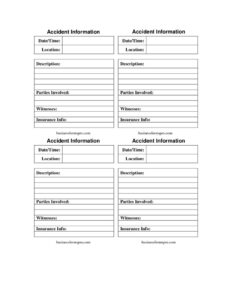
Accident Claim Worksheet
Use our free Accident Claim Worksheet template to record accident details, parties, witnesses, and insurance info accurately — free download in PDF and DOCX.
PDF
DOCX
3 downloads
0
likes
Download Files
- DOCX
An Accident Claim Worksheet is a simple, organized form for recording the essential facts of an accident immediately after it happens so the details are accurate when you file an insurance claim. People most often use it after a car crash, slip-and-fall, or workplace incident to capture the date, time, location, parties, witnesses, and insurance information in one place. You can download this Accident Claim Worksheet free in both PDF and DOCX formats, with no signup required.
What Is an Accident Claim Worksheet?
An Accident Claim Worksheet is a fact-gathering document used to collect and preserve information about an accident or incident shortly after it occurs. It is typically completed by the person involved, a manager, a property owner, or anyone helping document the event. Rather than serving as the official insurance claim itself, the worksheet acts as a structured record you can reference when you call your insurer, complete a claim form, or speak with an adjuster. Because memories fade quickly and physical evidence disappears, capturing the date, location, a clear description, the parties involved, witness contacts, and insurance details on a single sheet helps ensure nothing important is lost or misremembered later.
When Do You Need an Accident Claim Worksheet?
This worksheet is useful any time an unexpected event may lead to a claim, dispute, or report. Common situations include:
- Vehicle collisions — recording the scene, other drivers, and their insurance coverage after a car, motorcycle, or truck accident.
- Slip-and-fall or premises incidents — documenting a fall at a store, office, or rental property where injury or property damage occurred.
- Workplace accidents — capturing details of an injury or near-miss before filing a workers’ compensation or internal safety report.
- Property damage events — noting facts after a tree falls, a pipe bursts, or a delivery damages goods.
- Recreational or sports injuries — recording how and where an incident happened at a gym, park, or event.
- Witnessed incidents — when you are a bystander helping someone document what you saw while it is fresh.
What an Accident Claim Worksheet Should Have
A complete worksheet captures both the hard facts and the supporting context an insurer will ask about. The strongest worksheets include a precise date and time, an exact location, a factual description of what happened, the identity and contact details of everyone involved, witness information, and the relevant insurance details. It should also leave room for notes about conditions like weather, lighting, or road surface, and a place to list any photos or documents collected. The goal is to create a single reliable reference you can hand to an adjuster or attach to a formal claim form. Keeping the language objective — facts, not blame — makes the record more useful and credible.
How to Fill Out an Accident Claim Worksheet
- Date: Enter the calendar date the accident occurred. If you are completing the form later, also note the date you wrote it.
- Time: Record the time as precisely as you can, including AM or PM, and indicate whether it is approximate.
- Location: Write the full address or a clear description of the spot — street and cross-street, parking lot, aisle, or room. Add landmarks if there is no address.
- Description: Describe what happened in clear, factual sentences. Cover the sequence of events, what each party was doing, and any resulting injuries or damage. Avoid guesses about fault.
- Parties involved: List the full names, phone numbers, addresses, and roles of everyone directly involved, including drivers, pedestrians, or property owners.
- Witnesses: Record the names and contact details of anyone who saw the event. Independent witnesses are especially valuable.
- Insurance info: Note each party’s insurance company, policy number, and the name on the policy, plus any claim or report numbers already assigned.
Gathering Strong Supporting Evidence
The worksheet is most powerful when paired with evidence collected at the scene. Take clear photos from multiple angles showing damage, the surrounding area, road or floor conditions, and any signage. If a police officer, store manager, or supervisor responds, write down their name, badge or title, and the report number they provide. Keep copies of medical records, repair estimates, and receipts for any expenses tied to the incident. Note the weather, visibility, and surface conditions while you remember them. Attaching or referencing these items on the worksheet creates a complete package that speeds up the claims process and reduces back-and-forth with your insurer.
How the Worksheet Differs From an Insurance Claim
It is helpful to understand that the Accident Claim Worksheet is a preparation tool, not the claim itself. Your insurance company has its own claim forms and procedures, and most claims must be reported within a specific window after the incident. The worksheet ensures that when you make that call or submit those forms, you already have every fact organized and consistent. Using it also helps you avoid contradicting yourself across conversations with adjusters, which can complicate a legitimate claim. Think of it as your personal record that feeds the official process.
Common Mistakes to Avoid
- Waiting too long to write it down — details blur within hours, so complete the worksheet as soon as it is safe.
- Speculating about fault — stick to observable facts; conclusions about blame can hurt a claim and are the insurer’s job to determine.
- Skipping witness contact details — a name without a phone number is hard to follow up on later.
- Vague locations — “near the store” is not enough; pinpoint the exact spot.
- Incomplete insurance information — missing policy numbers or company names slow everything down.
- Not keeping a copy — save a photo or scan of the completed worksheet before handing anything over.
Frequently Asked Questions
What is an Accident Claim Worksheet used for? It is used to record the key facts of an accident — date, time, location, description, parties, witnesses, and insurance details — so you have an accurate reference when filing or discussing an insurance claim. It keeps everything organized in one place and helps prevent important details from being forgotten.
How do I fill out an Accident Claim Worksheet? Start with the date, time, and exact location, then write a factual description of what happened. List the names and contact information of everyone involved and any witnesses, and finish by recording each party’s insurance company and policy number. Complete it as soon as possible after the incident for the most accurate record.
Is an Accident Claim Worksheet a legal document? On its own it is an informational record rather than a binding legal document or an official insurance claim. However, the facts you record can become important supporting evidence in a claim, dispute, or legal matter, so accuracy and honesty are essential.
Does it need to be signed or notarized? Notarization is generally not required for a personal accident worksheet. You may choose to sign and date it, and have witnesses sign as well, to show when it was completed, but specific requirements vary depending on how the document will be used.
Who should fill out the worksheet? Anyone involved in or responsible for documenting the incident can complete it, including the person affected, a property owner, a manager, or a witness. The most reliable record comes from someone who directly observed the events.
How much does this template cost? This Accident Claim Worksheet template is completely free to download from Business Forms Pro in both PDF and DOCX formats, with no signup or payment required. You can print it for your vehicle or workplace, or fill it out digitally.
This Accident Claim Worksheet template is provided as a general example for informational purposes only and does not constitute legal, insurance, or financial advice. Insurance reporting deadlines and documentation requirements vary by company and jurisdiction — consult your insurer or a qualified professional for guidance on your specific situation.
Related Forms
Browse more in Miscellaneous.