
Correct Credit Report
Use this free Correct Credit Report dispute letter template to request removal of inaccurate items under the FCRA — free download in PDF and DOCX.
DOCX
0
likes
Download Files
- DOCX
A Correct Credit Report letter is a formal written request asking a credit reporting agency to investigate and remove inaccurate items from your credit file. People most often use it after spotting an error — a wrong balance, an account that isn’t theirs, or a debt that should have aged off — and need to dispute it in writing. You can download this template free in both PDF and DOCX formats, with no signup required.
What Is a Correct Credit Report Letter?
A Correct Credit Report letter is a written dispute sent to a consumer reporting agency (or sometimes the creditor that furnished the data) identifying specific inaccurate entries and requesting that they be investigated and deleted. It is issued by the consumer whose report contains the error and serves as a documented, dated record of the dispute. The letter typically references the Fair Credit Reporting Act (FCRA), which gives consumers the right to dispute information and obligates agencies to reinvestigate. Its purpose is to trigger that reinvestigation, correct your credit history, and create a paper trail you can rely on if the matter escalates or needs to be repeated.
When Do You Need a Correct Credit Report Letter?
This letter is appropriate any time you find information on your credit report that is wrong, outdated, or does not belong to you. Common situations include:
- You discover an account or debt on your report that you never opened, which may signal identity theft or a mix-up with another person’s file.
- A balance, payment status, or credit limit is reported incorrectly — for example, an account marked late that you actually paid on time.
- A debt that should have aged off your report still appears beyond the standard reporting period.
- A closed or paid account is still showing as open or with an outstanding balance.
- The same debt is listed twice (duplicate reporting), unfairly weighing down your score.
- A creditor’s name, account number, or other identifying detail is wrong and you want it corrected before applying for a loan, apartment, or job.
What a Correct Credit Report Letter Should Have
To be effective, your dispute letter should clearly identify you and the items you are challenging. Include your full name and current mailing address so the agency can match the letter to your file and respond. State plainly that you are formally disputing inaccurate information and requesting investigation and deletion. List each disputed item separately with the company or debtor name, the account number, and a short explanation of why it is wrong. Reference the FCRA and the agency’s obligation to reinvestigate within the statutory window, and request written notification once the correction is made. A dated signature completes the letter and establishes the timeline.
How to Fill Out a Correct Credit Report Letter
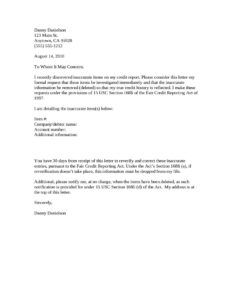
- At the top, enter your full name, street address, city, state, ZIP code, and phone number — for example, replacing the sample Danny Danielson, 123 Main St., Anytown, CA 95928 with your own details.
- Add the current date so the 30-day reinvestigation clock is documented from a clear starting point.
- Keep or adjust the salutation (“To Whom It May Concern”) or address it to the credit bureau’s dispute department.
- In the opening paragraph, state that you recently found inaccurate items and are formally requesting investigation and removal.
- For each error, complete the Item #, the Company/debtor name, the Account number, and the Additional information field explaining exactly what is wrong.
- Repeat the item block for every separate entry you are disputing so nothing is bundled together.
- Reference the FCRA’s reinvestigation requirement and your request for free written notice once items are deleted.
- Sign and print your name at the bottom, and keep a copy for your records.
Sending Your Letter and Keeping Records
How you send a credit dispute matters as much as what it says. Many people mail it by certified mail with a return receipt so they have proof of the date the agency received it — important because reinvestigation deadlines run from receipt. Enclose copies (never originals) of any supporting documents, such as a paid-in-full statement, a police report for identity theft, or correspondence with the creditor. Send a separate, tailored letter to each of the three major bureaus where the error appears, since correcting one does not automatically correct the others. Keep a dated copy of every letter and the certified mail receipt together in one folder.
A Note on the FCRA and Statutory References
The sample template cites the Fair Credit Reporting Act and a code section to assert your rights, but legal citations and exact procedures change over time. The correct U.S. Code reference for reinvestigation of disputed items is generally 15 U.S.C.
eferspecformatting in the template may be approximate, so verify the current statute and the bureau’s specific dispute instructions before relying on any citation. The core principle holds: credit reporting agencies must investigate disputed information, and items that cannot be verified are typically removed. Treat the legal language in the template as a general starting point rather than a precise legal authority.
Common Mistakes to Avoid
- Listing disputed items vaguely instead of giving the exact company name, account number, and reason for each — specifics make the dispute harder to dismiss.
- Sending originals of your supporting documents; always mail copies and keep the originals safe.
- Disputing with only one bureau when the error appears on multiple reports.
- Forgetting to date and sign the letter, which weakens your timeline and proof of authorship.
- Mailing without tracking, so you cannot prove when the agency received it.
- Disputing accurate, negative-but-truthful information, which wastes time and will not result in legitimate deletion.
Frequently Asked Questions
What is a Correct Credit Report letter? It is a written dispute you send to a credit reporting agency identifying inaccurate items and requesting that they be investigated and removed. It documents your complaint, references your rights under the Fair Credit Reporting Act, and creates a dated record of your request.
How do I fill out the template? Add your name, address, phone number, and the date at the top, then complete the item block for each error with the company name, account number, and an explanation of what is wrong. Sign and date the bottom and keep a copy for your files before mailing it.
Does this letter need to be notarized? No, a credit dispute letter does not generally need to be notarized or witnessed. What matters most is that it clearly identifies you and the disputed items and that you can prove when the agency received it, which is why certified mail is commonly used.
How long does the agency have to respond? Under the FCRA, credit reporting agencies typically must reinvestigate disputed items within about 30 days of receiving your request. If the information cannot be verified within that window, it generally must be corrected or removed from your file.
Is this letter legally binding? The letter itself is a request, not a contract, but it invokes your statutory rights and obligates the agency to act under the FCRA. Sending it properly and keeping proof of delivery strengthens your position if you need to escalate the matter.
How much does this template cost? Nothing — you can download the Correct Credit Report letter free in PDF and DOCX from Business Forms Pro, with no account or signup required. You can edit the DOCX version to add your own details and disputed items.
This template is a general example provided for informational purposes only and is not legal, financial, or credit-repair advice. Laws and credit reporting requirements vary by jurisdiction and change over time; consult a qualified professional or the relevant agency for guidance on your specific situation.
Related Forms
- Business Purchase Proposal
- Letter to Legislator Giving Support
- Dressing Room Numbers
- Request Transcript
- Credit Information Release Authorization
- Basic Entry Form
Browse more in Miscellaneous.