
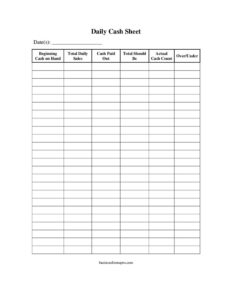
Daily Cash Sheet
Reconcile your register with this free Daily Cash Sheet template, tracking sales, payouts, and over/under amounts. Free PDF and DOCX download.
PDF
DOCX
107 downloads
1
likes
Download Files
- DOCX
Sample form for general use, not legal advice. Laws differ by state and province, so have a lawyer review contracts and legal forms before you rely on them. By downloading you agree to our Terms and Disclaimer.
A Daily Cash Sheet is a simple reconciliation form that lets a business compare the cash it expected to have in the drawer at the end of the day against the cash actually counted. The most common reason people use it is to catch register discrepancies early and keep an accurate daily record of sales and payouts. You can download it free in PDF and DOCX formats, with no signup required.
Six boxes, one subtraction
This sheet is tiny on purpose. After the line for Date(s): there are six boxes that run left to right: Beginning Cash on Hand, Total Daily Sales, Cash Paid Out, Total Should Be, Actual Cash Count and Over/Under. The first three are numbers you gather. The fourth is arithmetic. The fifth is what you count. The last is the difference.
What goes in each box
Date(s). Usually one day. The plural is there for a weekend you count once on Monday, or a stall that only closes out after a multi-day event.
Beginning Cash on Hand. This is the float you started the drawer with, counted before the first sale. If you leave the same amount in every night, it never changes. If you take deposits out, it will.
Total Daily Sales. Decide once whether this means all sales or cash sales only. Since the sheet is about the cash in the drawer, cash sales is the figure that makes the math work. Card sales go to the processor and never land in the drawer, so counting them here will make you look short every night.
Cash Paid Out. Money that left the drawer for something other than a deposit: a produce delivery, a courier tip, change for the till next door. Keep the receipts and slips in a clip. A payout with no paper behind it is the number most likely to cause an argument.
Total Should Be. Beginning cash plus sales, minus paid out.
Actual Cash Count. Count the drawer, bills first, then coins. Count it twice if the first total looks off.
Over/Under. Actual minus Should Be. A negative number means short, a positive one means over. A few cents either way is routine. A pattern is what you look for.
One day at a small coffee shop
All numbers made up.
| Beginning Cash on Hand | Total Daily Sales | Cash Paid Out | Total Should Be | Actual Cash Count | Over/Under |
|---|---|---|---|---|---|
| $200.00 | $1,184.50 | $46.25 | $1,338.25 | $1,336.75 | -$1.50 |
Paid Out was a $46.25 milk delivery paid in cash. A $1.50 shortage on a busy day is probably a miscounted nickel, so the owner writes it down and moves on. If the sheet read -$20 three days in a row, that would be a different conversation.
Who counts, who checks, how long it stays
The person closing the register fills in the first five boxes. Ideally a second person counts the drawer or at least initials the sheet. In a small shop that is often the owner the next morning, who compares the sheet to the bank deposit slip.
Many owners clip each day’s sheet to its deposit slip and file them by month. Hold on to them as long as your accountant or tax authority suggests; retention periods differ by state, province and business type.
PDF or DOCX, and what to add
You get a PDF (about 44 KB) and an editable DOCX (about 18 KB). It is one US Letter page, portrait, but the single row of boxes leaves most of the page empty. That space is yours to use.
A simple adaptation: in the DOCX, copy the row of boxes so you have a week’s worth of lines on one page, then print one sheet per week. The sheet has no signature line, so add “Counted by” and “Checked by” below the boxes.
Cash sheet questions after closing time
Should Total Daily Sales include card payments? For this sheet, no. Use cash sales only, since the sheet compares cash in the drawer to cash that should be there.
What if I take a deposit to the bank mid-day? Record it as Cash Paid Out, with a note, or reduce the next day’s Beginning Cash on Hand by that amount. Pick one habit and keep it.
Is a positive Over/Under better than a negative one? Not really. Both mean the drawer and the books disagree, and you want to find out why either way.
What does Date(s) mean when there are several dates? Write the range, such as Sat to Mon, and put the combined sales and payouts for those days in the boxes.
This Daily Cash Sheet template is provided as a general example for informational purposes only and does not constitute accounting, financial, or tax advice. Bookkeeping practices and record-keeping requirements vary by business and jurisdiction, so consult a qualified accountant or professional for guidance specific to your situation.
Official resource: for the rules that apply to your situation, see the Consumer Financial Protection Bureau.
Related Forms
- Profit And Loss Statement
- Large-Print Bill Tracker
- Roommate Expense Tracker
- Savings Breakdown
- Accounts Receivable Ledger
- Overdue Account History
Browse more in Money.