
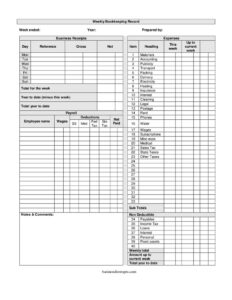
Weekly Bookkeeping Record
Track business receipts, expenses, payroll and year-to-date totals with our free Weekly Bookkeeping Record template, available as a free download.
PDF
DOCX
4 downloads
0
likes
Download Files
- DOCX
A Weekly Bookkeeping Record is a simple ledger that captures a small business’s income, expenses, and payroll for a single week and rolls those figures into running year-to-date totals. People most often use it to stay on top of cash flow without expensive software — and you can download it free here in PDF and DOCX with no signup required.
What Is a Weekly Bookkeeping Record?
A Weekly Bookkeeping Record is a structured worksheet used to log all money coming in and going out of a business across the seven days of one week. It is typically completed by an owner, bookkeeper, or office administrator, and it documents business receipts, categorized expenses, sales and other taxes, and payroll details. Because it shows both the week’s activity and cumulative year-to-date figures, the form doubles as a quick health check on the business. It is not a tax filing or a formal financial statement, but it organizes the raw numbers that feed into both, making month-end and year-end accounting far less stressful.
When Do You Need a Weekly Bookkeeping Record?
This form fits any small operation that wants consistent, low-overhead recordkeeping. Common situations include:
- Sole traders and freelancers who need a tidy weekly summary of receipts and expenses for self-assessment.
- Retail or service shops tracking daily takings from Monday through Sunday alongside running costs like rent and electricity.
- Small employers recording weekly wages, deductions, and net pay for one or more staff members.
- Cash-heavy businesses such as market stalls or trades that want a paper trail before money is banked.
- Owners preparing for an accountant who prefer to hand over clean weekly sheets instead of a shoebox of receipts.
- Anyone managing cash flow who wants to compare “this week” against “year to date” to spot trends early.
What a Weekly Bookkeeping Record Should Have
A complete record ties three things together: the income side, the expense side, and payroll. It should clearly identify the period (the week ended and the year), name the person who prepared it, and list business receipts day by day. The expense section needs labelled categories so costs are grouped consistently each week. Crucially, every block should carry three totals — the figure for this week, the amount up to the current week, and the combined total year to date — so the numbers reconcile. A notes area for unusual items and a payroll table for employee pay round out a thorough sheet.
How to Fill Out a Weekly Bookkeeping Record
- Header: Enter the week ended date, the year, and who prepared the record.
- Business receipts: For each day (Mon–Sun) log income with a reference, recording the gross and net amounts.
- Expenses: Work down each heading — materials, accounting, publicity, transport, packing, delivery, electricity, heating, insurance, interest, cleaning, legal, postage, rent, phones, water, wages, subscriptions, misc exps, and medical — entering the item and amount.
- Taxes: Record sales tax, state taxes, and other taxes separately.
- Weekly totals: Sum the total for the week, carry forward the year to date (minus this week), and add them for the total year to date.
- Payroll: List each employee name with wages, deductions, and net paid, then enter sub totals.
- Non-deductible items: Note payables, income tax, loans, interest, personal draws, and fixed assets, then complete the weekly total, amount up to current week, and final total year to date.
- Notes & comments: Add context for any irregular entry.
Understanding the Three Totals Columns
The biggest advantage of this layout is the trio of totals that appear throughout the form. This week shows the current period in isolation, which is what you compare against last week to judge momentum. Up to current week is the cumulative figure for the year before the current week is added — essentially your prior running balance. Total year to date is simply the two combined, and it must always equal “up to current week” plus “this week.” If those three numbers ever fail to reconcile, you have a data-entry error somewhere on the sheet. Checking this reconciliation every week takes seconds and prevents small slips from compounding into a frustrating year-end clean-up.
Separating Deductible Expenses from Non-Deductible Items
Notice that the form splits ordinary expenses (rent, phones, materials, wages) from a separate block for non-deductible items such as loan repayments, personal draws, income tax, and fixed-asset purchases. This distinction matters: loan principal and owner withdrawals reduce your cash but are not business expenses, while fixed assets are usually capitalized rather than expensed. Keeping them apart means your weekly expense total reflects genuine operating costs, giving you a cleaner read on profitability. Tax treatment varies by jurisdiction, so use these categories as an organizing tool and confirm the specifics with your accountant.
Common Mistakes to Avoid
- Mixing gross and net figures inconsistently — pick a convention for receipts and apply it every week.
- Skipping the year-to-date carry-forward, which breaks the running totals and hides your true position.
- Lumping unrelated costs into “misc exps” instead of using the proper heading like transport or postage.
- Recording loan repayments or personal draws as expenses rather than putting them in the non-deductible block.
- Forgetting sales tax as a separate line, which distorts both income and what you owe.
- Leaving the prepared-by and week-ended fields blank, making it impossible to audit who logged what and when.
Frequently Asked Questions
What is a Weekly Bookkeeping Record used for? It is used to log a business’s weekly receipts, categorized expenses, taxes, and payroll in one place. The cumulative year-to-date columns also let you track performance over time, so the form serves both as a weekly snapshot and an ongoing summary feeding your monthly and annual accounts.
How do I fill out the receipts and expenses sections? Enter each day’s income under Mon through Sun with a reference and the gross and net amounts, then list costs against the matching expense headings. At the end of the week, total each section and reconcile it with the prior year-to-date figure to produce a new running total.
Does this form need to be signed or notarized? No. A bookkeeping record is an internal accounting document, not a legal contract, so it does not require notarization or witnesses. It is good practice, however, to have the preparer named on the sheet and to keep the records on file in case your accountant or tax authority asks for support.
Is a Weekly Bookkeeping Record a legal financial statement? Not by itself. It is a working ledger that organizes raw figures, which an accountant can then use to prepare formal statements or tax filings. Treat it as the source data behind your accounts rather than a finished, official report.
How is this different from a profit and loss statement? A profit and loss statement summarizes income and expenses over a longer period, usually a month, quarter, or year, in a standardized format. This weekly record captures the granular day-by-day detail that ultimately rolls up into those summaries, giving you far more immediate visibility into cash flow.
How much does this template cost? Nothing — it is completely free to download from Business Forms Pro in both PDF and DOCX formats with no signup required. You can print it for handwritten use or edit the DOCX version to match your own expense categories and business name.
This Weekly Bookkeeping Record template is a general example provided for informational purposes only and does not constitute legal, financial, or tax advice. Accounting and tax requirements vary by jurisdiction and by business type, so consult a qualified accountant or tax professional before relying on it for your records.
Official resource: for the rules that apply to your situation, see the Consumer Financial Protection Bureau.
Related Forms
- Monthly Bookkeeping Record
- Bill Organizer
- Restaurants Cash Envelope
- Debit Register Wallet
- Irregular Income Plan
- Credit Change Notice
Browse more in Money.