
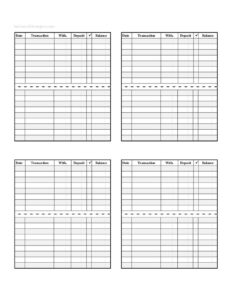
Debit Register Wallet
Track every debit card purchase with a free Debit Register Wallet template you can print, fold, and carry — free download in PDF and DOCX, no signup.
PDF
DOCX
2 downloads
0
likes
Download Files
- DOCX
A Debit Register Wallet is a pocket-sized tracking sheet that lets you record every debit card transaction, withdrawal, and deposit so you always know your true balance. People most often use it to avoid overdraft fees and reconcile their account by hand instead of trusting the bank’s pending total. It’s completely free to download here in both PDF and DOCX formats, with no signup required.
What Is a Debit Register Wallet?
A Debit Register Wallet is a compact version of a traditional check register, designed to fold and fit inside a wallet, billfold, or card sleeve. Instead of recording paper checks, it focuses on debit card swipes, ATM withdrawals, electronic transfers, and direct deposits — the transactions that actually move through a modern checking account. Each line captures the date, a short description, the amount in or out, and a running balance you update as you go. It’s used by anyone who wants real-time control over their spending: budgeters, students, people rebuilding credit habits, and cash-flow-conscious households. Because it lives in your wallet rather than an app, it works offline and keeps your number front of mind every time you reach for your card.
When Do You Need a Debit Register Wallet?
This little register earns its keep any time the gap between what you spent and what the bank shows could cost you money. Common situations include:
- Avoiding overdraft and NSF fees by knowing your real available balance before a purchase clears.
- Tracking pending transactions that haven’t yet posted to your online banking but have already left your spendable cushion.
- Sticking to a weekly or monthly budget where you want a visible total shrinking with each swipe.
- Managing a shared or joint account so both partners can see what the other has spent without waiting for the statement.
- Teaching teens or young adults the discipline of recording every transaction by hand before relying on apps.
- Reconciling at month-end by comparing your handwritten running balance against the official bank statement to catch errors or fraud.
What a Debit Register Wallet Should Have
A complete debit register is simple but disciplined. To be useful it should include a column for the transaction date, a short transaction or payee description, a reference or category code, a debit (payment/withdrawal) column, a credit (deposit) column, and a running balance column that you recalculate on every line. A header area for the account nickname or last four digits helps if you carry more than one card. Generous row counts and narrow, clearly labeled columns make the fold-up format readable in tight wallet space. A small notes line at the bottom for the starting balance ties everything together.
How to Fill Out a Debit Register Wallet
Follow these steps each time you use your card or check your account:
- Set your starting balance. Write today’s confirmed available balance from your bank at the top of the first line so every calculation flows from a known number.
- Enter the date of the transaction in the date column as it happens, not days later.
- Describe the transaction briefly in the description field — the merchant name, “ATM withdrawal,” “payroll deposit,” or “transfer to savings.”
- Add a reference or category code if your sheet has one, such as “DC” for debit card, “ATM,” “DEP,” or a budget tag like “groceries.”
- Record the amount. Put money leaving the account in the debit/payment column and money coming in into the deposit/credit column.
- Update the running balance. Subtract a debit or add a deposit to the previous balance and write the new total in the balance column.
- Reconcile regularly. Compare your running balance to your bank statement and mark each line as it clears, investigating any difference right away.
Tips for Keeping an Accurate Register
The register only works if you treat it as the source of truth, not the bank’s flashing “available” figure. Record transactions at the moment of purchase — keep the wallet sheet and a pen together so there’s no friction. For recurring charges like subscriptions, autopay bills, or membership fees, jot them in on their scheduled dates even before they post so your balance reflects committed money. Round nothing; pennies add up and throw off reconciliation. If you carry a small buffer, write your true starting balance lower than the bank shows so a forgotten transaction can’t tip you into overdraft. Finally, start a fresh sheet each month and carry the closing balance forward to the new one’s first line.
Debit Register vs. Check Register
A traditional check register was built around sequential check numbers and slow-clearing paper checks, with a column dedicated to the check number. A Debit Register Wallet swaps that emphasis for card swipes, ATM activity, and instant electronic transfers, which clear far faster and rarely carry a check number. The math is identical — start with a balance, subtract debits, add deposits — but the categories and the compact fold-to-fit layout are tailored to card-first spending. Many people use both columns interchangeably, treating any reference field as a flexible spot for a check number, confirmation code, or budget category.
Common Mistakes to Avoid
- Trusting the bank’s “available” balance while pending debit holds and uncleared transactions are still floating.
- Forgetting recurring autopayments like streaming, insurance, or gym fees that silently reduce your balance.
- Skipping the running-balance update on a line, which breaks every total below it.
- Mixing debits and deposits in the wrong columns, turning a withdrawal into an addition.
- Letting receipts pile up to enter later, when amounts get misremembered or lost.
- Never reconciling against the statement, so small arithmetic errors and fraudulent charges go unnoticed.
Frequently Asked Questions
What is a Debit Register Wallet used for? It is a small, foldable tracking sheet for recording debit card purchases, ATM withdrawals, transfers, and deposits. By updating a running balance after each entry, it shows your true available money and helps you avoid overdraft fees. It works entirely offline inside your wallet.
How do I fill out a debit register? Start with your confirmed bank balance, then for each transaction write the date, a description, the amount in the debit or deposit column, and recalculate the running balance. Subtract debits and add deposits as you go. Reconcile against your statement regularly to catch any differences.
How is this different from my banking app? An app shows what the bank knows after transactions post, which can lag behind real spending and ignore charges you’ve committed to but not yet incurred. A handwritten register reflects your own complete, real-time picture and keeps you actively aware of every dollar. Many people use both together.
Is the Debit Register Wallet template free? Yes. You can download it here for free in both PDF and DOCX formats with no signup or account required. Print it, fold it, and start tracking immediately, or edit the DOCX version to add your own columns.
Does a debit register need to balance with the bank exactly? Ideally yes — your running balance should match the bank statement once all transactions clear, aside from any buffer you intentionally keep. If they don’t match, recheck your arithmetic, look for missed or duplicated entries, and verify there are no unauthorized charges. Reconciling each month keeps the two aligned.
Can I use it for more than one account? You can, but it’s cleaner to use a separate sheet for each account or card so the running balances never get confused. Label each register’s header with the account nickname or the last four digits of the card. Carry only the sheets you actively need in your wallet.
This Debit Register Wallet template is a general example provided for informational purposes only and is not financial, tax, or accounting advice. Banking terms, fees, and reconciliation practices vary by institution — verify your balance with your bank and consult a qualified financial professional for guidance on your specific situation.
Official resource: for the rules that apply to your situation, see the Consumer Financial Protection Bureau.
Related Forms
- Hobby Cash Envelope
- Appointment Of Collection Agent
- Profit And Loss Worksheet
- Weekly Bookkeeping Record
- Overdue Account History
- School Cash Envelope
Browse more in Money.