
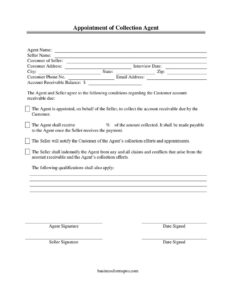
Appointment Of Collection Agent
Download a free Appointment of Collection Agent template to authorize an agent to collect an overdue account receivable — free PDF and DOCX download.
PDF
DOCX
2 downloads
0
likes
Download Files
- DOCX
An Appointment of Collection Agent is a written agreement in which a seller authorizes another party — the agent — to pursue and collect a specific overdue account receivable owed by a customer. It is most often used when a business owner wants help recovering money without handling the collection process personally. You can download this template free in both PDF and DOCX formats, with no signup required.
What Is an Appointment of Collection Agent?
An Appointment of Collection Agent is a short contract between a seller (the party owed money) and an agent (the person or company collecting it). It documents that the seller is delegating the task of collecting a defined account receivable from a named customer, and it sets the terms of that arrangement — most importantly the agent’s fee and how payment is handled. The form identifies the customer, the unpaid balance, and the percentage the agent earns from any amount recovered. By putting the appointment in writing, both sides have a clear record of authority, compensation, and responsibility before any collection efforts begin.
When Do You Need an Appointment of Collection Agent?
This form is useful any time a seller decides to bring in outside help to recover a past-due balance. Common situations include:
- A customer has stopped responding to invoices and the seller wants a third party to follow up professionally.
- A small business lacks the time or staff to chase overdue accounts and hires an independent collector.
- A seller engages a friend, contractor, or specialist on a commission basis rather than a flat fee.
- A company wants to formalize an existing informal arrangement so the agent’s authority is documented.
- Before turning a debt over to a collection professional, the seller needs a written record of the percentage agreed upon.
- An accountant or bookkeeper needs documentation showing who is authorized to collect a particular receivable.
What an Appointment of Collection Agent Should Have
A complete appointment clearly identifies everyone involved and the exact debt being collected. It should name the agent and the seller, identify the customer along with full contact details, and state the account receivable balance in dollars. It must spell out the agent’s compensation as a percentage of the amount collected and confirm that the agent is paid only after the seller receives payment. Strong versions also state that the seller will notify the customer of the agent’s involvement, include an indemnification clause protecting the agent from claims arising out of the collection effort, leave room for additional qualifications, and provide signature and date lines for both parties.
How to Fill Out an Appointment of Collection Agent
- Enter the Agent Name — the individual or company being appointed to collect the debt.
- Enter the Seller Name — the business or person owed the money.
- Fill in the Customer of Seller — the name of the party who owes the balance.
- Record the Customer Address, along with the City, State, and Zip so the customer can be properly identified and contacted.
- Add the Interview Date, the Customer Phone No., and the Email Address on file for the customer.
- Write the Account Receivable Balance in the dollar field — the exact amount currently owed.
- Enter the percentage the agent will receive of any amount collected; confirm payment is made to the agent once the seller receives the funds.
- Review the conditions covering customer notification and the seller’s indemnification of the agent.
- Add any extra terms under the qualifications section.
- Both parties sign and date at the Agent Signature and Seller Signature lines.
Understanding the Commission and Payment Terms
The defining feature of this arrangement is that the agent is paid a percentage of what is actually collected, not a flat fee charged up front. That means if nothing is recovered, the agent typically earns nothing — a contingency structure that ties the agent’s reward to results. The form also states that payment to the agent is made after the seller receives the funds, which protects the seller from paying out before the money is in hand. When completing the percentage field, be precise: a vague or blank figure is one of the most common sources of later disputes. Spell out whether the percentage applies to the gross amount collected or to a net figure if any costs are involved.
Notification and Indemnification
Two clauses deserve attention. First, the seller agrees to notify the customer that an agent is now handling collection. This keeps the process transparent and reduces confusion if the customer suddenly hears from a new party. Second, the indemnification clause means the seller agrees to protect the agent from claims and conflicts that arise out of the receivable and the collection effort. Collection activity is regulated in many places, so both parties should understand that this agreement governs their relationship — it does not exempt anyone from applicable consumer-protection and debt-collection laws, which vary by jurisdiction.
Common Mistakes to Avoid
- Leaving the agent’s percentage blank or writing it ambiguously, which invites disputes over what the agent is owed.
- Failing to state the exact account receivable balance, making it unclear which debt is being collected.
- Omitting full customer contact details, which slows the agent’s ability to make contact.
- Forgetting to notify the customer of the agent’s involvement as the agreement requires.
- Not signing and dating the form, leaving the appointment unenforceable between the parties.
- Assuming the agreement overrides local collection laws — it governs the seller and agent, not third-party legal obligations.
Frequently Asked Questions
What is an Appointment of Collection Agent used for? It is used to formally authorize an agent to collect a specific overdue account receivable on behalf of a seller. The document records who the agent is, which customer owes money, the balance due, and the commission the agent earns. It gives both parties a clear, written record before collection begins.
How is the agent paid? Under this template, the agent receives an agreed percentage of the amount actually collected. Payment is made to the agent only after the seller has received the funds from the customer. If you want a different structure, such as a flat fee, you should edit the terms before signing.
Does this form need to be notarized or witnessed? Notarization is not typically required for a private agreement like this, and the template provides only signature and date lines. Requirements vary by jurisdiction, so if you want added formality you can have the signatures witnessed or notarized. Check your local rules if you are unsure.
Is an Appointment of Collection Agent legally binding? When both the agent and the seller sign and date the form and the terms are clear, it generally creates a binding agreement between them. Its enforceability depends on the completeness of the terms and applicable local law. The form does not, by itself, grant any rights against the customer beyond what the law allows.
Can I edit the template to fit my situation? Yes. The DOCX version is fully editable, so you can adjust the commission percentage, add qualifications, or refine the indemnification language. Be sure both parties review and agree to any changes before signing. Keep the completed copy for your records.
How much does this form cost? The Appointment of Collection Agent template is completely free to download here in both PDF and DOCX formats, with no signup or payment required. You can use it as many times as you need. Only the underlying debt and any agent commission represent real costs in your arrangement.
This template is a general example provided for informational purposes only and is not legal, financial, or tax advice. Debt collection is regulated and requirements vary by jurisdiction. Consult a qualified professional before relying on this document for your specific situation.
Official resource: for the rules that apply to your situation, see the Consumer Financial Protection Bureau.
Related Forms
- Date Night Cash Envelope
- Charity Cash Envelope
- Large Check Register
- Tax Refund Planner
- Full Page Check Register
- Debt Snowball Form
Browse more in Money.