
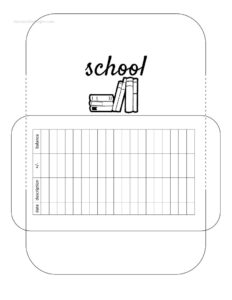
School Cash Envelope
Use this free School Cash Envelope template to collect, label, and track classroom cash and checks securely — free download in PDF and DOCX.
PDF
DOCX
0
likes
Download Files
- DOCX
A School Cash Envelope is a simple, pre-printed envelope used by teachers, parents, and school staff to collect and account for money brought into a classroom or school office. It is most commonly used to gather cash and checks for field trips, fundraisers, book fairs, or lunch payments while creating a clear record of who paid and how much. You can download it free in both PDF and DOCX formats with no signup required.
What Is a School Cash Envelope?
A School Cash Envelope is a labeled collection envelope that holds and documents money submitted for a specific school purpose. It is typically issued by a teacher, club sponsor, office assistant, or PTA volunteer and filled out by whoever is turning in the funds. The envelope captures key details such as the student’s name, the reason for payment, the amount of cash and checks enclosed, and the date received. Rather than tossing loose bills into a drawer, schools use these envelopes to keep payments organized, reduce the risk of lost money, and create a paper trail that can be reconciled later against a class roster or deposit slip.
When Do You Need a School Cash Envelope?
Cash still flows through schools constantly, and an envelope keeps it traceable. Common situations include:
- Field trips: Collecting permission-slip fees and bus or admission costs from each student in a class.
- Fundraisers: Gathering proceeds from candy sales, wrapping paper, or read-a-thon pledges turned in by students.
- Book fairs and spirit wear: Holding cash and checks for items purchased on-site over several days.
- Lunch and snack accounts: Receiving prepayments parents send in to top up a child’s cafeteria balance.
- Club and activity dues: Collecting membership fees, uniform deposits, or competition entry money.
- Yearbook and photo orders: Securing payments tied to a specific order form or deadline.
In each case the envelope serves two roles at once: a secure container for the money and a written record of the transaction.
What a School Cash Envelope Should Have
A complete envelope makes reconciliation fast and disputes rare. Strong templates include space for the school or classroom name, the teacher or staff member collecting the funds, and the purpose of the collection. There should be a clearly labeled line for the student or payer’s name, the date received, and separate totals for cash and checks so the amounts can be added accurately. Many envelopes also include a check-number column, a signature line for the person submitting the money, and a verification line for the staff member who counts and confirms the contents. A spot for the deposit date or batch number helps tie the envelope to the eventual bank deposit.
How to Fill Out a School Cash Envelope
Because this template is a flexible, general-purpose envelope, fill it out in this order:
- School and classroom: Write the school name, teacher or sponsor name, and room or grade at the top so the envelope can be routed correctly.
- Purpose: State exactly what the money is for — for example, “4th Grade Zoo Trip” or “Fall Fundraiser.”
- Payer name: Enter the student’s name (and parent name if helpful) so each payment maps to a roster entry.
- Date: Record the date the money was received.
- Cash amount: Count the bills and coins and write the cash total clearly.
- Checks: List each check with its number and amount; total the checks separately.
- Total enclosed: Add cash plus checks for one grand total.
- Signatures: Have the submitter sign, then sign or initial as the staff member who verified the count.
Handling and Securing the Money
Once an envelope is filled out, treat it as cash itself. Count the contents in the presence of a second person when possible, then seal the envelope and store it in a locked drawer, safe, or designated office cash box until it can be deposited. Avoid leaving completed envelopes in a backpack, on a desk, or in an unlocked classroom overnight. Schools that follow a two-person counting rule — one person counts, a second verifies — dramatically reduce errors and protect everyone involved. Recording a deposit date on the envelope and matching the total to the bank receipt closes the loop and gives administrators a clean audit trail.
School Cash Envelope vs. a Receipt Book
An envelope and a receipt book solve related but different problems. The envelope physically holds the money and summarizes a single collection event, making it ideal when many small payments arrive over a short window. A receipt book, by contrast, gives each individual payer a tear-off proof of payment to take home. Many schools use both: the envelope keeps the funds and the running tally, while a receipt confirms each transaction for parents who want documentation. If your collection involves only a handful of payers, the envelope’s name-and-amount lines may be all the record you need.
Common Mistakes to Avoid
- Skipping the purpose line: An unlabeled envelope makes it impossible to know which fundraiser or trip the money belongs to.
- Not separating cash and checks: Lumping them together leads to deposit errors and reconciliation headaches.
- Failing to count with a witness: A single counter leaves staff exposed if totals don’t match later.
- Leaving envelopes unsecured: Money left on a desk or in a bag invites loss or theft.
- Delaying deposits: Holding cash for days increases risk; deposit promptly per your school’s policy.
- Forgetting to record check numbers: Missing details make it hard to trace a bounced or lost check.
Frequently Asked Questions
What is a School Cash Envelope used for? It is used to collect and document money brought into a school for a specific purpose, such as a field trip, fundraiser, or lunch payment. The envelope holds the cash and checks while recording who paid, how much, and why. This keeps funds organized and traceable until they are deposited.
How do I fill out a School Cash Envelope? Start with the school and classroom details, then write the purpose of the collection and the payer’s name and date. Count the cash and list each check separately, add them for a grand total, and have both the submitter and a verifying staff member sign. Filling it out completely makes later reconciliation far easier.
Is a School Cash Envelope legally binding? The envelope is a record-keeping and accountability tool rather than a legal contract. However, the signatures and recorded totals can serve as useful documentation if a discrepancy or audit arises. Always follow your school district’s specific cash-handling policies.
Do I need two people to count the money? Many schools require or recommend a two-person count, where one person counts and a second verifies and initials the total. This protects staff and reduces errors. Check your district’s procedures, but using a witness is a widely accepted best practice.
Should checks and cash be recorded separately? Yes. Listing cash and checks separately — including each check number and amount — keeps your totals accurate and makes bank deposits and reconciliation much smoother. It also helps you trace a specific check if a problem comes up later.
How much does this template cost? Nothing — this School Cash Envelope template is completely free to download in both PDF and DOCX formats with no signup required. You can print it as-is or customize the DOCX version with your school name and collection categories.
This template is a general example provided for informational purposes only and is not legal, financial, or accounting advice. Cash-handling rules and record-keeping requirements vary by school, district, and jurisdiction — consult your administration or a qualified professional to confirm the procedures that apply to you.
Official resource: for the rules that apply to your situation, see the Consumer Financial Protection Bureau.
Related Forms
- Payroll Budget Estimate
- Accounts Receivable Aging
- Consumer Equity Form
- Open Orders Tracker
- Investment Record
- Credit Card History
Browse more in Money.