
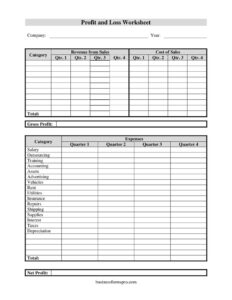
Profit And Loss Worksheet
Track quarterly revenue, expenses, and net profit with this free Profit and Loss Worksheet template — easy free download in PDF and DOCX.
PDF
DOCX
3 downloads
0
likes
Download Files
- DOCX
A Profit and Loss Worksheet is a simple financial tool that organizes a company’s revenue, costs, and expenses to calculate net profit over a set period. Most people use it to see at a glance whether a business is making or losing money quarter by quarter. You can download it free in PDF and DOCX — no signup required.
What Is a Profit and Loss Worksheet?
A Profit and Loss Worksheet is a structured statement that summarizes how much a business earned and spent during a defined timeframe, usually broken down by quarter and totaled for the year. It starts with revenue from sales, subtracts the cost of sales to reveal gross profit, then lists operating expenses such as rent, salaries, and utilities to arrive at net profit. Business owners, bookkeepers, and accountants use it to monitor performance, support tax preparation, and inform decisions about pricing and spending. Unlike a formal audited statement, this worksheet is a working document you can update throughout the year as the numbers come in.
When Do You Need a Profit and Loss Worksheet?
This worksheet is useful any time you need a clear picture of financial performance. Common situations include:
- Quarterly reviews — comparing Qtr. 1 through Qtr. 4 to spot seasonal trends or rising costs.
- Year-end and tax prep — pulling together revenue and expense totals before filing or meeting with an accountant.
- Applying for a loan or credit — lenders often want to see profit and loss figures before approving financing.
- Pitching to investors or partners — demonstrating that the business generates a healthy gross profit and net profit.
- Budgeting and forecasting — using last year’s actuals to plan next year’s spending on advertising, supplies, and training.
- Tracking a side business or freelance income — keeping a tidy record of earnings and deductible expenses.
What a Profit and Loss Worksheet Should Have
A complete worksheet captures both halves of the profit equation. On the income side, it records Revenue from Sales and the Cost of Sales, which together produce Gross Profit. On the expense side, it itemizes operating costs by category — rent, salary, utilities, insurance, advertising, and more — so nothing gets overlooked. It should clearly label the Company name and Year, separate amounts by quarter, and total each row across the four quarters. Finally, it must subtract total expenses from gross profit to display Net Profit, the bottom-line figure that tells you whether the period was profitable.
How to Fill Out a Profit and Loss Worksheet
- Enter the Company name and the Year the worksheet covers at the top.
- Under Revenue from Sales, record income for Quarter 1, Quarter 2, Quarter 3, and Quarter 4 in their respective columns.
- Enter the Cost of Sales for each quarter — the direct cost of producing or buying what you sold.
- Subtract cost of sales from revenue to calculate Gross Profit per quarter.
- Fill in each operating expense Category by quarter: Accounting, Advertising, Depreciation, Insurance, Interest, Outsourcing, Rent, Repairs, Salary, Shipping, Supplies, Taxes, Training, Utilities, and Vehicles.
- Add the four quarterly figures across each row to get the Total for every line.
- Sum all expense categories to find total Expenses.
- Subtract total expenses from gross profit to produce the final Net Profit.
Understanding Gross Profit vs. Net Profit
One of the most valuable things this worksheet teaches is the difference between two profit measures. Gross Profit is what remains after you subtract only the cost of sales from revenue — it shows how efficiently you produce or source your product. Net Profit goes further by deducting every operating expense, from advertising to vehicles, leaving the true bottom line. A business can show strong gross profit yet still post a net loss if overhead like rent, salary, and interest runs too high. Watching both numbers across quarters helps you decide where to cut costs and where to invest.
Tips for Accurate Quarterly Tracking
Keep entries consistent so comparisons stay meaningful. Record revenue and expenses in the quarter they actually occur, not when invoices are paid, unless you intentionally use cash-basis accounting throughout. Reconcile each category against bank statements, receipts, and your accounting software so the worksheet matches your books. Note any unusual one-time costs, such as a large equipment repair, so they don’t distort your reading of a trend. Updating the sheet at the close of every quarter — rather than scrambling at year-end — makes tax season far less stressful and gives you early warning if a category like utilities or shipping is creeping upward.
Common Mistakes to Avoid
- Mixing personal and business expenses — only business-related costs belong on the worksheet.
- Forgetting non-cash items — depreciation is a real expense that affects net profit even though no cash leaves the account.
- Double-counting revenue — record each sale once, in a single quarter.
- Leaving categories blank instead of zero — an empty cell can break your totals; enter 0 when there’s no activity.
- Math errors in the totals — verify that each row’s Total equals the sum of all four quarters and that net profit ties out.
- Misclassifying costs — keep cost of sales separate from operating expenses so gross profit stays accurate.
Frequently Asked Questions
What is a Profit and Loss Worksheet used for? It is used to summarize a business’s income and expenses over a period so you can calculate gross profit and net profit. Owners rely on it for performance reviews, budgeting, tax preparation, and loan or investor applications. It turns scattered numbers into a single, readable snapshot of financial health.
How do I fill out the worksheet? Start by entering your company name and year, then record revenue and cost of sales by quarter to find gross profit. Next, fill in each expense category — rent, salary, advertising, and the rest — and total every row across the four quarters. Finally, subtract total expenses from gross profit to reveal net profit.
What’s the difference between gross profit and net profit? Gross profit is revenue minus the cost of sales only, reflecting production efficiency. Net profit subtracts all operating expenses on top of that, showing the actual bottom line. A business can have healthy gross profit but still lose money if overhead is too high.
Is this worksheet a legal financial statement? No, it is a working template for tracking and planning, not an audited or certified statement. For official filings, loan packages, or tax returns, your accountant may prepare a formal profit and loss statement based on your records. Use this worksheet to organize the underlying figures.
How much does the template cost? It is completely free to download here in both PDF and DOCX formats, with no signup or account required. The DOCX version is editable so you can adapt categories to your business. You can reuse it every year at no cost.
How often should I update it? Updating at the end of each quarter keeps the data current and makes year-end reconciliation easier. Frequent updates also help you catch rising costs or slowing sales early. Some businesses update monthly and then roll figures into the quarterly columns.
This Profit and Loss Worksheet template is a general example provided for informational purposes only and is not legal, financial, or tax advice. Accounting standards and tax requirements vary by jurisdiction and business type — consult a qualified accountant or tax professional before relying on these figures for filings or decisions.
Official resource: for the rules that apply to your situation, see the Consumer Financial Protection Bureau.
Related Forms
- Tax Records
- Utilities Tracker
- Weekly Sales Commission Tracker
- Pocket Tip Calculator
- Cosigner Agreement
- Account Statement
Browse more in Money.