
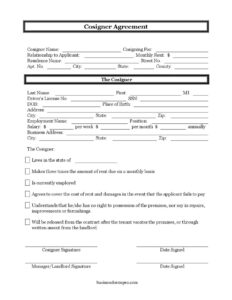
Cosigner Agreement
Download a free Cosigner Agreement template to guarantee a tenant's rent and damages, with full field guidance and FAQs—free PDF and DOCX download.
PDF
DOCX
0
likes
Download Files
- DOCX
A Cosigner Agreement is a document in which a third party promises to cover a tenant’s rent and damages if the tenant fails to pay, giving a landlord added financial security before approving a lease. Renters with limited credit, short rental history, or income below the property’s requirement most often need one, and this template is free to download in PDF and DOCX with no signup.
What Is a Cosigner Agreement?
A Cosigner Agreement is a written promise signed by a cosigner (sometimes called a guarantor) who agrees to be financially responsible for a tenant’s lease obligations. The cosigner typically must live in the same state, be currently employed, and earn roughly three times the monthly rent. By signing, the cosigner pledges to pay rent and cover damages if the primary applicant defaults. Importantly, the cosigner gains no right to occupy or use the premises and has no say in repairs, improvements, or furnishings. The agreement is usually attached to or referenced by the lease and signed by both the cosigner and the manager or landlord. It protects the landlord while helping an applicant who might not otherwise qualify on their own.
When Do You Need a Cosigner Agreement?
Landlords and applicants reach for this form whenever a tenant’s qualifications fall short of standard approval criteria. Common situations include:
- A student or first-time renter with little or no credit history needs a parent or relative to back the lease.
- An applicant’s income is below the three-times-rent threshold, so a higher-earning cosigner provides the missing financial cushion.
- A renter has a past eviction, late payments, or a low credit score that makes a landlord hesitant without a guarantor.
- A recent graduate or new hire has a job offer but limited verifiable rental or income history.
- A self-employed applicant with irregular income wants to strengthen an application using a salaried cosigner.
- An international or relocating tenant without local credit references asks a friend or family member to cosign.
In each case, the cosigner is not moving in—they are simply backstopping the financial promises in the lease.
What a Cosigner Agreement Should Have
A complete agreement clearly identifies the cosigner, the applicant they are cosigning for, and the property involved. It should state the monthly rent being guaranteed, confirm the cosigner’s employment and income, and spell out the scope of the obligation—covering both unpaid rent and damages. Equally important is the language clarifying what the cosigner does not get: no possession of the premises and no authority over repairs or improvements. Finally, the form should describe how the cosigner is released, typically once the tenant vacates or with the landlord’s written consent, and provide signature lines and a date for both the cosigner and the manager or landlord.
How to Fill Out a Cosigner Agreement
- Enter the Cosigner Name, broken into First, MI, and Last Name, and confirm the State where the cosigner lives.
- Provide the cosigner’s residential Address, including Street No., Apt. No., City, County, State, and Zip.
- Add personal identifiers used to verify the cosigner: DOB, Place of Birth, Driver’s License No., and SSN.
- Complete the employment section: Employment Name, Business Address, Position, and the Salary shown per week, per month, and annually.
- Identify who is being guaranteed in Cosigning For and the cosigner’s Relationship to Applicant (parent, relative, friend, etc.).
- Record the Residence Name or property and the Monthly Rent $ the cosigner is agreeing to cover.
- Review the obligation and release terms, then sign the Cosigner Signature, enter the Date Signed, and have the Manager/Landlord Signature added.
Double-check that the names, property, and rent amount exactly match the lease they support.
How a Cosigner Agreement Differs From the Lease
The lease is the contract between the landlord and the tenant that governs occupancy, rent, and house rules. The Cosigner Agreement is a separate but related promise that makes a third party financially liable if the tenant breaks those lease terms. The cosigner is not a tenant: they cannot live in the unit, request repairs, or demand changes to the property. This distinction matters because some people mistakenly assume cosigning gives them rights to the apartment—it does not. The agreement also explains the exit path: a cosigner is usually released once the tenant moves out or when the landlord agrees in writing to discharge them, which is why retaining a signed copy is essential.
Tips for Cosigners and Landlords
For cosigners, treat this as a real financial commitment. If the tenant misses rent, you may be pursued for the full balance, and unpaid amounts can affect your own credit. Keep a copy of the signed agreement and the lease, and ask the landlord in writing when your obligation ends. For landlords, verify the cosigner’s income and employment just as you would the applicant’s, confirm the cosigner meets the three-times-rent standard, and keep the executed form on file with the lease. Both parties should make sure every field is accurate, because vague or missing information can weaken the document’s usefulness if a dispute ever arises.
Common Mistakes to Avoid
- Leaving the Monthly Rent $ or property name blank, which makes the scope of the guarantee unclear.
- Failing to confirm the cosigner actually earns three times the rent and is currently employed.
- Skipping verification fields like SSN, DOB, or Driver’s License No., leaving the landlord unable to confirm identity.
- Assuming the cosigner gains access or rights to the unit—the form explicitly states they do not.
- Not getting both the Cosigner Signature and the Manager/Landlord Signature with a matching Date Signed.
- Forgetting to clarify or document the release terms, so the cosigner doesn’t know when their liability ends.
Frequently Asked Questions
What is a Cosigner Agreement? It is a document in which a third party promises to pay a tenant’s rent and cover damages if the tenant defaults. The cosigner provides financial backing for the lease but does not have the right to live in or control the property. It is commonly used when an applicant cannot fully qualify on their own.
How do I fill out a Cosigner Agreement? Enter the cosigner’s name, address, and identifying details, then complete the employment and salary fields to show they meet the income requirement. Identify the applicant being cosigned for, list the property and monthly rent, and have both the cosigner and the landlord or manager sign and date it. Make sure every detail matches the lease.
Is a cosigner responsible for the entire lease? Generally, yes—the cosigner agrees to cover unpaid rent and damages if the tenant fails to pay, which can mean the full amount owed under the lease. The exact extent depends on the wording of the agreement and lease. Cosigners should read the obligation carefully before signing.
Does a Cosigner Agreement need to be notarized or witnessed? Many landlords accept a signed agreement without notarization, but requirements vary by state and by the landlord’s policy. Some prefer notarized signatures for added verification, especially for high-value leases. Check your local rules and the landlord’s preference before signing.
When is the cosigner released from the agreement? Typically the cosigner is released after the tenant vacates the premises or when the landlord provides written assent to discharge them. Until one of those events occurs, the cosigner generally remains responsible. Keep written documentation of any release.
How much does this Cosigner Agreement template cost? It is completely free to download from Business Forms Pro in PDF and DOCX formats with no signup required. You can edit it to fit your property and lease details. Always review the final document carefully before anyone signs.
This Cosigner Agreement template is a general example provided for informational purposes only and is not legal, financial, or tax advice. Cosigner and landlord-tenant requirements vary by jurisdiction. Consult a qualified attorney or professional before using this document.
Official resource: for the rules that apply to your situation, see the Consumer Financial Protection Bureau.
Related Forms
- Daily Sales Commission Tracker
- Utilities Tracker
- Kids Cash Envelope
- Automatic Payment Dates Tracker
- Personal Care Envelope
- Large Check Register
Browse more in Money.