
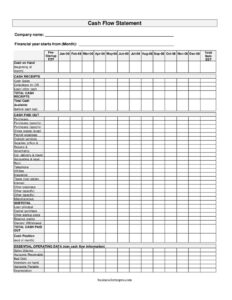
Cash Flow Statement
Track money in and out of your business with this free Cash Flow Statement template, available as a free PDF and DOCX download — no signup needed.
PDF
DOCX
1 downloads
0
likes
Download Files
- DOCX
A Cash Flow Statement is a financial worksheet that tracks the actual cash moving into and out of your business over a set period, showing whether you have enough money on hand to cover expenses. Most people use it to forecast and monitor liquidity month by month so they don’t run short of cash. You can download this template free in both PDF and DOCX formats, with no signup required.
What Is a Cash Flow Statement?
A Cash Flow Statement is a record of the cash a business receives and spends during a given timeframe, typically organized by month across a financial year. Unlike a profit-and-loss statement, which can include non-cash items, a cash flow statement focuses on real money — the cash you actually have available to pay bills, wages, and loans. It is used by small business owners, bookkeepers, startups, and managers to confirm that incoming cash keeps pace with outgoing payments. The statement begins with cash on hand, adds all receipts, subtracts everything paid out, and arrives at a closing cash position. This template also captures essential operating data such as sales volume and inventory to give context to the numbers.
When Do You Need a Cash Flow Statement?
- Starting a new business — to project how long your initial capital will last before revenue catches up to startup costs and reserve needs.
- Applying for a loan or investment — lenders and investors often request a cash flow forecast to judge whether you can service debt and meet loan principal payments.
- Managing seasonal swings — when sales rise and fall across the year, the statement reveals which months are tight so you can plan ahead.
- Monitoring monthly operations — comparing projected figures against actual receipts and payments helps you spot problems before they become emergencies.
- Deciding on a large purchase — before a capital purchase or hiring, you can model the impact on your cash position.
- Reviewing collections and credit — tracking collections from credit accounts and accounts receivable shows how quickly customers actually pay.
What a Cash Flow Statement Should Have
A complete cash flow statement clearly separates three things: the cash you start with, the cash that comes in, and the cash that goes out. It should list every meaningful receipt category — cash sales, collections from credit, and loans — and every payment category, from purchases and wages to rent, utilities, taxes, and loan principal. It also needs running subtotals so each section adds up, and a final cash position figure that carries forward to the next period. Strong statements include essential operating data — sales volume, accounts receivable, inventory, and accounts payable — to explain the trends behind the cash numbers.
How to Fill Out a Cash Flow Statement
- Enter your company name and the month your financial year starts from at the top.
- Record cash on hand at the beginning of the period — your opening balance.
- Under cash receipts, list cash sales, collections from credit (collections fm CR), and any loan or other cash received, then add these for total cash receipts.
- Add cash on hand and total receipts to get total cash available.
- In the cash paid out section, enter each expense: purchases, gross wages, payroll expenses, outside services, supplies, repairs, advertising, car, delivery & travel, accounting & legal, rent, telephone, utilities, insurance, taxes, interest, and other, then total the subtotal.
- Add non-operating outflows: loan principal, capital purchase, other startup costs, reserve, and owners’ withdrawal, then calculate total cash paid out.
- Subtract total cash paid out from total cash available to find your cash position.
- Fill in the essential operating data: sales volume, accounts receivable, bad debt, inventory on hand, accounts payable, and depreciation.
Operating vs. Non-Operating Cash
It helps to think of your payments in two groups. Operating outflows — purchases, wages, rent, utilities, advertising, and similar — recur as part of day-to-day business and make up the subtotal. Non-operating outflows — loan principal, capital purchases, startup costs, reserve, and owners’ withdrawal — are larger or less frequent and sit below the subtotal so they don’t distort your view of routine spending. Keeping these separate lets you see whether your core operations generate enough cash on their own, before financing and one-time items are factored in. This distinction is especially useful when explaining your numbers to a lender or partner.
Using the Essential Operating Data
The operating data section turns a cash snapshot into a diagnostic tool. Rising accounts receivable alongside falling cash often means customers are slow to pay. Growing inventory on hand can tie up cash that would otherwise be available. Accounts payable shows what you owe suppliers, while bad debt flags collections you may never recover. Depreciation is a non-cash figure, but tracking it reminds you that assets are wearing down and may need replacing. Reviewing these alongside your cash position helps you understand the why behind the numbers.
Common Mistakes to Avoid
- Mixing projected and actual figures without labeling them, which makes it impossible to measure how forecasts performed.
- Forgetting to carry forward the closing cash position as the next period’s opening cash on hand.
- Recording sales as cash when customers buy on credit — only money actually received counts as a receipt.
- Omitting loan principal because it isn’t an expense; it is still real cash leaving the business.
- Leaving out owners’ withdrawals, which quietly drain cash and distort your true position.
- Skipping the operating data, so you miss early warning signs hidden in receivables and inventory.
Frequently Asked Questions
What is the difference between a cash flow statement and a profit-and-loss statement? A profit-and-loss statement measures earnings and can include non-cash items like sales on credit and depreciation. A cash flow statement focuses strictly on cash that moves in and out, so a profitable business can still show a cash shortage. Both documents matter, but only the cash flow statement tells you whether you can pay the bills this month.
How do I calculate my cash position? Start with cash on hand, add total cash receipts to get total cash available, then subtract total cash paid out. The remaining figure is your cash position at the end of the period. Carry that number forward as next period’s opening cash on hand.
Do collections from credit count as cash sales? No. Cash sales are payments received at the time of sale, while collections from credit are payments arriving later for purchases customers made earlier. List them separately so you can see how much of your incoming cash is delayed.
Should I include loan principal payments? Yes. Even though loan principal is not an operating expense, the payment is real cash leaving your business, so it belongs in the cash paid out section. Interest is listed separately because it is an expense, while principal repays the borrowed amount.
Is this cash flow statement free to download? Yes. You can download this Cash Flow Statement template completely free in both PDF and DOCX formats, with no signup or account required. Edit it in your preferred software and reuse it for each month or financial year.
How often should I update my cash flow statement? Most businesses update it monthly so they can spot tight periods early, though weekly tracking can help if cash is very limited. Comparing each period to the last builds a reliable picture of your trends over time.
This Cash Flow Statement template is a general example provided for informational purposes only and is not financial, accounting, or tax advice. Requirements and best practices vary by jurisdiction and by business, so consult a qualified accountant or financial professional before relying on it for important decisions.
Official resource: for the rules that apply to your situation, see the Consumer Financial Protection Bureau.
Related Forms
- Personal Care Envelope
- Consumer Equity Form
- Home Budget Cuts Worksheet
- Pocket Tip Calculator
- Payment Calculator per $1000
- Stock Portfolio
Browse more in Money.