
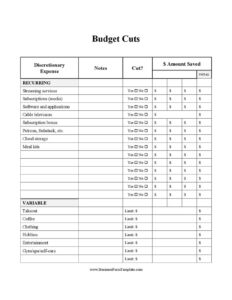
Home Budget Cuts Worksheet
Use our free Home Budget Cuts Worksheet to spot expenses you can trim, reduce monthly spending, and reach your savings goals faster — free download.
PDF
1 downloads
0
likes
Download Files
A Home Budget Cuts Worksheet is a simple planning tool that helps you review your household spending, identify expenses you can reduce or eliminate, and calculate how much you will save each month. Most people reach for it when money feels tight or when they want to free up cash for a specific goal. It is free to download here in both PDF and DOCX formats — no signup required.
What Is a Home Budget Cuts Worksheet?
A Home Budget Cuts Worksheet is a one-page (or multi-page) document that lists your current expenses category by category and gives you space to record a target reduced amount and the monthly savings for each line. Unlike a full budget that simply tracks where money goes, this worksheet is action-oriented: its entire purpose is to help you decide what to cut and by how much. Anyone managing a household can use it — individuals, couples, families, students, or someone helping a relative regain control of their finances. It documents both your starting point and your plan, so you can measure progress over time.
When Do You Need a Home Budget Cuts Worksheet?
This worksheet is most useful during moments of financial change or when you have a clear money goal in mind. Common situations include:
- You lost income or had your hours reduced and need to lower spending quickly.
- You are trying to pay down credit card debt or a loan faster.
- You want to build an emergency fund and need to find the cash to do it.
- You are saving for a big purchase like a car, a home down payment, or a vacation.
- Your monthly expenses have crept up over time and you want to reset.
- You are preparing for a major life change such as retirement, a new baby, or a move.
In each case, the worksheet turns a vague intention to “spend less” into a concrete, line-by-line plan with real dollar figures.
What a Home Budget Cuts Worksheet Should Have
A complete budget cuts worksheet captures three things for every expense: what you currently spend, what you want to spend, and the resulting savings. Beyond the expense lines, a strong worksheet includes a clear separation between fixed costs (rent, insurance, loan payments) and flexible costs (dining out, subscriptions, entertainment), since the flexible ones are usually where the easiest cuts live. It should also include a totals row so you can see your overall monthly savings at a glance, a column or note for the action you will take, and a space to record your savings goal. A date or month label helps you compare one version against the next.
How to Fill Out a Home Budget Cuts Worksheet
- Label the period. Write the month or date range at the top so you can track changes over time.
- List your expense categories. Enter each category on its own line — housing, utilities, groceries, transportation, insurance, debt payments, subscriptions, dining out, entertainment, and any others that apply to your household.
- Record the current amount. For each category, write what you actually spend per month based on recent bank and card statements, not what you guess.
- Set a target amount. Decide a realistic reduced figure for each category. Be honest about which are fixed and which are flexible.
- Calculate the savings. Subtract the target from the current amount to get the monthly savings for each line.
- Note the action. Briefly describe how you will achieve the cut — for example, “cancel streaming,” “cook at home twice more per week,” or “shop insurance quotes.”
- Total it up. Add the savings column to see your total monthly and annual savings, then compare it to your goal.
Tips for Making Cuts That Actually Stick
The biggest savings often come from a few large fixed expenses rather than many tiny ones, so start there: refinancing a loan, shopping insurance, or renegotiating a phone or internet plan can save more than skipping coffee. That said, recurring small charges add up, so review every subscription and ask whether you still use it. Aim for cuts you can sustain — an extreme plan that lasts two weeks helps less than a modest one you keep for a year. Automate the money you free up by moving it straight into savings or toward debt the day you get paid, so it never sits in your checking account waiting to be spent.
Fixed vs. Flexible Expenses
Understanding the difference helps you target the right lines. Fixed expenses stay roughly the same each month and are harder to change quickly — rent or mortgage, insurance premiums, and loan payments. Flexible (or variable) expenses change with your choices and are the easiest place to start: groceries, dining out, entertainment, clothing, and discretionary shopping. A smart approach is to make a few one-time fixed-cost changes for lasting savings, then tighten flexible spending for immediate relief. Mark each line on your worksheet so you know which strategy applies.
Common Mistakes to Avoid
- Guessing your current spending. Use real statements; estimates almost always run low and undercut your plan.
- Cutting only tiny items. Ignoring big fixed costs leaves the largest savings on the table.
- Setting unrealistic targets. A target you cannot live with will be abandoned within weeks.
- Forgetting irregular expenses. Annual or quarterly bills like car registration still belong in your plan.
- Not redirecting the savings. Money you free up will get spent unless you move it to a goal right away.
- Filling it out once and never revisiting. Update the worksheet monthly to keep it accurate and motivating.
Frequently Asked Questions
What is a Home Budget Cuts Worksheet? It is a planning tool that lists your household expenses alongside a target reduced amount and the savings for each, helping you decide what to trim and by how much. Its goal is to turn a desire to spend less into a concrete, dollar-based plan.
How do I fill out a budget cuts worksheet? List each expense category, record what you currently spend from your statements, set a realistic target amount, and subtract to find the savings. Add a short note describing the action you will take, then total the savings column to compare against your goal.
How much should I cut from my budget? There is no single right number — it depends on your income, goals, and how much breathing room you need. Many people start by aiming to trim 5 to 15 percent of flexible spending and adjust from there based on what feels sustainable.
What expenses are easiest to cut? Flexible expenses like dining out, subscriptions, entertainment, and discretionary shopping are usually the quickest to reduce. For larger lasting savings, look at fixed costs such as insurance, phone or internet plans, and loan terms.
Is this worksheet free to download? Yes. You can download the Home Budget Cuts Worksheet here for free in PDF or DOCX format with no signup required, and reuse or edit it as often as you like.
How often should I update my budget cuts plan? Reviewing it monthly works well for most households so you can compare actual spending to your targets and adjust. Revisit it sooner after any major change in income or expenses.
This Home Budget Cuts Worksheet template is a general example provided for informational purposes only and is not financial, tax, or investment advice. Individual circumstances and requirements vary, so consider consulting a qualified financial professional before making significant money decisions.
Official resource: for the rules that apply to your situation, see the Consumer Financial Protection Bureau.
Related Forms
- Debt Worksheet
- School Cash Envelope
- Check Register Colorful
- Savings Passbook
- Kids Cash Envelope
- Stop Payment On Check
Browse more in Money.