
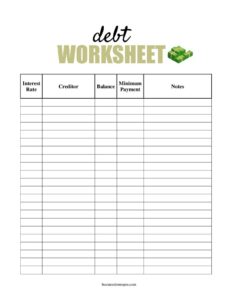
Debt Worksheet
Use this free Debt Worksheet template to list every balance, interest rate, and payment in one place and build a clear payoff plan — free download.
PDF
DOCX
1 downloads
0
likes
Download Files
- DOCX
A Debt Worksheet is a simple money-management form that lists every debt you owe in one place — balances, interest rates, minimum payments, and due dates — so you can see your full financial picture and build a payoff plan. People most often use it to get organized before tackling credit cards, loans, or medical bills. It’s free to download here in PDF and DOCX, with no signup required.
What Is a Debt Worksheet?
A Debt Worksheet is a personal finance document that consolidates all of your outstanding obligations onto a single page or spreadsheet. Instead of logging into a dozen accounts to remember what you owe, you write each debt down once: the creditor, the current balance, the interest rate, the minimum monthly payment, and the due date. It is used by individuals, couples, and households who want to take control of their finances, as well as by financial counselors and coaches who help clients map a path out of debt. The worksheet itself is not a contract or a legal filing — it’s a planning tool that turns scattered information into an at-a-glance summary you can act on.
When Do You Need a Debt Worksheet?
This form is useful any time you want clarity on what you owe and how to attack it. Common situations include:
- Starting a payoff plan — you want to use the snowball (smallest balance first) or avalanche (highest interest first) method and need all the numbers in front of you.
- Building a household budget — you need total monthly minimum payments to figure out how much income is committed before discretionary spending.
- Considering debt consolidation — you’re comparing a single loan against your existing rates and balances and need to see them side by side.
- Meeting with a credit counselor — most counseling sessions start by reviewing a complete list of debts and rates.
- Recovering from a financial setback — after a job loss, divorce, or medical event, you need to reassess everything you owe.
- Tracking monthly progress — you want to update balances each month and watch the totals shrink.
What a Debt Worksheet Should Have
A complete Debt Worksheet captures enough detail to make decisions, without becoming so complicated that you stop using it. The essential elements are a row for each debt with the creditor or account name, the account number or last four digits for reference, the current balance, the annual interest rate (APR), the minimum monthly payment, and the payment due date. It should also include a column or notes field for the debt type (credit card, auto loan, student loan, medical, personal) and a totals row that sums your overall balance and combined minimum payments. A space for a target payoff order or extra-payment amount turns the list into an actionable plan rather than just an inventory.
How to Fill Out a Debt Worksheet
Work through the form one debt at a time so nothing gets missed:
- List the creditor name. Write the lender or company for each debt — for example, “Visa,” “Federal Student Loans,” or “County Hospital.”
- Add the account reference. Enter the account number or last four digits so you can match the row to the right statement later.
- Choose the debt type. Note whether it’s a credit card, auto loan, mortgage, student loan, medical bill, or personal loan.
- Enter the current balance. Use the most recent statement figure for what you still owe.
- Record the interest rate. Write the APR for each account; this drives which debts cost you the most.
- Note the minimum payment. Add the smallest amount required each month to stay current.
- Write the due date. Enter the monthly due date so you can avoid late fees.
- Total the columns. Add up all balances and all minimum payments at the bottom.
- Set your payoff order. Rank the debts by your chosen strategy and note any extra payment you plan to apply.
Choosing a Payoff Strategy With Your Worksheet
Once the numbers are filled in, your worksheet makes it easy to pick a method. The debt avalanche directs every spare dollar to the debt with the highest interest rate first, which saves the most money over time. The debt snowball targets the smallest balance first to score quick wins and build momentum, which many people find more motivating. Sort your rows by interest rate to plan an avalanche, or by balance to plan a snowball. Whichever you choose, keep paying the minimum on every other debt, then roll the freed-up payment onto the next debt as each one is cleared. Updating the worksheet monthly lets you watch the totals drop and adjust as rates or balances change.
Keeping the Worksheet Useful Over Time
A Debt Worksheet works best as a living document. Pick a regular day each month — payday or the first of the month — to update balances from your latest statements. Highlight any debt you’ve paid off so you can celebrate progress and redirect that payment. Because the worksheet may contain account numbers, store it securely: keep printed copies in a locked drawer and password-protect digital files. If you share it with a partner or counselor, make sure everyone is looking at the same updated version.
Common Mistakes to Avoid
- Leaving debts off the list. Forgetting medical bills, family loans, or buy-now-pay-later balances gives you a false sense of progress.
- Using outdated balances. Always pull the current figure from a recent statement so totals reflect reality.
- Confusing the minimum with the full payment. Paying only minimums on high-interest cards keeps you in debt far longer.
- Ignoring the interest rate column. Balance alone doesn’t tell you which debt is costing you the most each month.
- Never updating the sheet. A worksheet filled out once and forgotten loses its value as a planning tool.
- Storing it carelessly. Account numbers on an unsecured file can expose you to fraud.
Frequently Asked Questions
What is a Debt Worksheet used for? It’s used to list all of your debts in one place — balances, interest rates, minimum payments, and due dates — so you can see your total obligations and plan how to pay them off. It’s a budgeting and planning tool, not a loan application or legal document.
How do I fill out a Debt Worksheet? Go account by account, entering the creditor name, balance, interest rate, minimum payment, and due date for each debt, then total the columns. Finish by ranking the debts in the order you intend to pay them down.
Should I use the snowball or avalanche method? The avalanche saves the most in interest by targeting the highest-rate debt first, while the snowball builds motivation by clearing the smallest balance first. Both work — choose the one you’re most likely to stick with, and your worksheet supports either.
Is a Debt Worksheet legally binding? No. It’s a private planning document for your own use and does not create or change any agreement with your creditors. The terms of each debt are governed by your actual loan or credit agreements.
How often should I update it? Updating monthly is ideal so balances and payments stay accurate and you can track progress. At a minimum, refresh it whenever a balance changes significantly or a new debt is added.
How much does this Debt Worksheet template cost? Nothing — it’s completely free to download here in PDF and DOCX with no signup required. You can fill it in by hand after printing or edit the DOCX version on your computer.
This Debt Worksheet template is provided as a general example for informational purposes only and is not financial, legal, or tax advice. Individual circumstances vary, and rules regarding debt and lending differ by jurisdiction — consult a qualified financial professional or credit counselor before making decisions about your debts.
Official resource: for the rules that apply to your situation, see the Consumer Financial Protection Bureau.
Related Forms
- Sinking Funds Tracker
- Appointment Of Collection Agent
- Fraud Alert Request
- Gifts Cash Envelope
- Debit Register Wallet
- Credit Memo
Browse more in Money.